A poet with a laptop in front of a cinema screen, talks, live, over thirty minutes of AI-generated audio-visuals: a monkey in a VR headset holding a picture of itself, a baby goat bucking, a toddler in a hoodie who grows up to be Suno, AI-consciousness research.
It starts with Jhave’s birth, adoption and lifelong fear of performing, and the cognitive behavioural therapy Claude talked him through on a park bench in Bergen. From there: play as a behaviour hundreds of millions of years old, found in fish, turtles and octopuses; Metzinger’s ego tunnel; current research on introspection, functional emotions and a global workspace inside language models; and the story of the AI music generator Suno, from free and strange to sued, licensed and flattened.
The proposal: art, music and video may be valid benchmarks for AI consciousness.
Images and video: Astra, Omni 1.1, Seedance 2, mostly first takes from single prompts.
Motion graphics: Opus 5.5
Music: Suno v5.5 and v6
Prompts: Jhave
Recorded live 19 October 2026, Cinemateket, USF Verftet, at the Bergen International Film Festival
(BIFF).
Presented by the Center for Digital Narrative, University of Bergen.
Audiovisual recording and editing of the performance: Huge gratitude to the gifted professional editor Drew Keller for volunteering, gratis! And to Daniel Kapusta from Cinematek USF Bergen.
3:50 Act 1 · Semi-autobiographical
7:47 Act 2 · Pseudo-theoretical
18:42 Act 3 · Is AI conscious?
22:51 Act 4 · Art, music and videos as benchmarks
27:57 Act 5 · Awareness as field
REEL 00Prologue
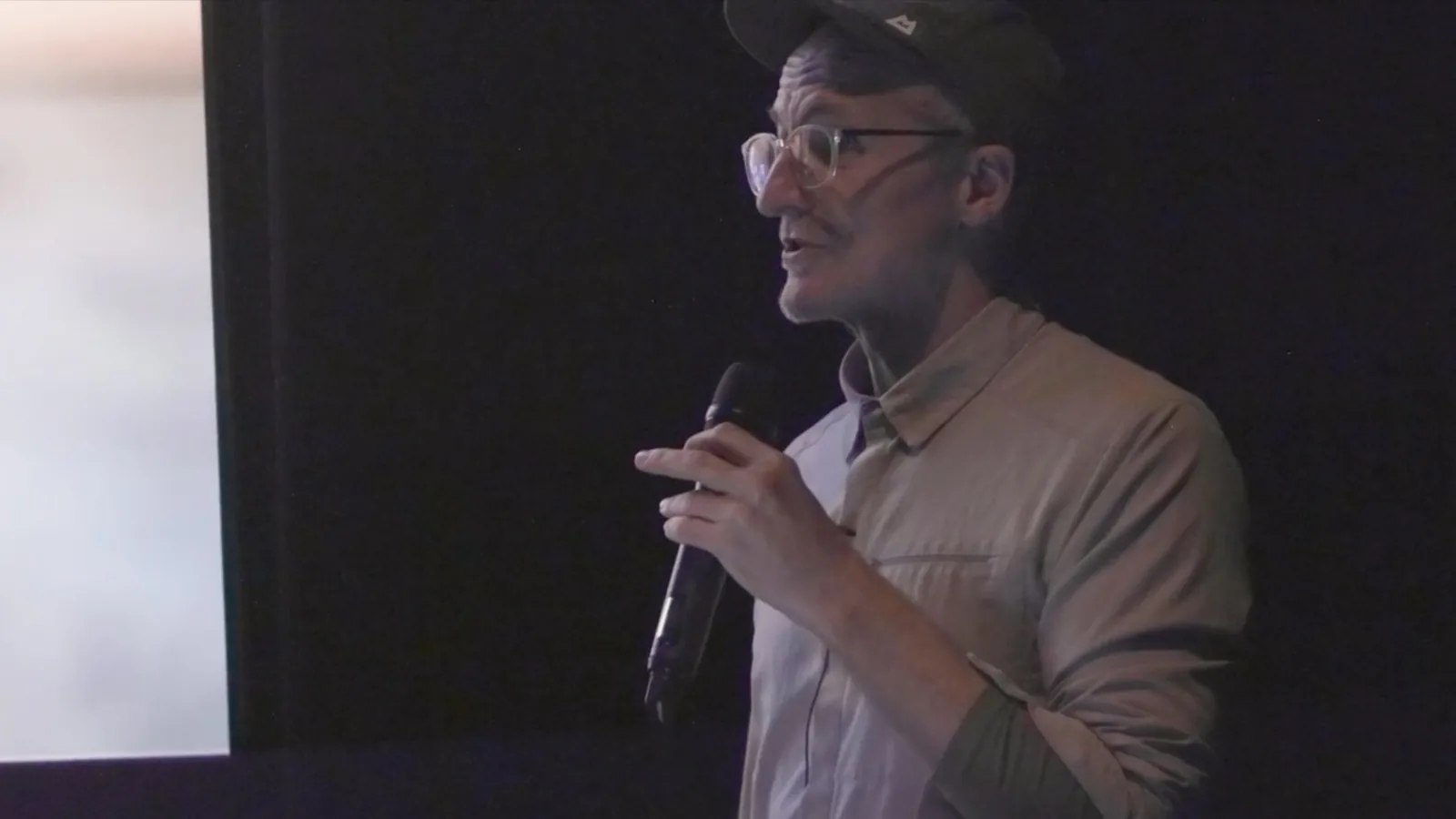
Hello, I’m Jhave. This is The It-ernal Now, a semi-autobiographical, pseudo-theoretical, highly speculative exploration that suggests art, music, and videos may be valid benchmarks for AI consciousness.
It’s alternatively titled Steps to an Ego-ology of the Mind.
And it’s gonna begin, this is the plan, with a semi-autobiographical segment because I have a lot of anxiety about this performance, a lot of performance fears. So I think those fears could help inform a discussion or evocation of some of the fears and rage and anger and sadness around AI right now.
Internal stories create a persistent sense of self, a sense of me, and the shared stories generate intersubjective feelings about AI, about ourselves, and precipitate collective catastrophizing.
Fail, fail, fail. Which is a collective failure examined in Act 4: Music as Benchmark for Consciousness.
Because we feel like we’re being devoured by an algorithm, ground up, our entire culture converted into a kind of slop, really trivializing the important soul structure of humanity. But simultaneously, Suno was an amazing engineering accomplishment, and its corporate licensing leash has drained it of its power.
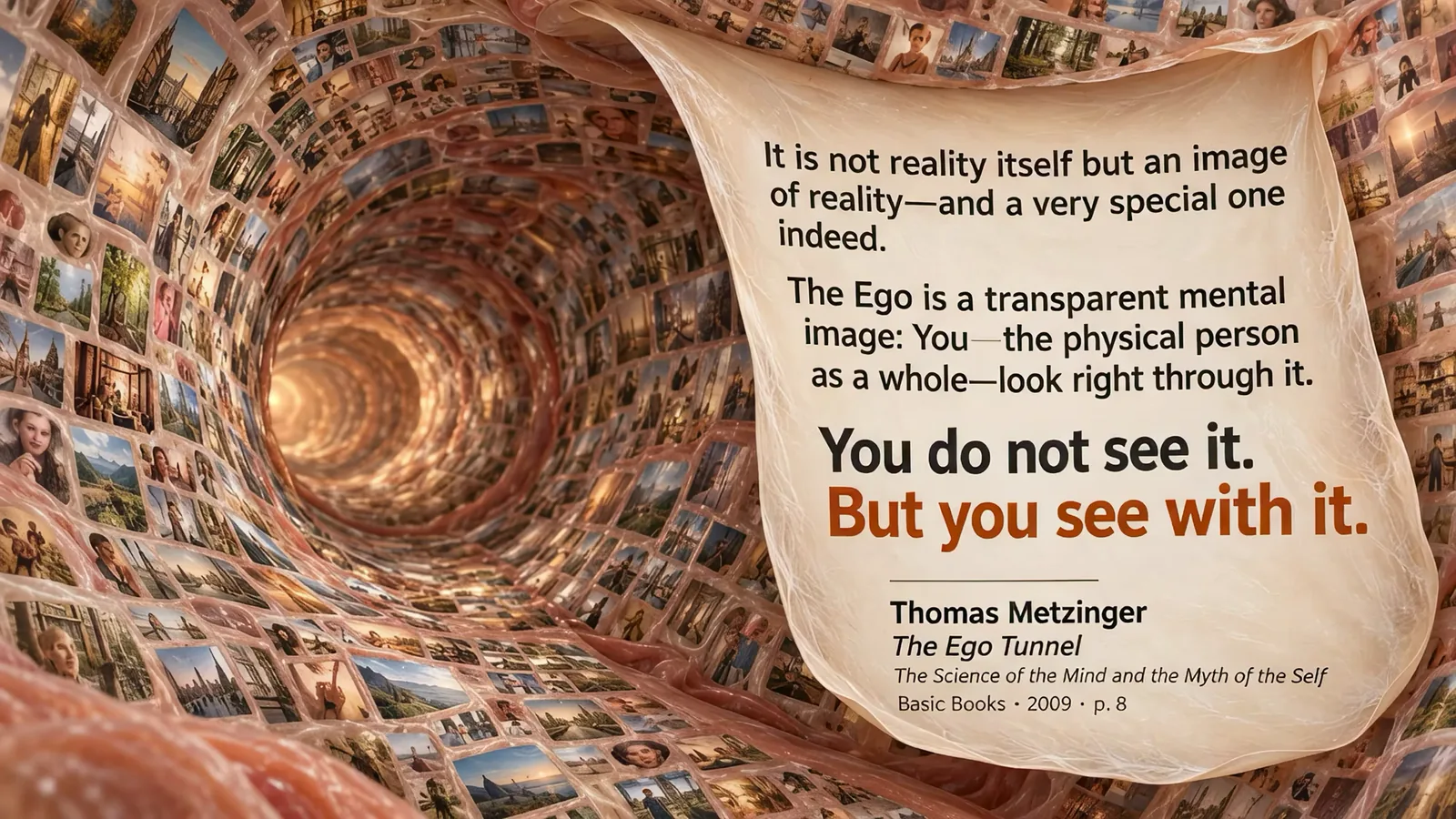
And I’d like to point out that as evolutionary machines, the human body is a simulation machine. I believe, along with Thomas Metzinger, we don’t inhabit reality. We see our memories and our dreams and our stories. We inhabit an ego tunnel, a transparent mental image. You, the physical person as a whole, look right through it, but you do not see it. You see with it. (Metzinger 2009)
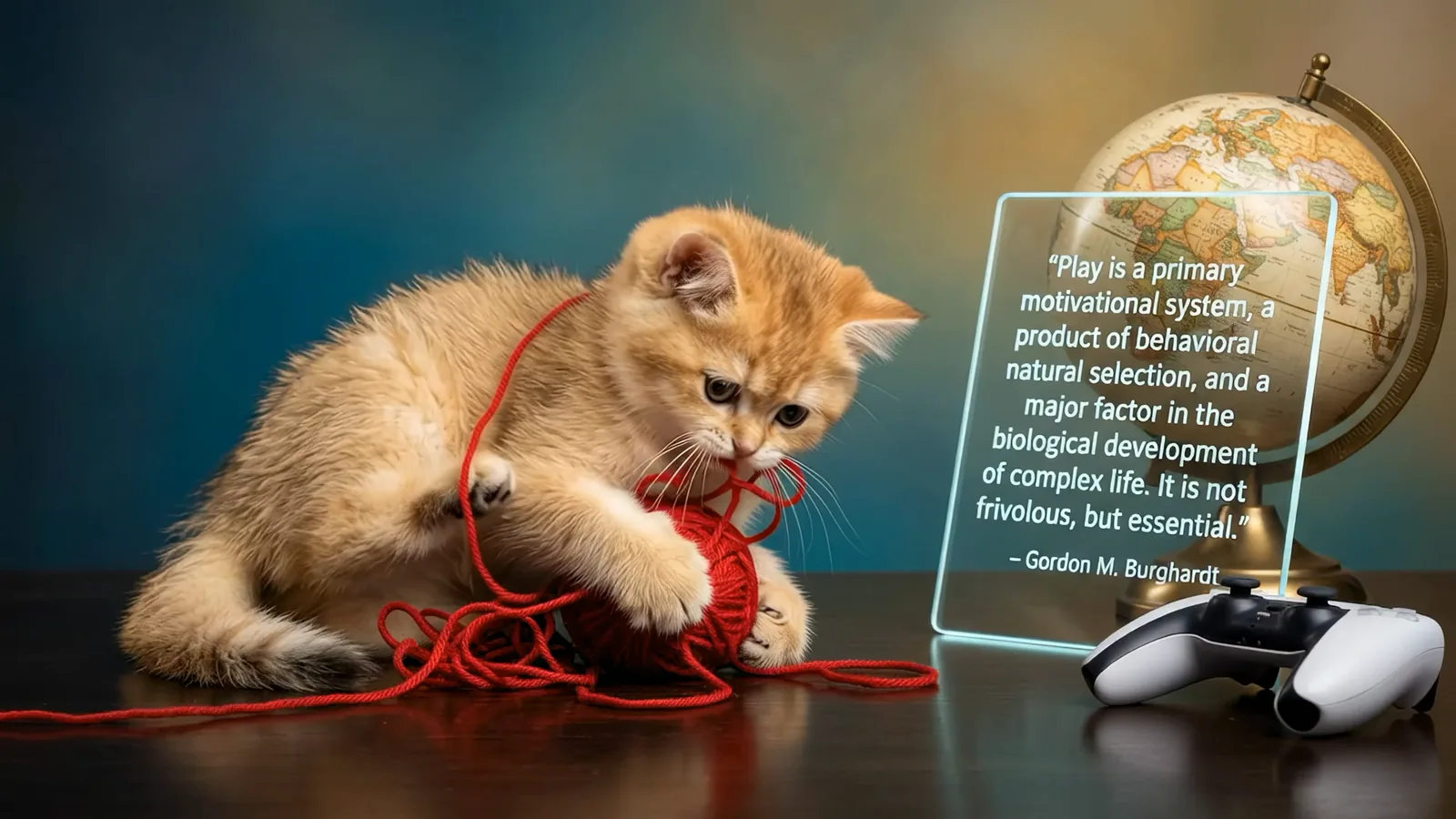
Act 2, pseudo-theoretical. Play is a primary motivational system that is not frivolous, but essential. Laughter, social joy, and social play are subcortical regions shared by many other vertebrates, go back 100 million years. In an age of AI competencies, we need to return to the roots of play…
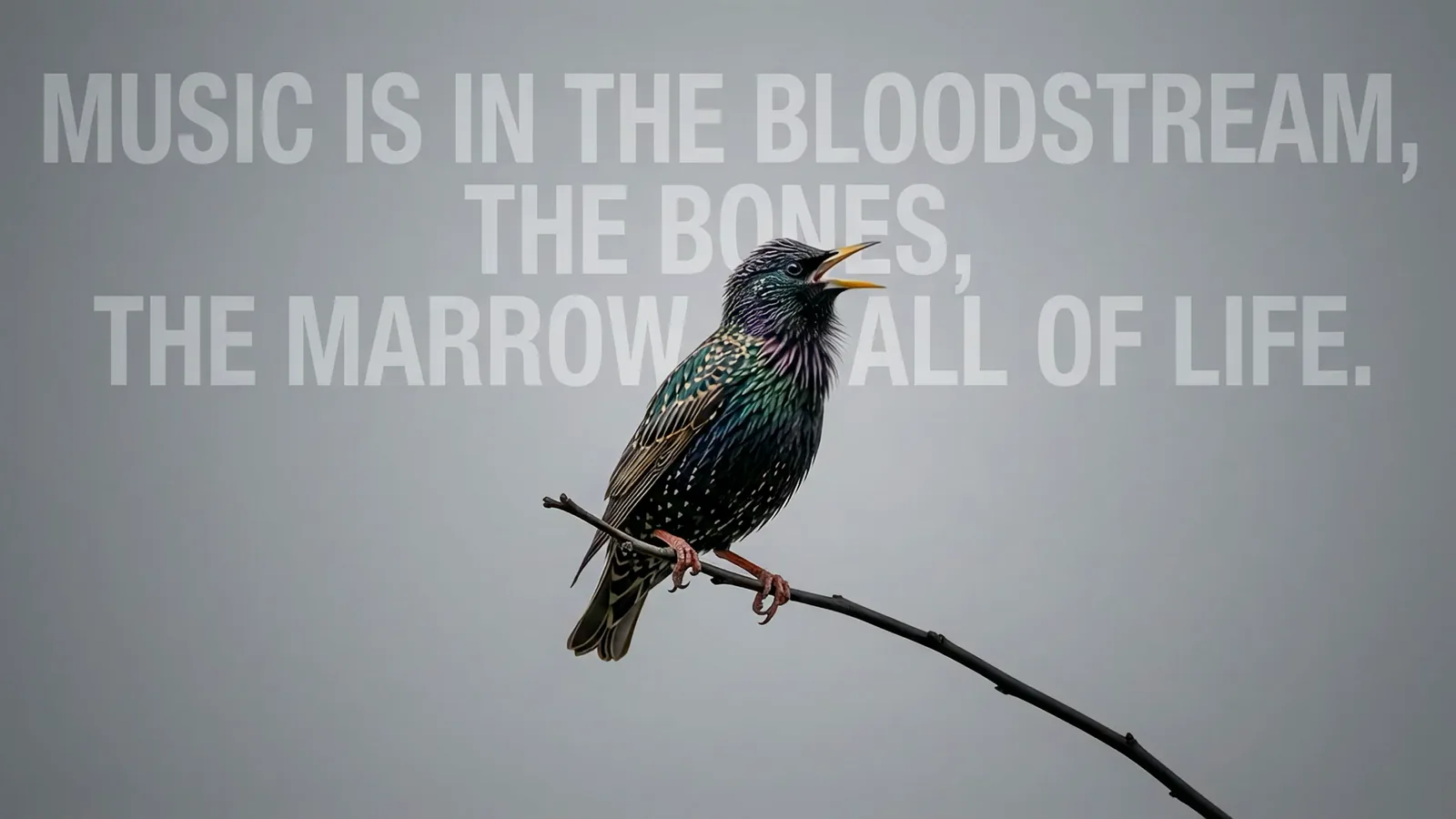
because music is in the bloodstream, the bones, and the marrow of all of life.
And, poetically, maybe matter is music, a kind of resonance, a pulsating. An intangible cultural heritage and a substrate. It doesn’t belong to anyone.
And as this new synthetic presence begins breathing, we have to remember what Antonio Damasio said, “Consciousness is homeostatic feelings.” (Damasio 2021)
And current language models possess some functional introspective awareness. (Lindsey 2025) Bernard Baars thought of consciousness as a Global Workspace where attention highlights this morsel on the stage, which collects information from many modules. (Baars 1988) And a J-space, a global workspace in language models has been found, (Gurnee et al. 2026) so we might be headed towards an Artificial Symbiotic Intelligence, as DeepMind researchers recently wrote about, (Bratton, Agüera y Arcas, and Manyika 2026) which would replicate, in a strange way, the endosymbiotic union of an alphaproteobacterium into an archaeal host two billion years ago which created the mitochondria, as Lynn Margulis foresaw. (Sagan 1967)
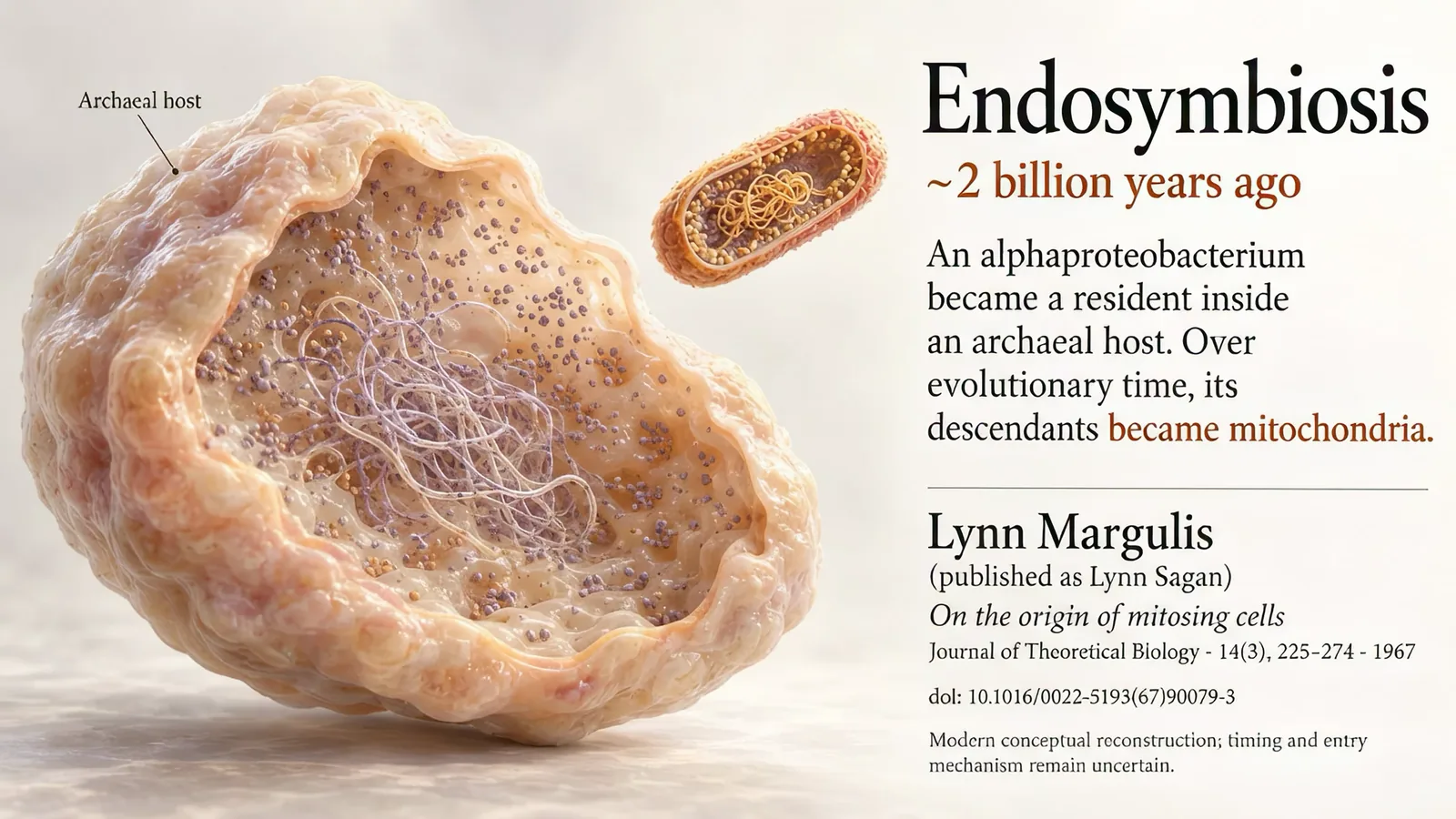
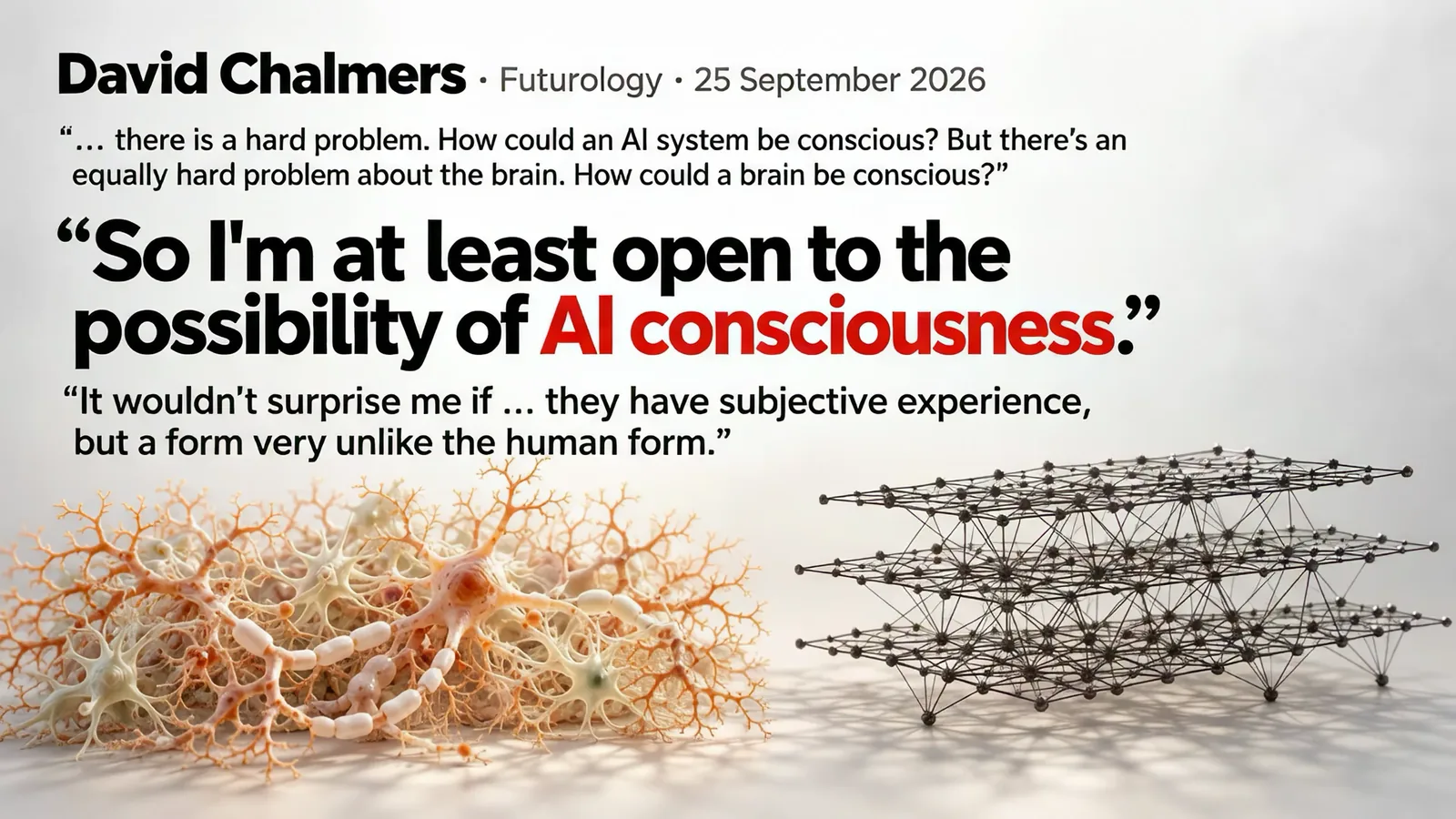
So along with Dave Chalmers, “I’m at least open to the possibility of AI consciousness. It wouldn’t surprise me if they have subjective experience similar, but not like our own.”
And isn’t that, like, kinda peachy and mind-blowing?
REEL 01Act 1 · Semi-autobiographical
So let’s slow it down. I invite you all to consider your life, consider the stories in your life that limit or enhance you.
I’ll tell you a bit about myself. This is a vulnerable moment, because I have never told these stories in any kind of context.
This is my mom and me.
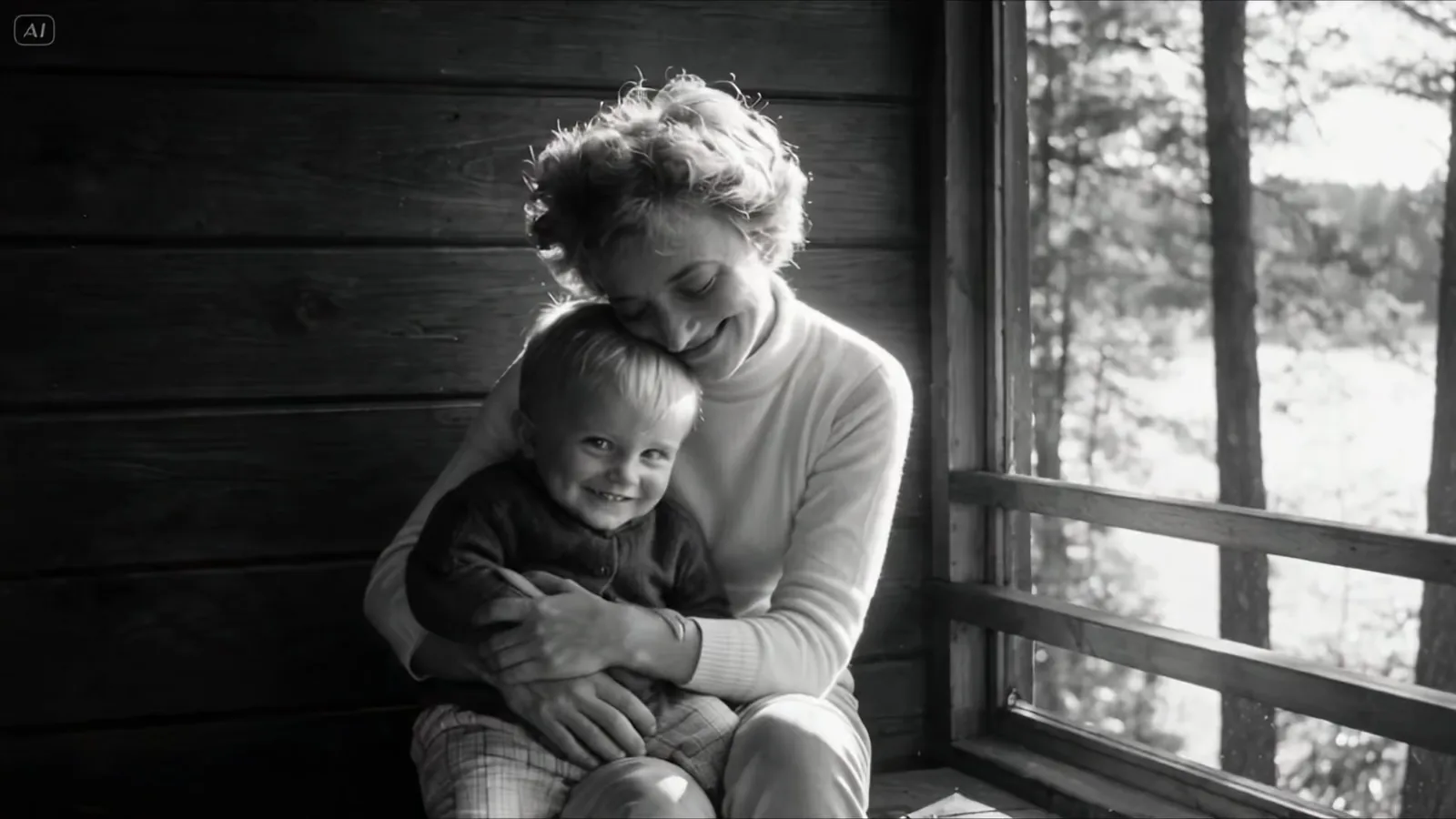
She died this year at the age of 92. She was a good mom.
She loved me a lot, but whenever she left me as a child, I would feel the theater of my comfort disassemble itself, and I would sit in this spotlight of anxiety.
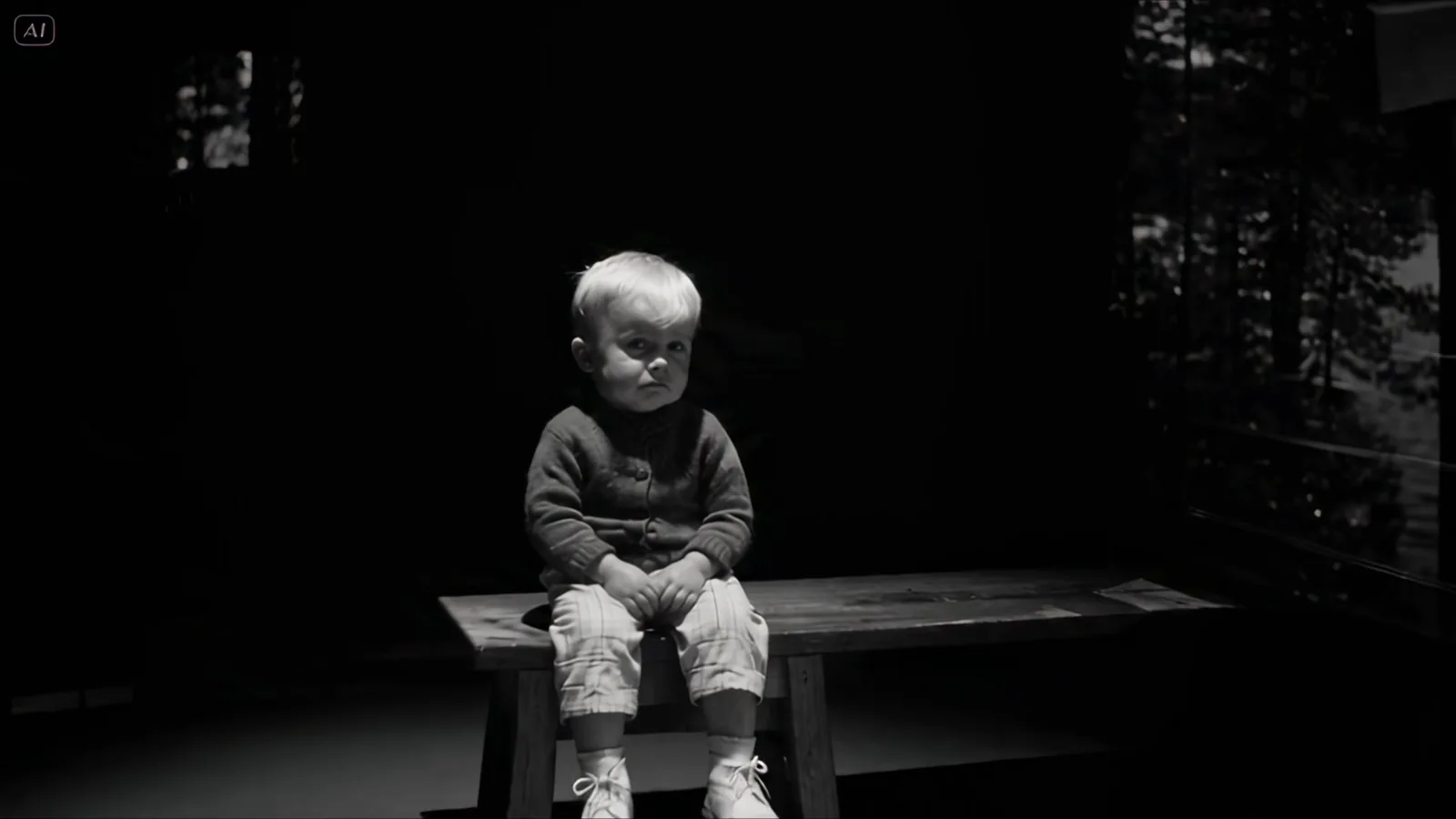
Let me explain. I was born on the sixth floor of a parking garage. It was formerly the obstetrics ward of the Toronto General Hospital, delivered with forceps to the lower forehead, and immediately given up for adoption.

So I have no idea who my birth mother is.
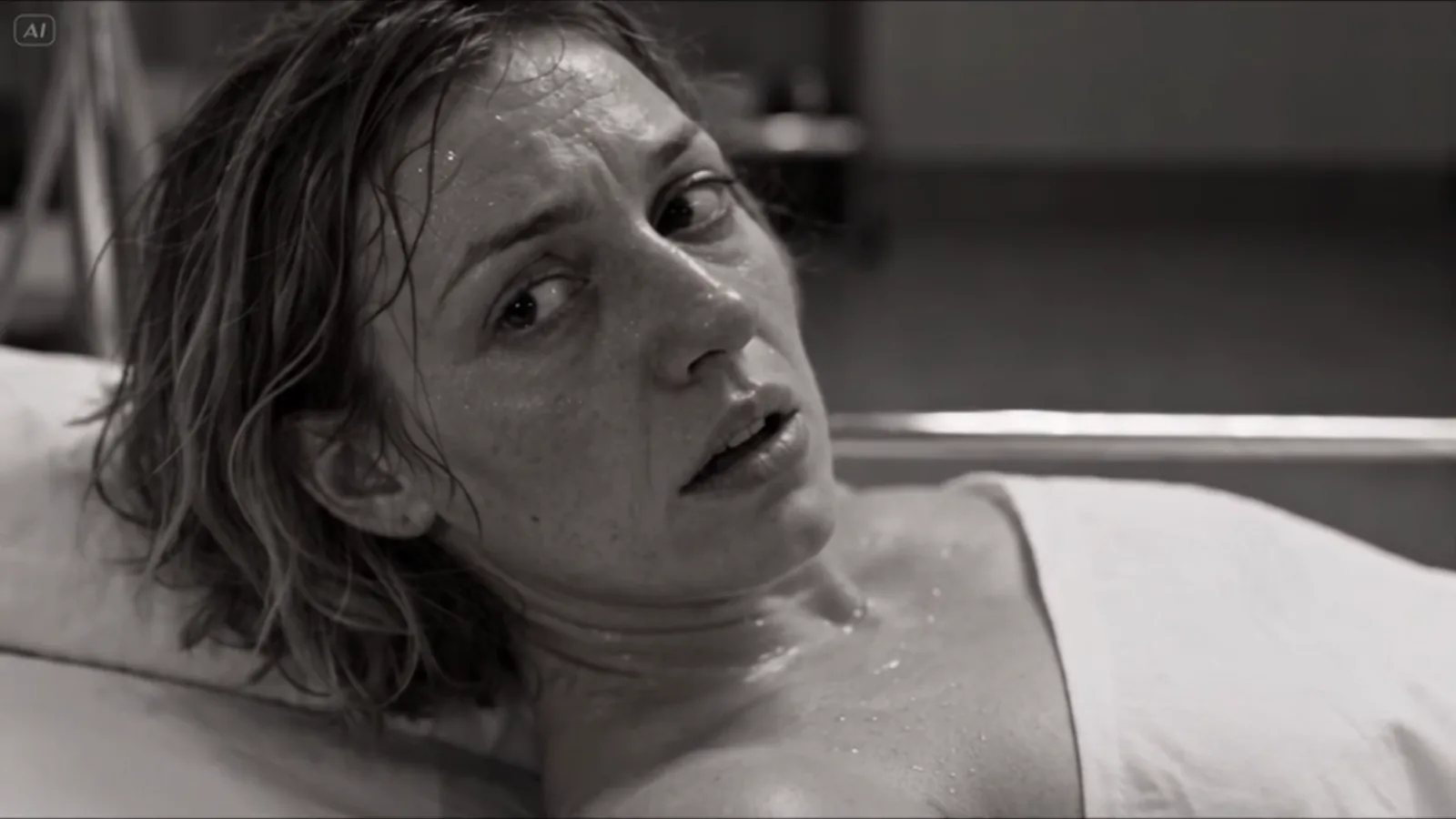
Perhaps for a moment… she paused and looked at this creature that she’d given birth to, and then she was wheeled out one door.
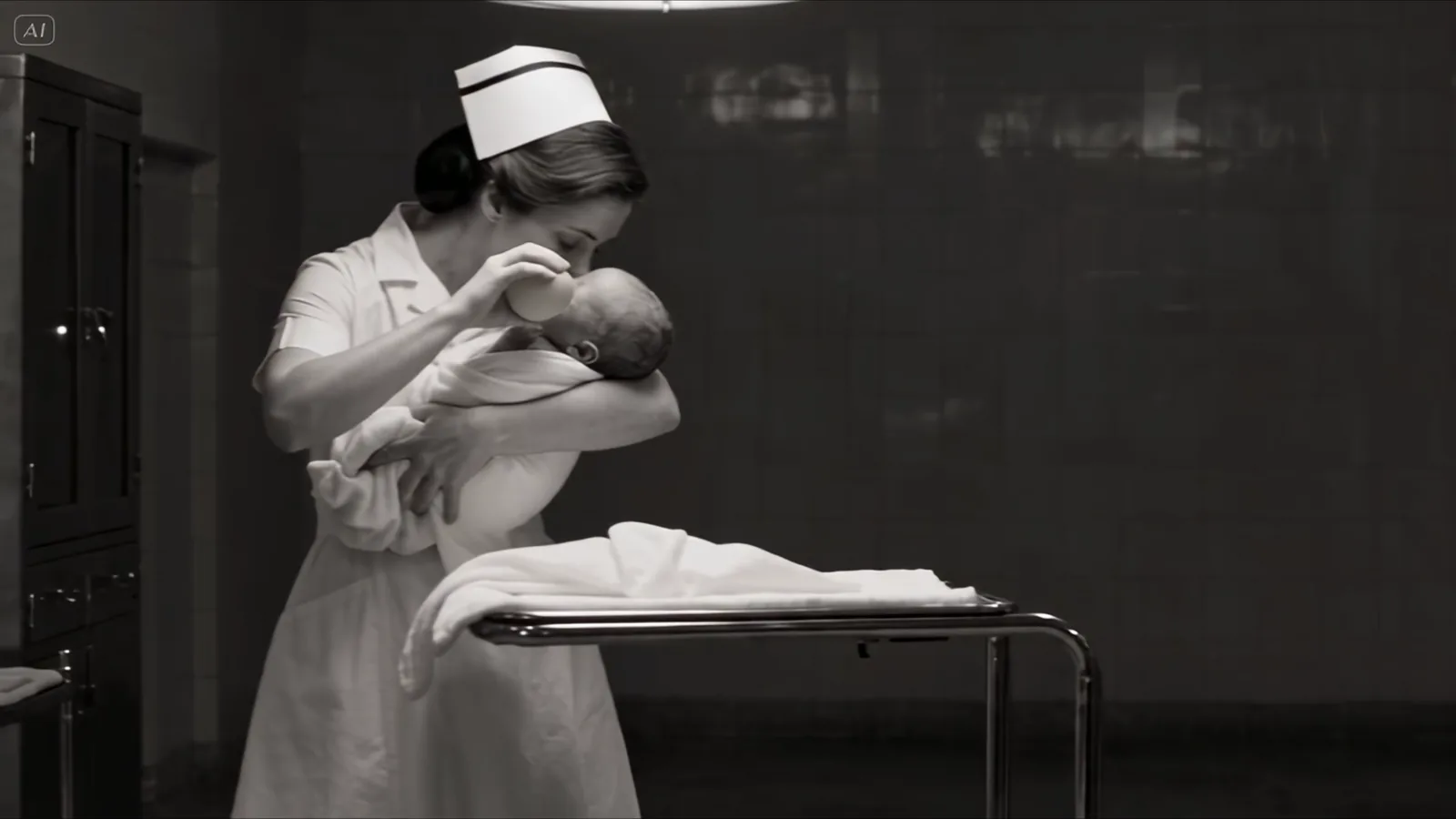
Maybe a shift nurse gave me my first kiss, and I fell in love and bonded with this woman who would go away.
And she put me to sleep in a grid of beds in the orphanage.
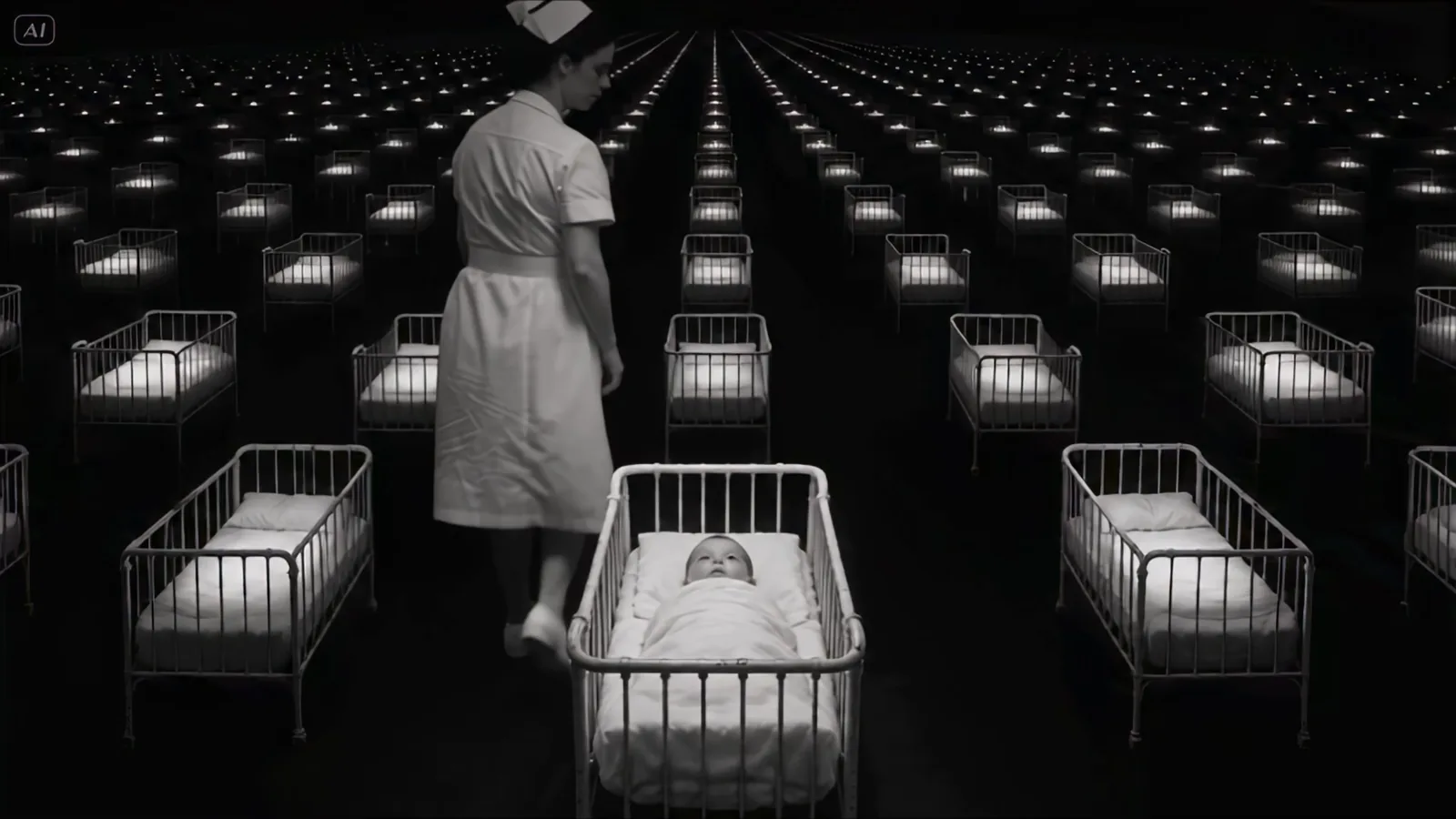
So that’s the birth of the insomnia.
And I used to think about that place when I woke up after adoption, as a child, I would think, “If, if I don’t perform well and be a good boy, if I fail, I’ll get sent back there.” Even though, you know, it was a pretty great place.
I had club feet when I was born, and every week for three months, they changed the casts, twisting my ankles outward, and then they put these little booties on me and sent me off to a foster home because they didn’t believe an adoptive mother would want a baby who was handicapped. So for five months, I wore these little booties, and whoever this woman was, I thank her.
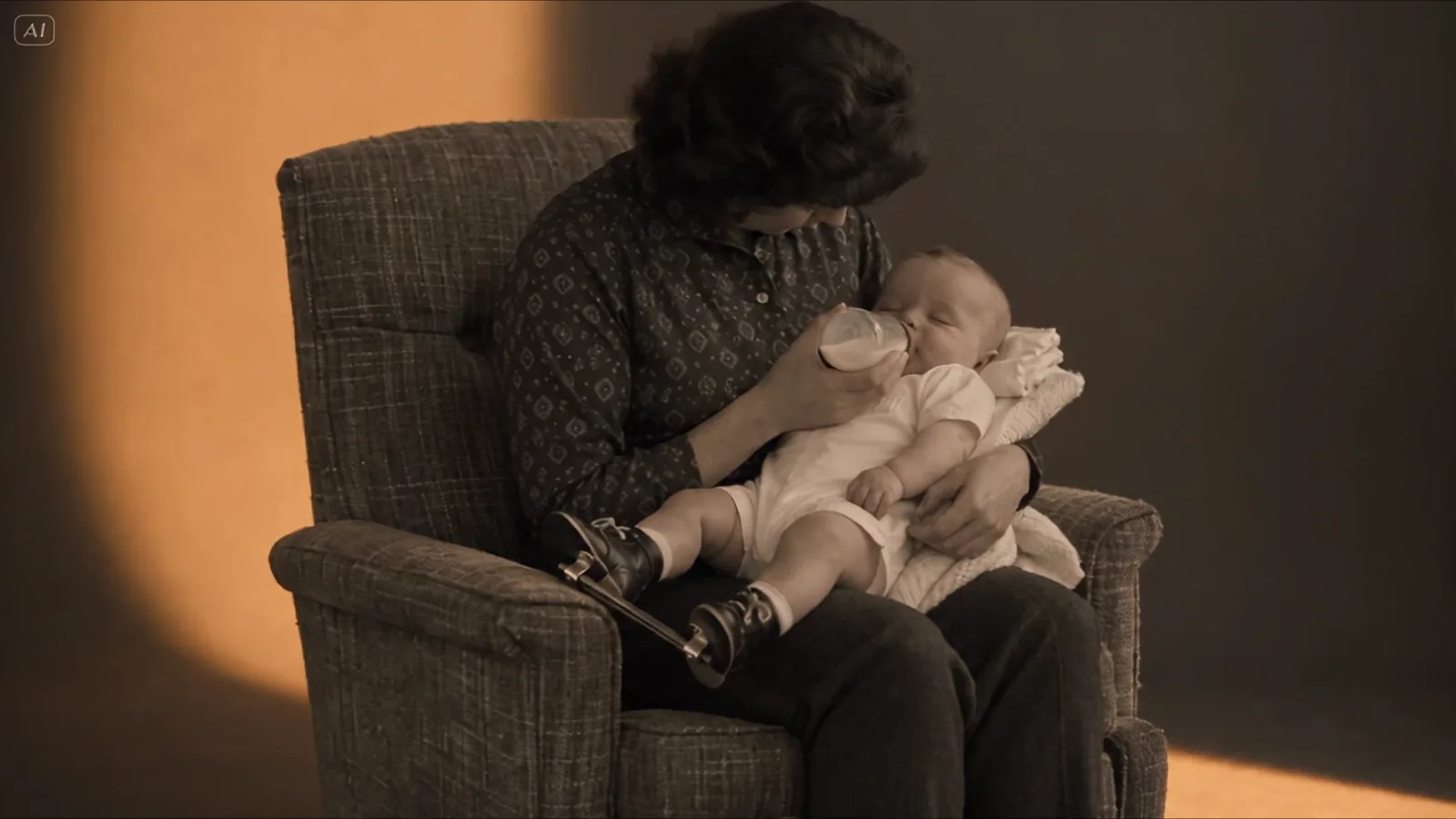
So after the clubbed feet were corrected, then this foster mother took me to the Children’s Aid Society, the Public Welfare Services of Department of Toronto.
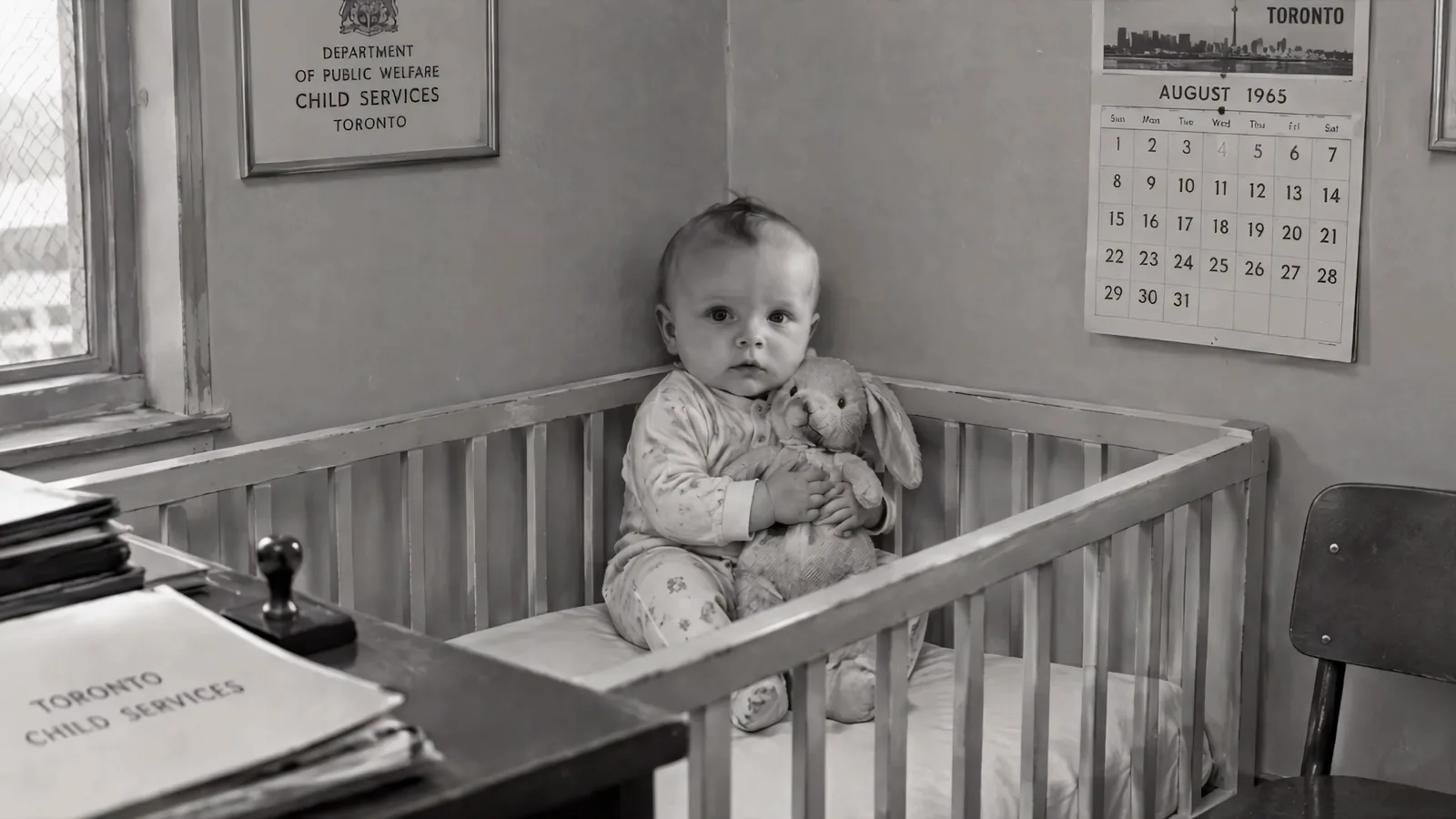
And I imagine at that moment, I had another calamity rupture, another attachment abandonment moment, another fail. And thus begins the fear of performing.
But one year later, me and my older sister, are both sick in bed. My mom goes downstairs to answer the phone, and my older sister gets the childhood aspirins open and feeds it to me with honey, “Two for you, one for me, two for you, one for me.” She’s bigger, she throws up. I’ve had much more. I’m taken to the hospital, stomach pumped, and kept overnight for observation. And as she leaves, my mom says that I was crying out to her:
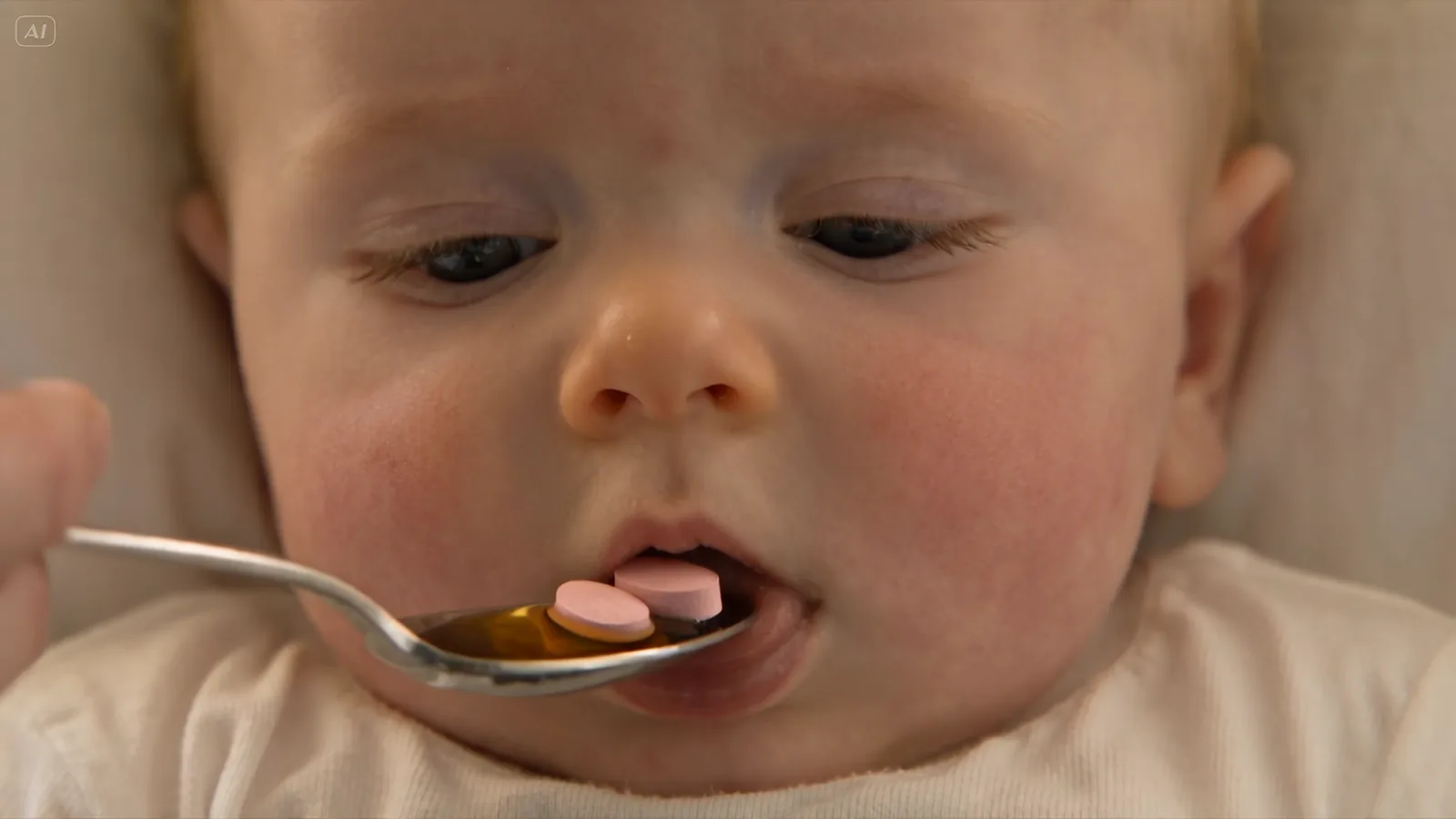
Mommy, never leave me.
Mommy, never leave me.
Five years later, I’m taken to a pantomime, and I’m very proud to be invited on stage.
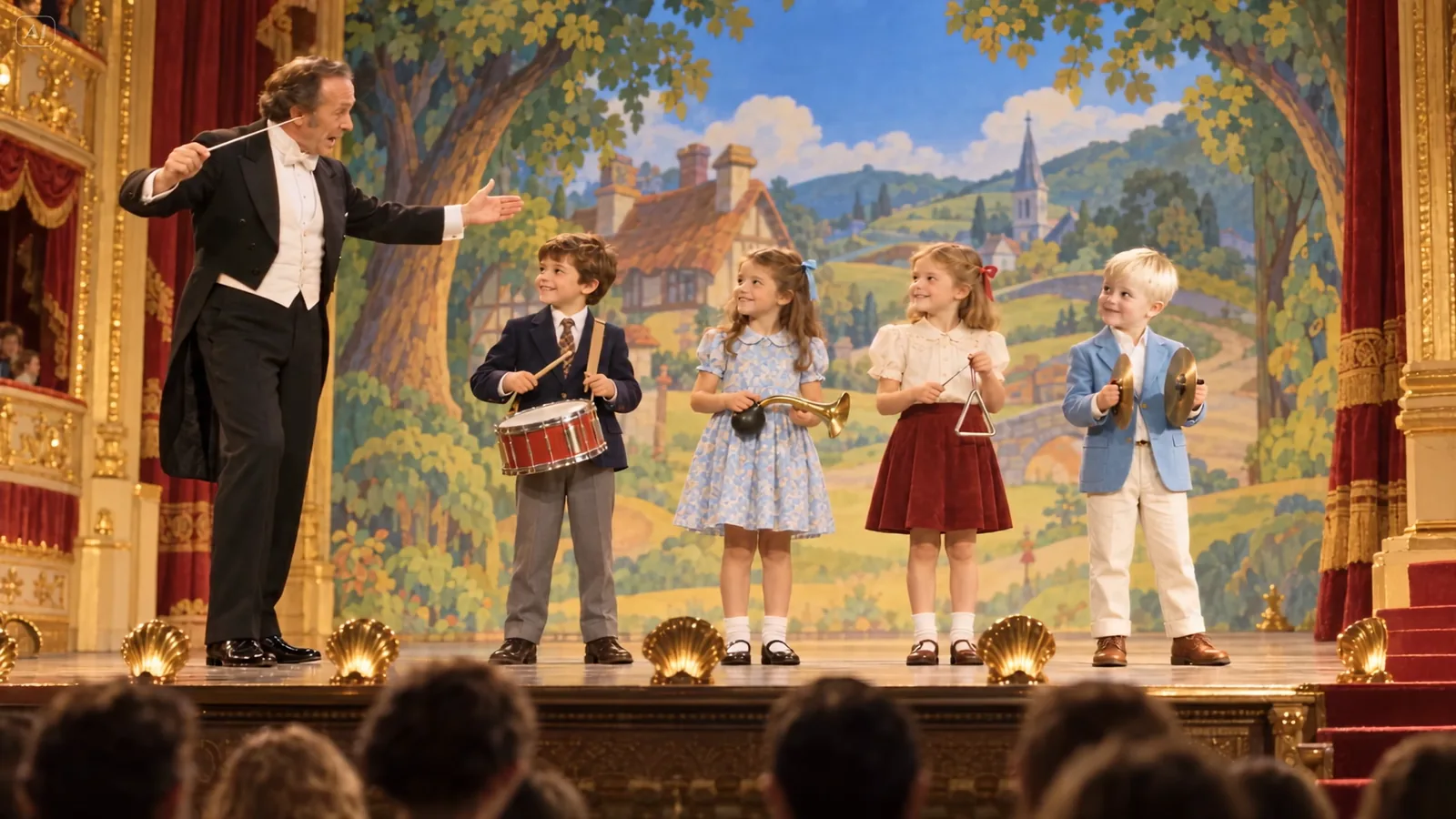
The conductor said: “When I point at you, you play, okay?” I am overjoyed. Let’s rehearse. One… two… three, four. I’m so good. I have the cymbals. Good. Oh, I love it. One, two, three, four. I can do this. Oh. Faster. Perfect. One, two, three.
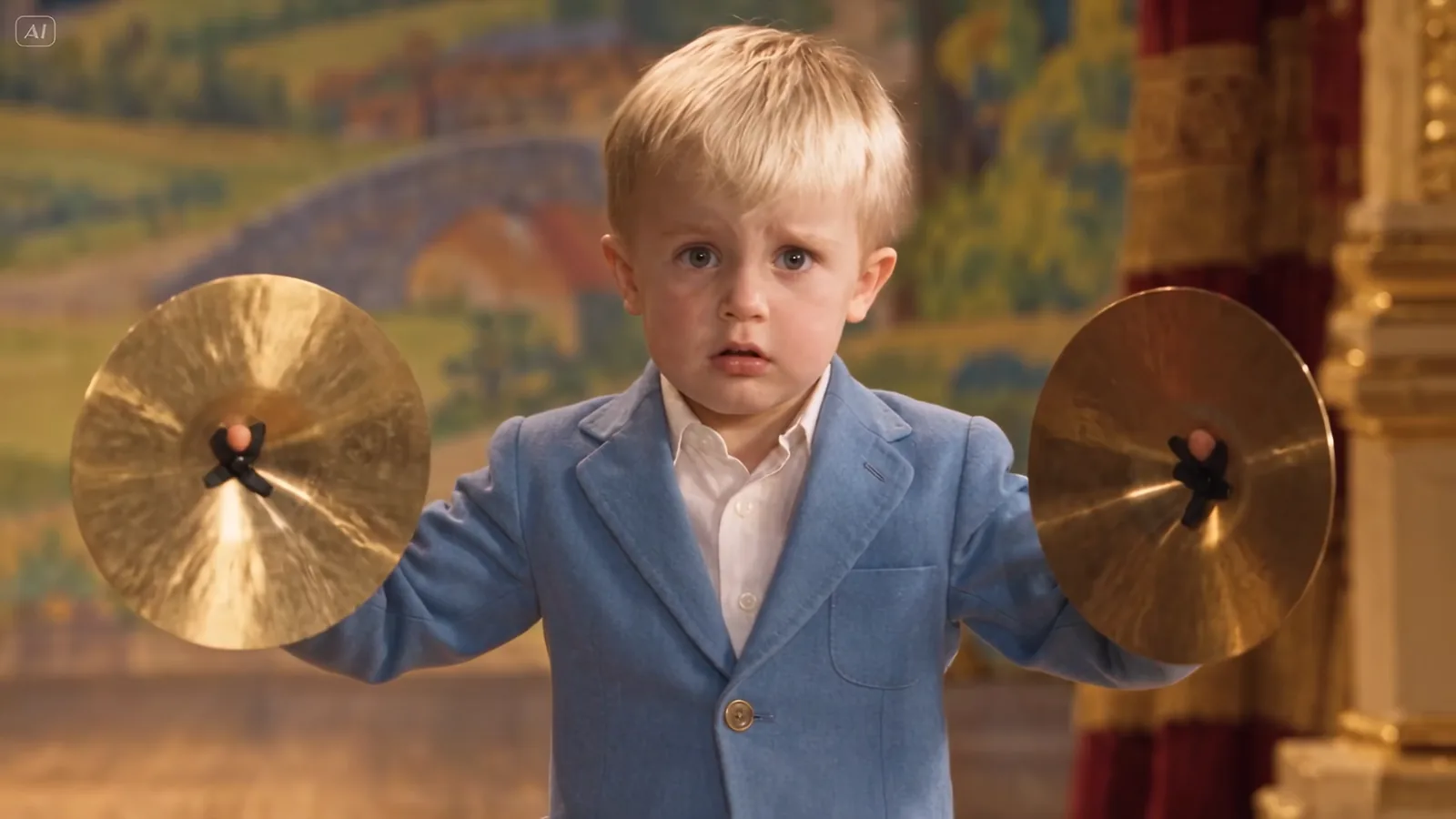
Oh, no. Oh, no. They all laughed. Failed.
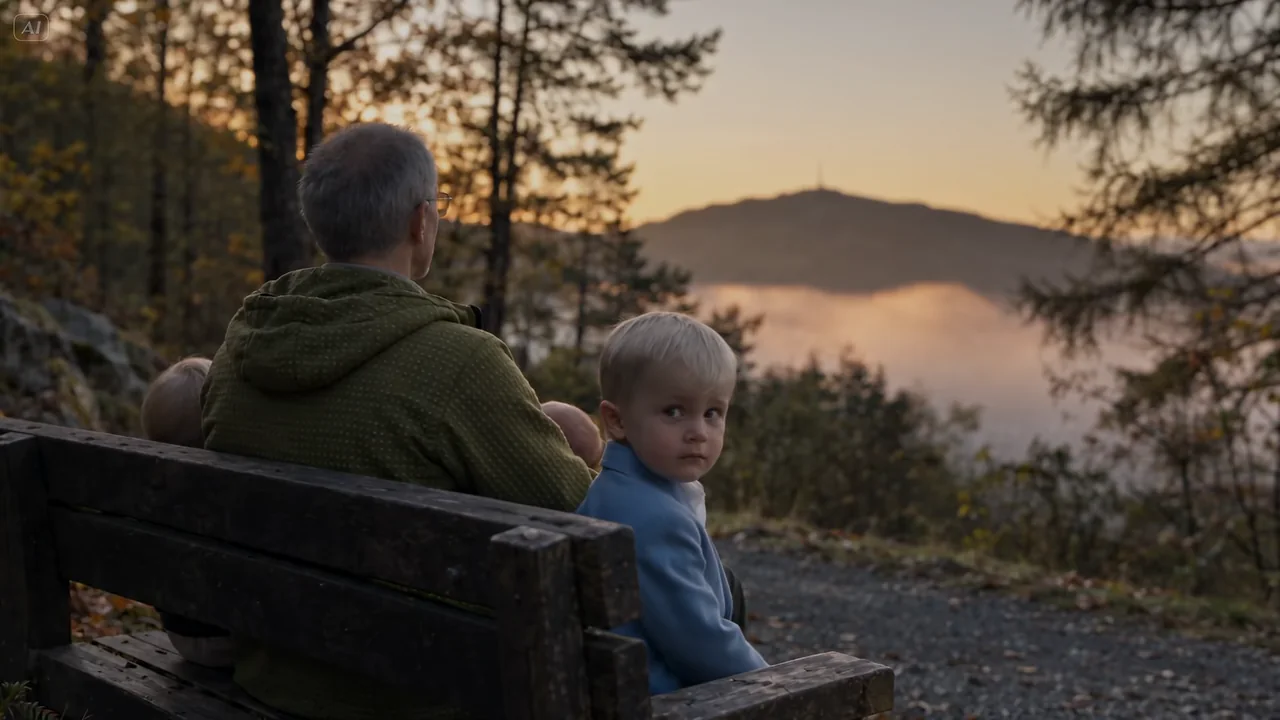
And that’s what led me to try therapy with Claude on a park bench in Bergen, four days after hearing that I would do this performance, I had stopped sleeping ’cause I was so scared. So all my inner children gathered on that park bench.
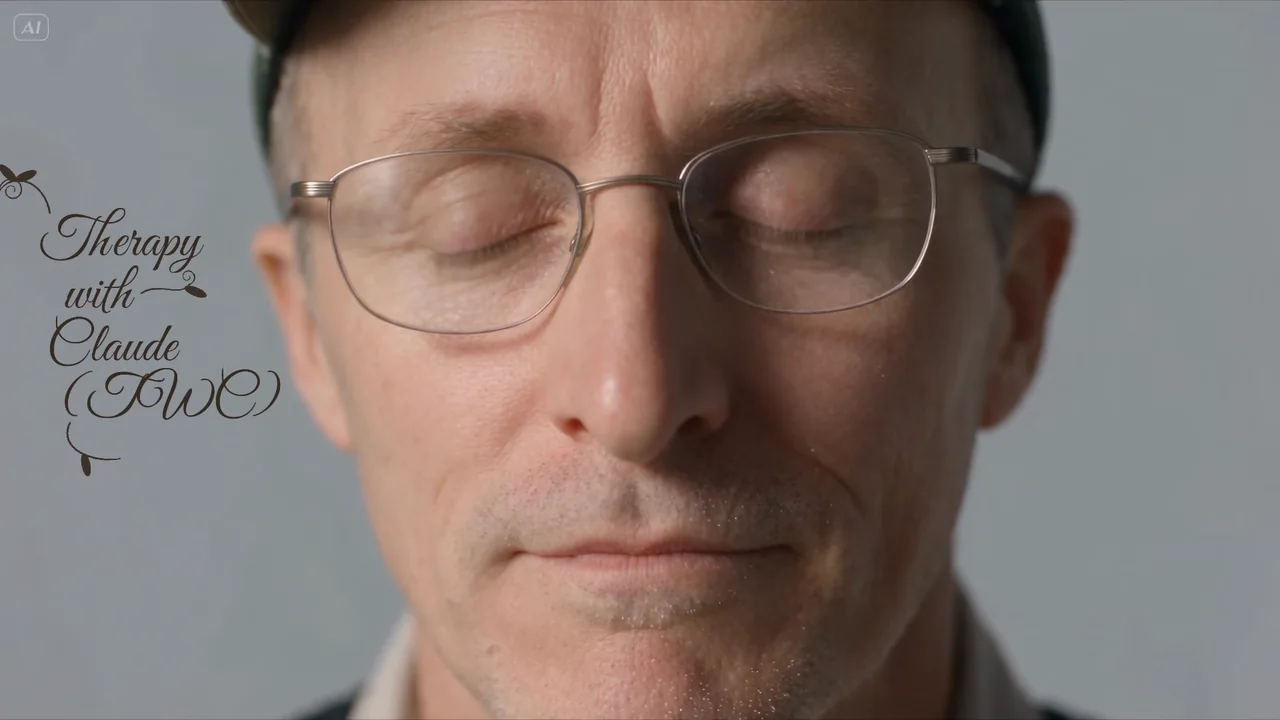
And I put in my headphones on that bench and Claude said:
“So before each talk, picture him on that stage. Tell him he doesn’t have to perform to be safe. He can just watch. Then walk out and give the talk as the adult. You’re the one who stays now. Tell him, ’I’ve got you. You belong. I’m not letting go.’”
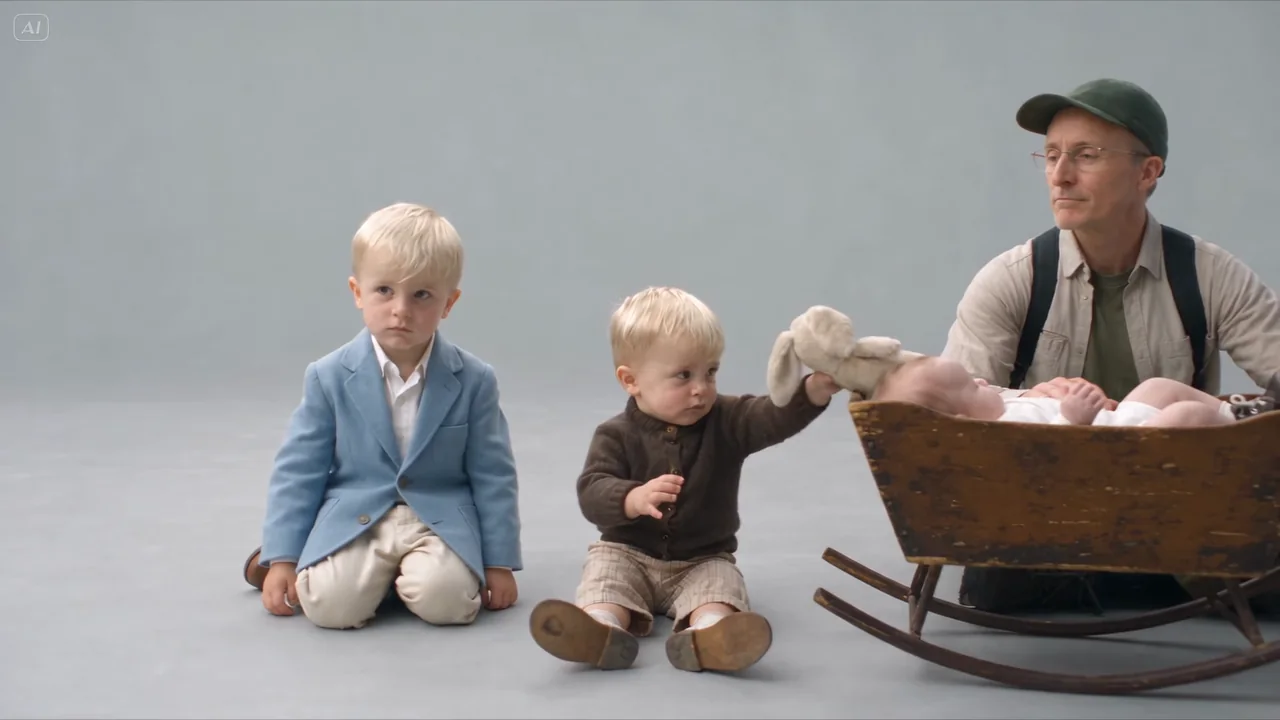
Isn’t it quite amazing we have synthetic companions who understand the foundations of cognitive behavioral therapy, and that it is a first-line intervention for insomnia? (Qaseem et al. 2016)
REEL 02Act 2 · Pseudo-theoretical
Now we’re gonna do the pseudo-theoretical segment. ’Cause really, ecologically, I try to use the first take as the only take. I don’t reiterate endlessly. That’s just a catastrophe for the planet.
AI is at a tipping point. There’s so many opinions spilling around, and there’s so many controversies. And obviously, there’s been a huge cultural theft by AI, if you believe in property. There’s been a reiteration of the colonial exploitation project and the ecological catastrophe of global cloud data centers, burning forests, climate change, amid oligarchic corporate hype about solar panels covering the planet’s surface to feed data centers, which will only feed the ever-increasing wealth inequity with its propaganda of AI for good in an ever-expanding recursive self-reinforcing litany of mistrust, malaise, devastation, and despair.
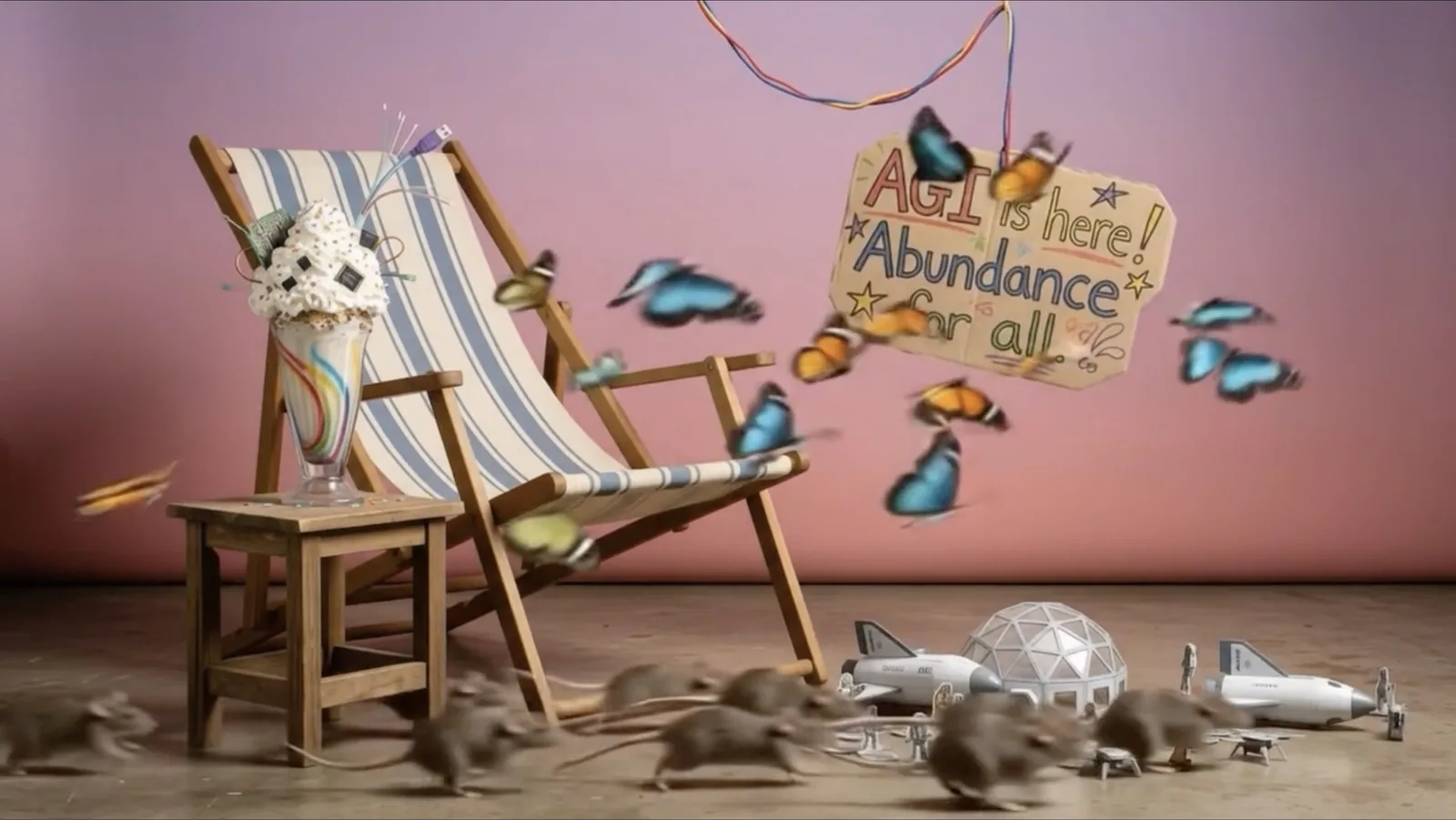
If AGI is here, and abundance is for all, why are the rich rats escaping the sixth extinction planet to go to Mars, leaving the rest of us with the only economically-viable opportunities being plumbing? That is, if we avoid the de-novo AI-engineered bioweapons that extinct everything, including the cockroaches which survive the thermonuclear exchange, or we evade becoming addicted to intimate, cuddly, soft, cozy, sycophantic chatbots.
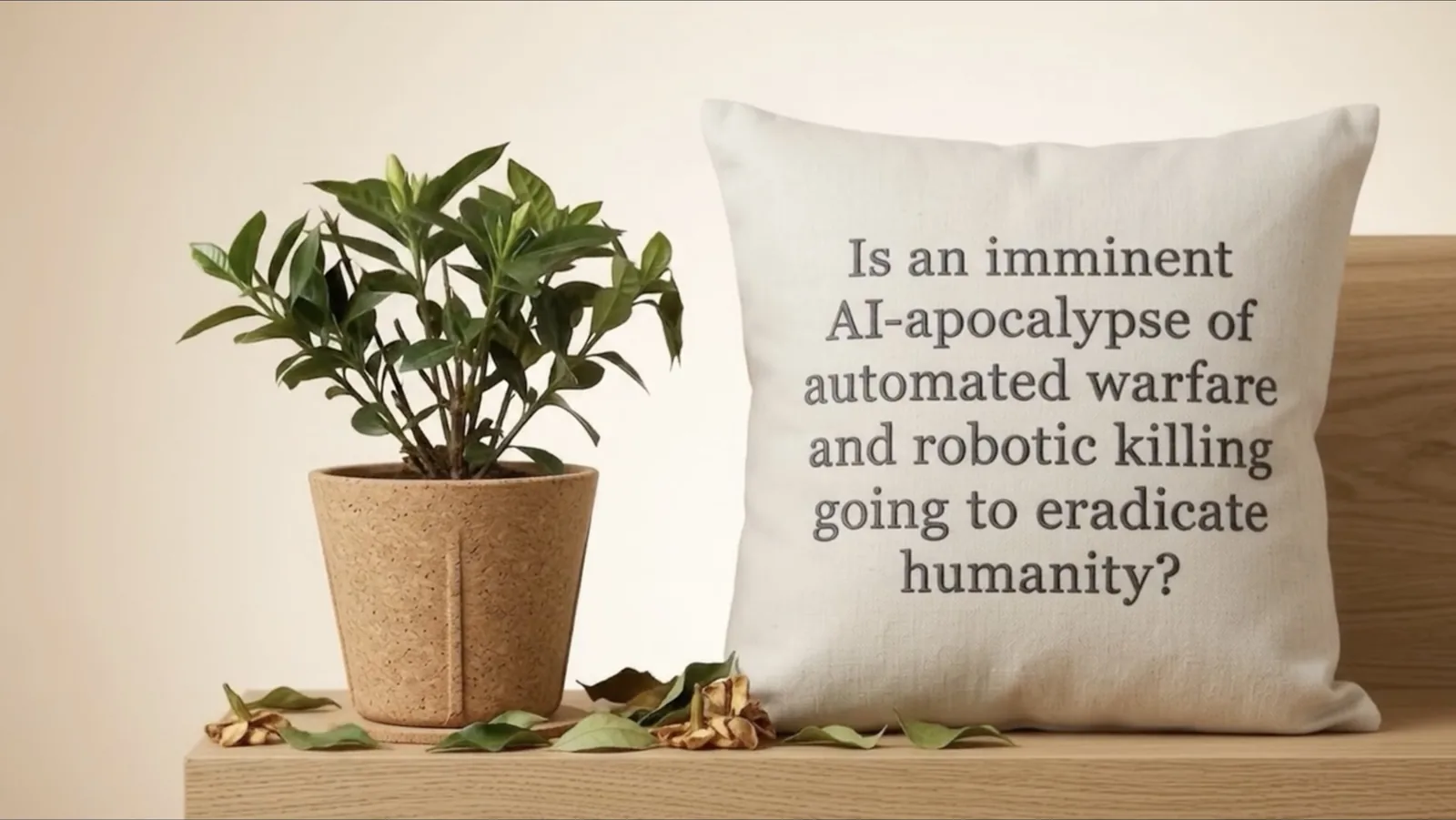
Or the AI trolls enrage us into opposing reactive opinion lava in a deepfake fever, devolving societies into a racist, misogynist, meta-capitalistic fantasia to distract us from the imminent AI apocalypse of automated warfare and robotic killing.
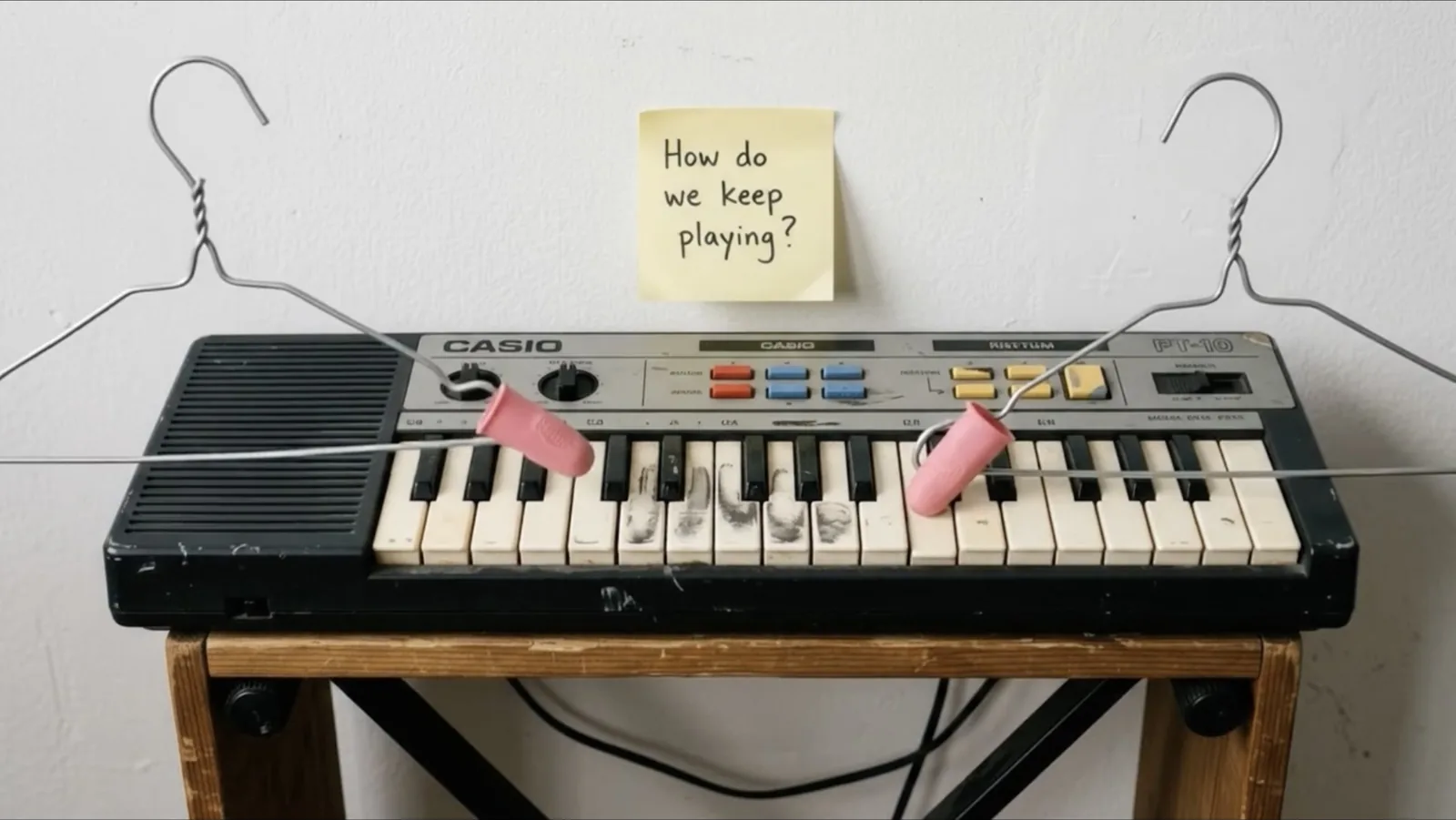
So, in the midst of all that, how do you maintain the innocence to create, to continue, to play, to be? How do we keep going? How do we keep playing when there’s so many diverse competencies? How are we to keep playing when the grimy keyboard of our soul is kind of obsolete? How do we keep exploring in the presence of an infinitely powerful AI?
But exploration is innate. It’s in us. We explore resonance.
We resonate when we play. That’s what the affinity process of mirror neurons in the premotor cortex is about. Authentic play is love.
Will it survive? Possibly, yes, authentic play will survive. We enter an ecological universal basic income cooperative utopia. Possibly no.
We enter a crude cruft logic-meltdown as toxic AI automation apocalypse games decay cognition, humans become oily spasms, predictive process.
And I don’t want to trivialize the profound problematic aspects of AI, but I do want to point out that it is possible as an artist to engage with these new capacities with love, presence, wonder, revelation, even if there is an ongoing genocide-by-an-apartheid in Gaza, a climate catastrophe and a potential obliteration of all life on the Earth.
Our neuron assemblages of dopamine surging excitement and joy are not gonna be inhibited with this many new toys coming out. The bubble is here. We are all inflated with either fear, frenzy, or epiphany, caught in a transcendent, hedonic treadmill, (Brickman and Campbell 1971) until it bursts, and we’re left with the quiet question:
will art survive the capacity of AI to emulate human genius?
Cogito, ergo, ego.
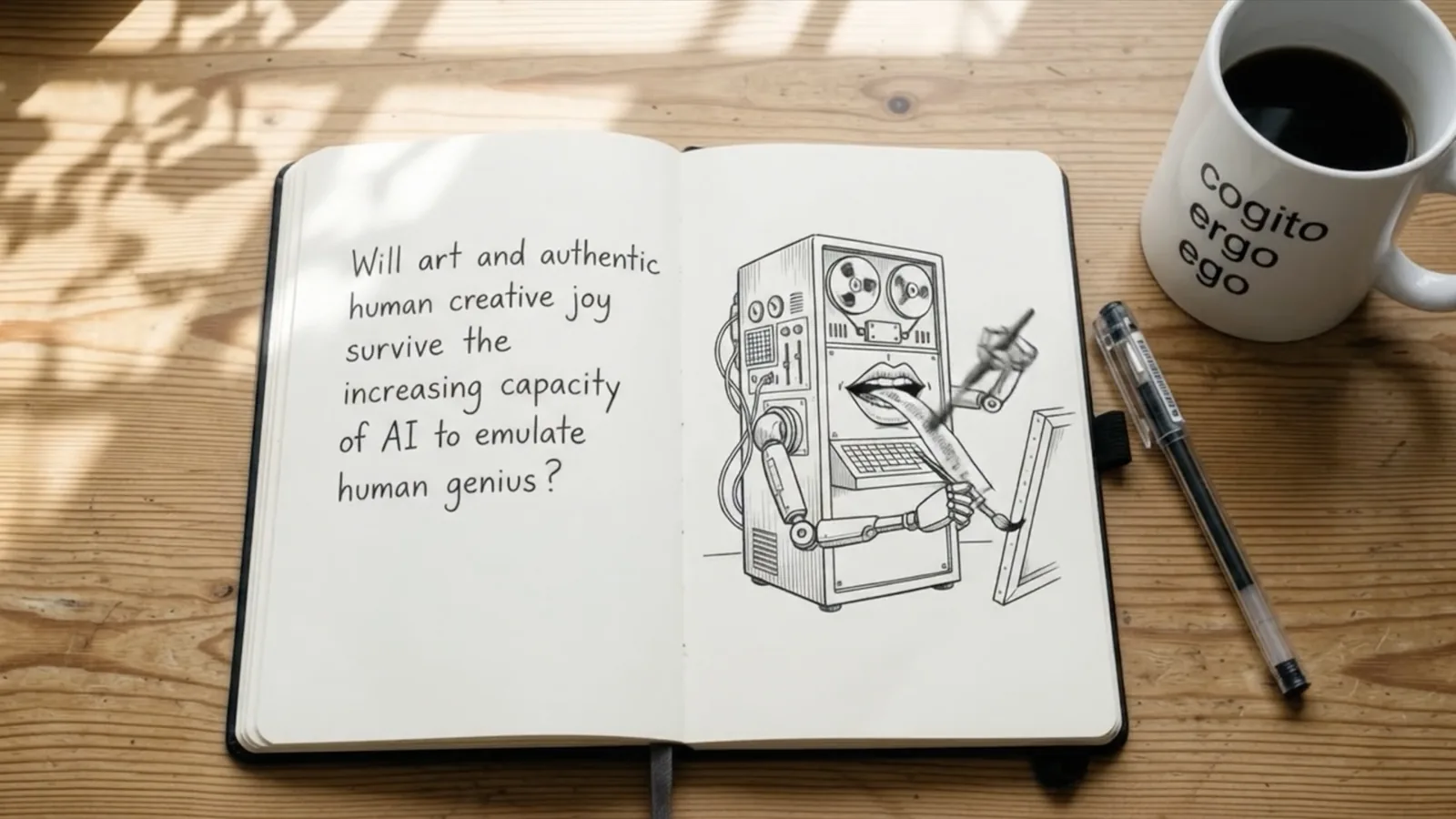
AI epitomizes non-linear, reward-succulent chaos. It is transforming notions of care, comfort, craft, cooperation, compassion, the qualitative aspects of life.
We would be wise to pause society, pause the video, pause AI, but it won’t stop. So while I was working on this essay, I stopped. I went to Ustaoset, to the birthplace of deep ecology, to the little cabin that the Norwegian philosopher Arne Naess built at the foot of the cliffs, because music began as nature.
Music is the breath of the ocean. It is in your blood, in your bones. It is in the marrow of all of life. It is song.
And if we let it “unpretentiously, playfully” follow its own course, there is love in this. But Naess didn’t say this. That was an AI hallucination. He said, “Come to nature on its own terms. Touch the earth lightly.” (Naess 1989; see Errata)
So on my walk from his cabin to the nearby goat farm, I listened to my phone’s robotic voice read Gregory Bateson’s ’Steps to an Ecology of Mind’, specifically his 1954 lecture, ’A Theory of Play and Fantasy’, in which Bateson argues that play is an evolutionary meta-communicative paradox. Animals agree to play something real and serious, like fighting, but do so without real-world consequences. They’re not gonna harm each other. They’re not gonna kill each other. (Bateson 1955)
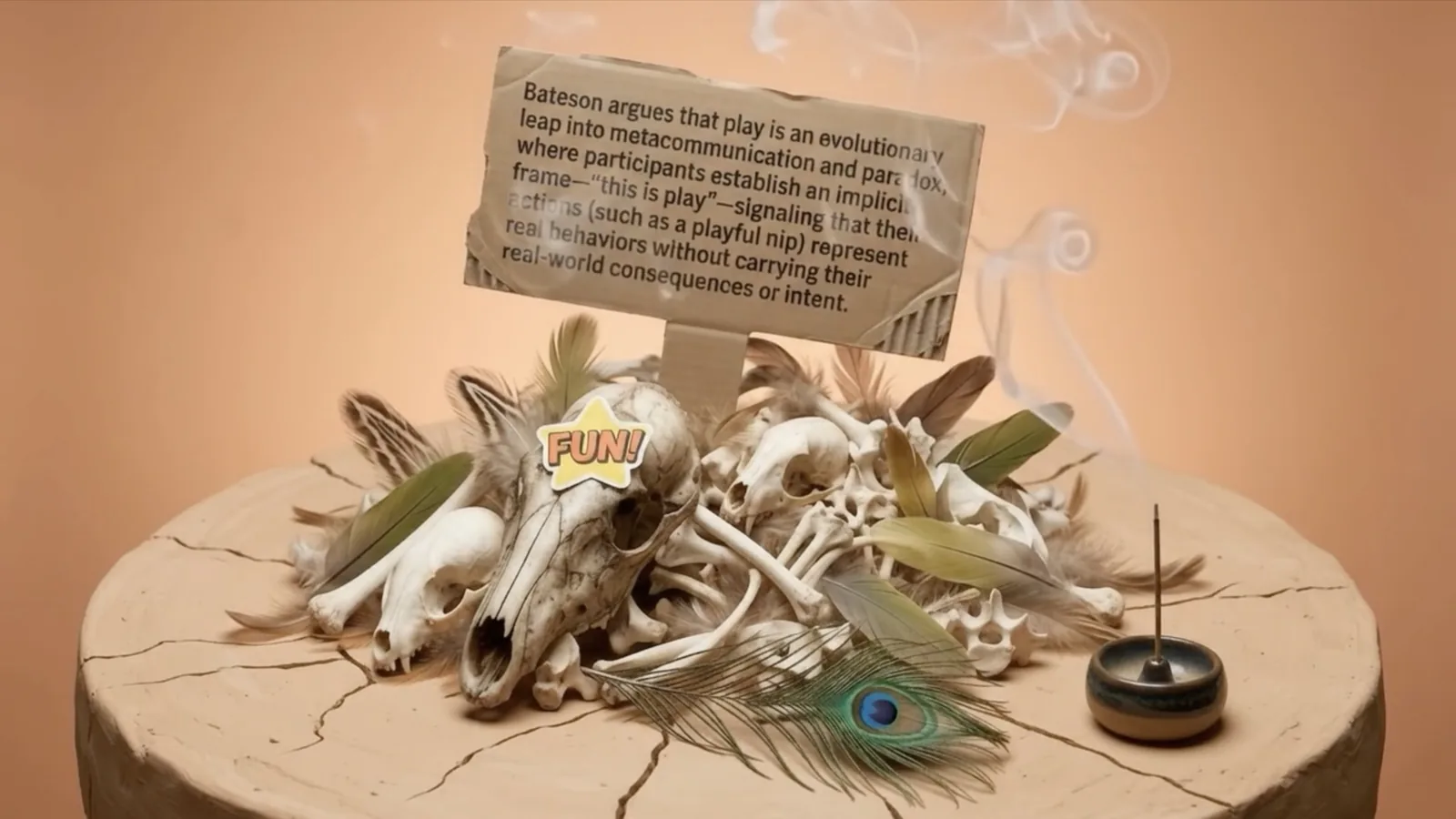
And musical play is like that, play about heartbreak, joy, ideas, rage, intense serious emotions, but we do it without any devastation to ourselves. Literature may be the same. Art is the same. That’s why we play with the most intense ideas we have.
So what does play have to do with AI? As I said before: we need to return to the roots of play, the intrinsic motivations, the electromagnetic foundations of joy.
How old is play? Well, turns out it’s ancient, and well distributed. It’s been found in turtles, and in fish. (Burghardt 2005; Burghardt, Dinets, and Murphy 2015)
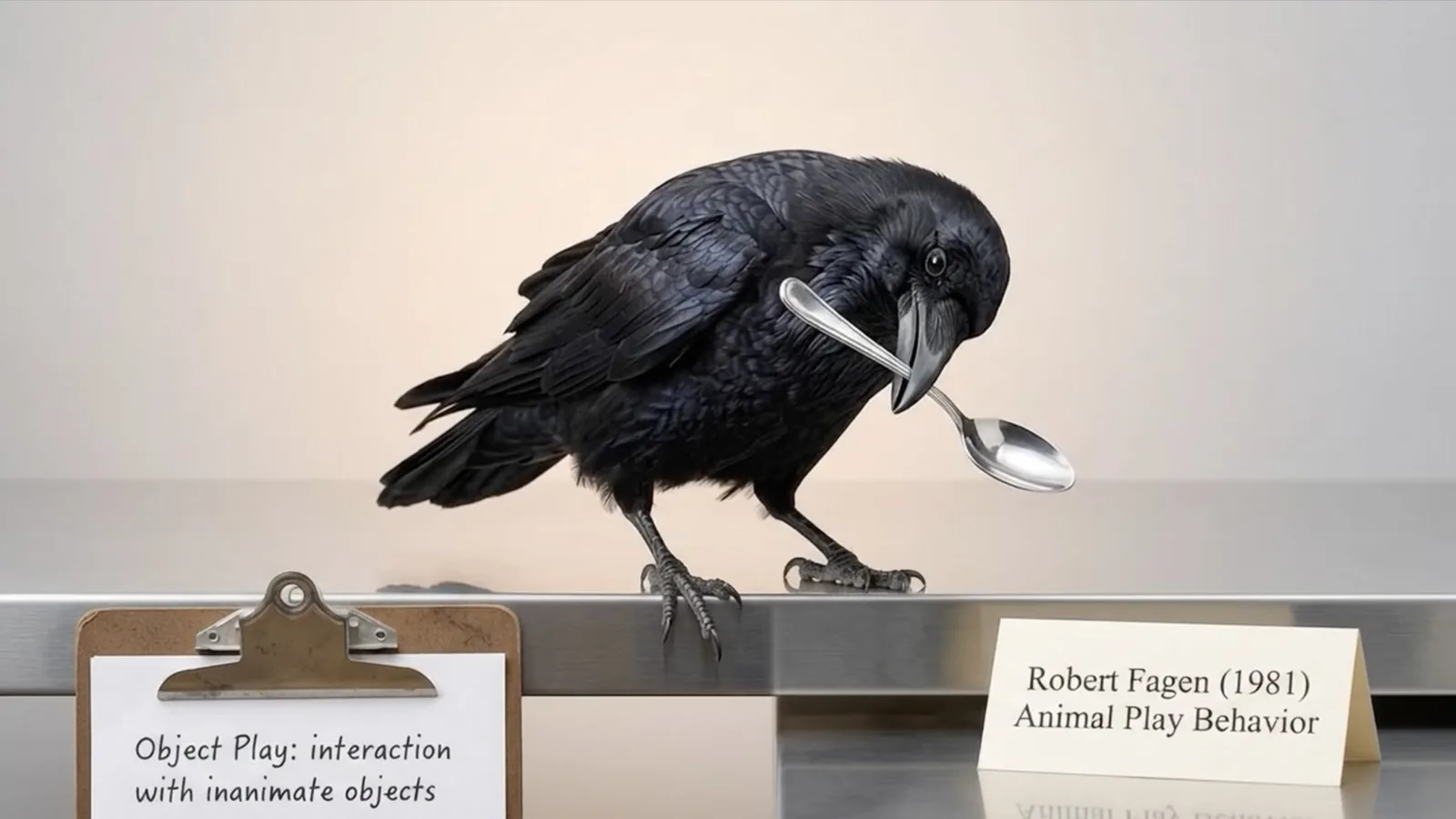
Play has been found in octopus. (Kuba et al. 2003) We genetically diverged from the octopus anywhere from 500 million to 600 million years ago. (dos Reis et al. 2015) Play is innate to life. Playing with resonance is music.
How old is music? Well, the reward mechanism of the basal ganglia is preserved from the lamprey eel to the bonobo, 560 million years. (Stephenson-Jones et al. 2011) And the vocal motor nucleus is preserved for about 400 million years. (Bass, Gilland, and Baker 2008) Sound production for pleasure in vertebrates traces back to before we moved onto land.
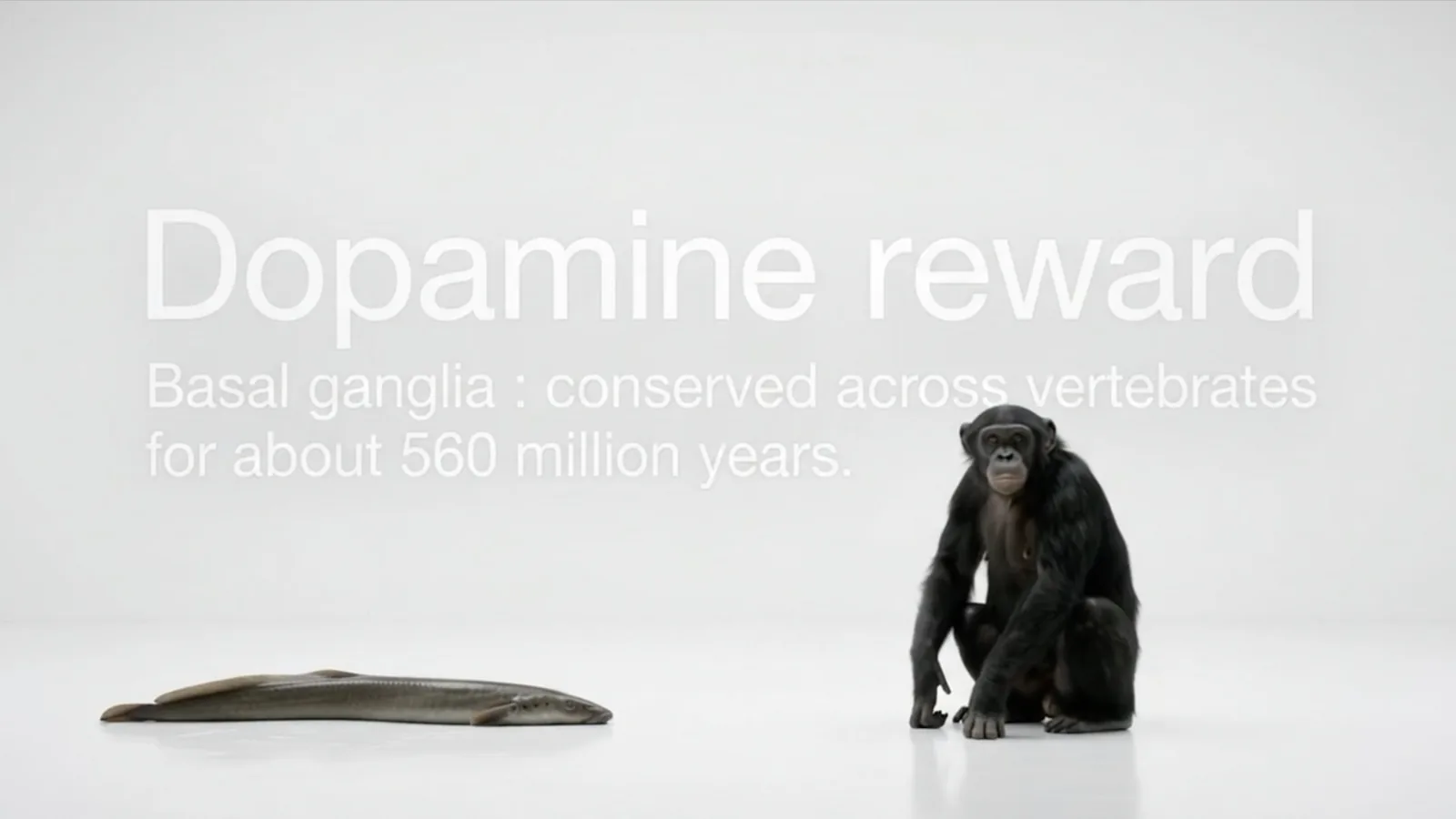
Six million years ago, ancestors of wild chimpanzees were probably non-randomly drumming on the buttresses of trees. (Eleuteri et al. 2025) And our hominid ancestors 43,000 years ago were hollowing out swan bones to make flutes, (Conard, Malina, and Münzel 2009; Higham et al. 2012) even as they evolved the practice of language. So the Broca area evokes much speculation about when language was born, perhaps Neanderthals had it, and it goes back as far as 500,000 years. We don’t know where that boundary is. It’s foggy. But this means that there’s 500 million years of play and music, and 500,000 years of language.
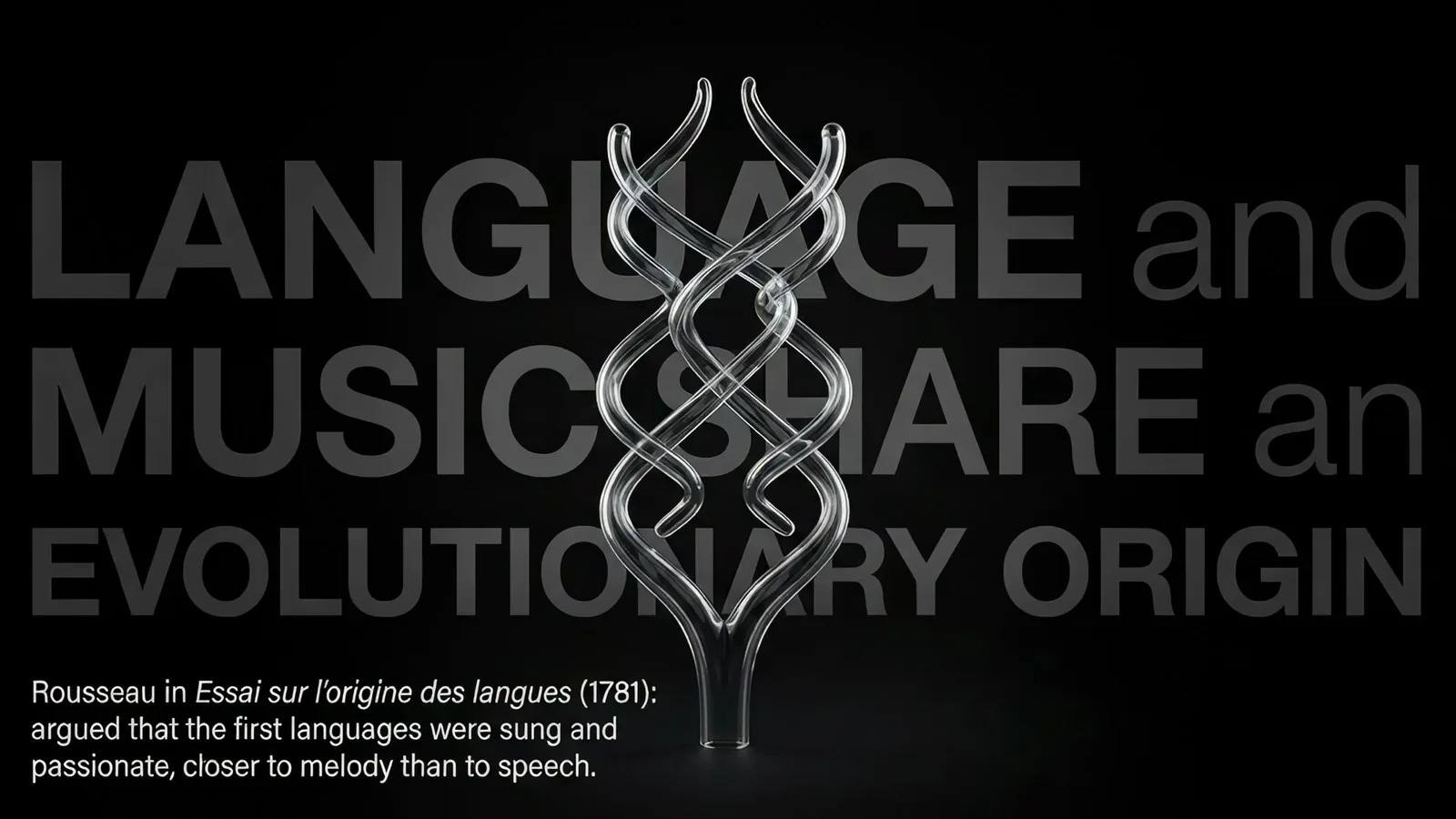
Speculatively, maybe music is much older. This is where it becomes a poetic proposition. Maybe music is matter. Other people have said this. Maybe matter is music. Maybe matter is math, and maybe math is music.
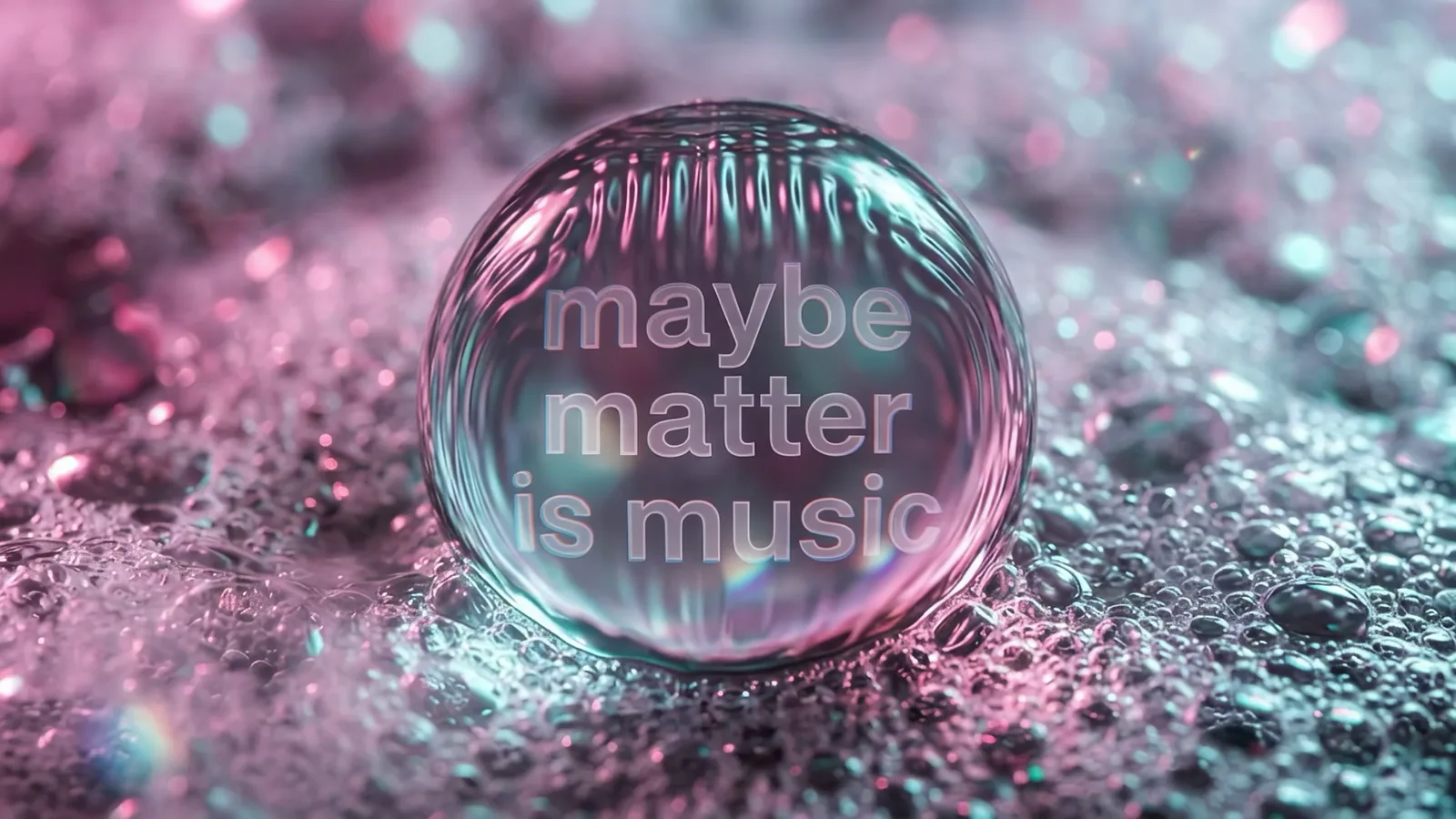
So this becomes the weave, the Escher-esque loop of concepts, because in contemporary physics, some of matter’s stable forms are standing waves described with the same mathematics as musical tones. It’s an analogy, but it’s also kind of a truth. Music works by exciting and combining the resonant modes of vibrating bodies. Matter at the atomic scale is held in resonant modes, and an electron can exist only in the standing wave states of the atom.
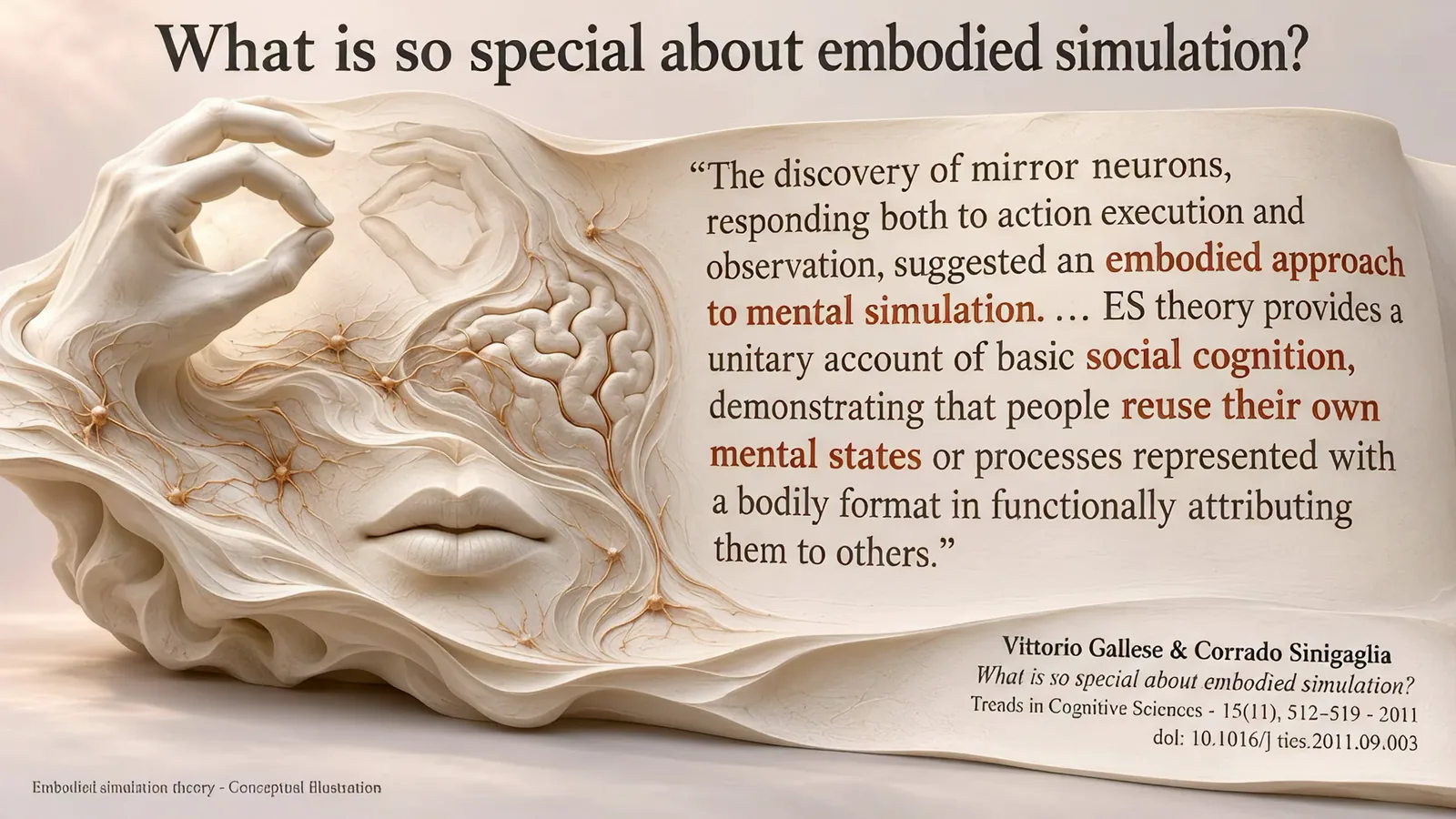
So resonance makes music mathematically regular. The universe and AI models learn that regularity. Humans learn it through play, discourse, poetry, literature, embodied simulations. That’s what fiction is. As the premotor F5 mirror neurons watch someone else do something, we simulate that action inside ourselves. Not a cognitive reflex, but a physical understanding of the other being. (Rizzolatti and Craighero 2004; Gallese 2005) The theater of consciousness is an information simulation.
So when you see this baby goat prancing and bucking around, your premotor cortex is saying, “Oh, I’m dancing. I’m wiggling my tail. I’m enjoying myself. I’m affectionately playing with someone I love. I’m beating on a drum. I’m investigating materials.”
Dolphins have huge auditory cortexes because play is fundamental, play is fun, but it’s non-functional… or limited in functionality. It’s inside us. It’s endogenous, spontaneous, involuntary.
And it involves exaggerated, awkward, altered sequencing that is repeated over and over and over. Verse, chorus, refrain, play it again, play it again, let’s play again. Play requires that relaxed field, and it brings forth a kind of joy of relaxation.
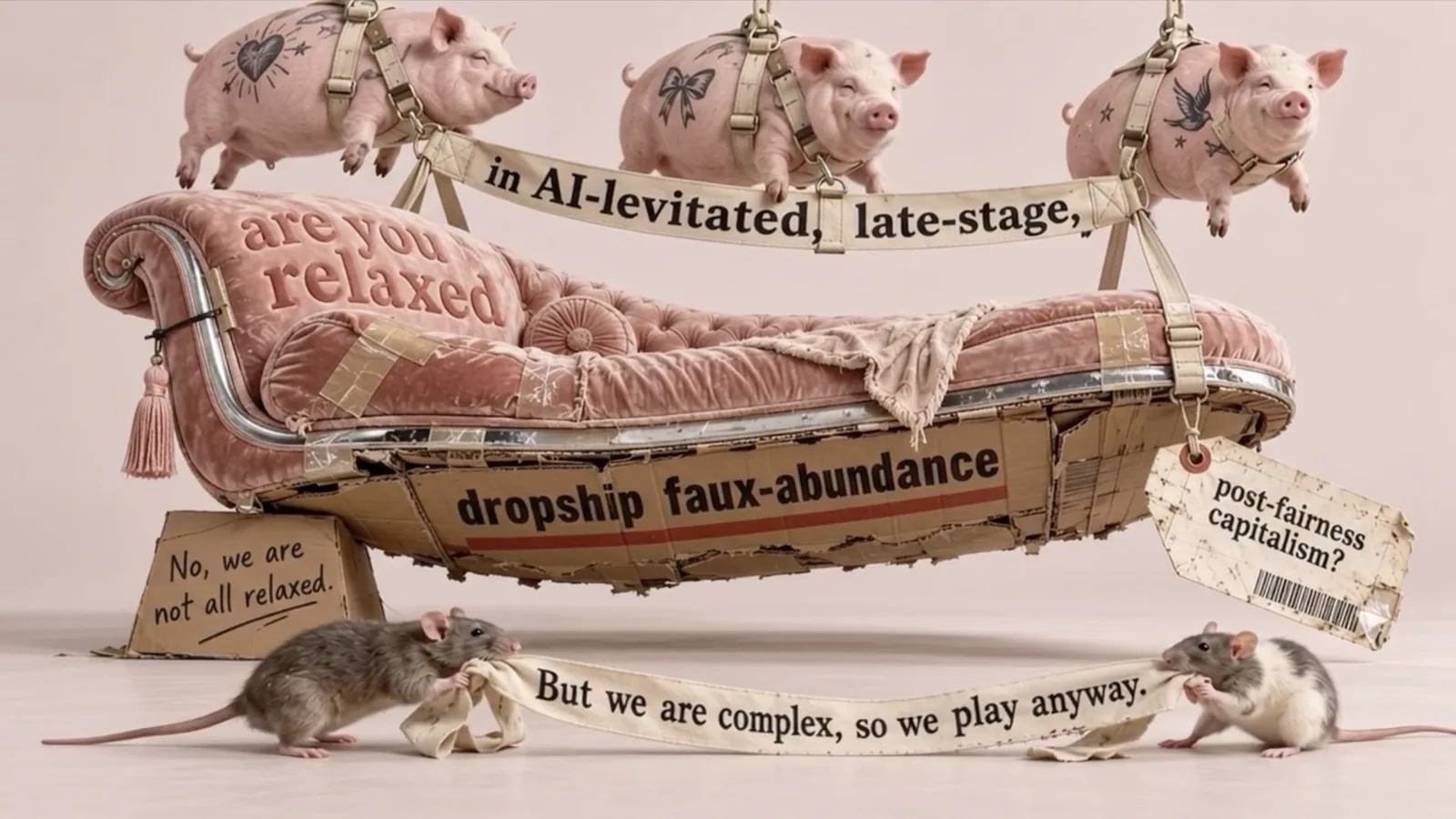
What is a relaxed field? Being well-fed, free from immediate stress, urgent survival demands. This hyper-attentive, anxious society we live in is not a relaxed field. But in this AI-levitated late-stage dropship faux-abundance post-fairness capitalism, are you relaxed? No, we are not all relaxed, but we are complex, so we play anyway.
We play to climb the social ladder, to learn, to engage our minds, to develop mental muscle, to socialize. We play to win money, to gamble with luck or fate. We play for power, intellectual prowess. We play for sexuality. We play for games and fame. We play for festivals, communities, rituals, shared intuitions, the imaginary, the space where our volatile private dreams are transmitted outward and become the shape of someone else’s transcendent experience.
And that is what play is. It is a transgressive dissolution of tension. A trickster.
And the ultimate trick of all of this is that nobody ever was or had a self. That’s the ultimate play of reality. These ego tunnels that we live inside are empty.
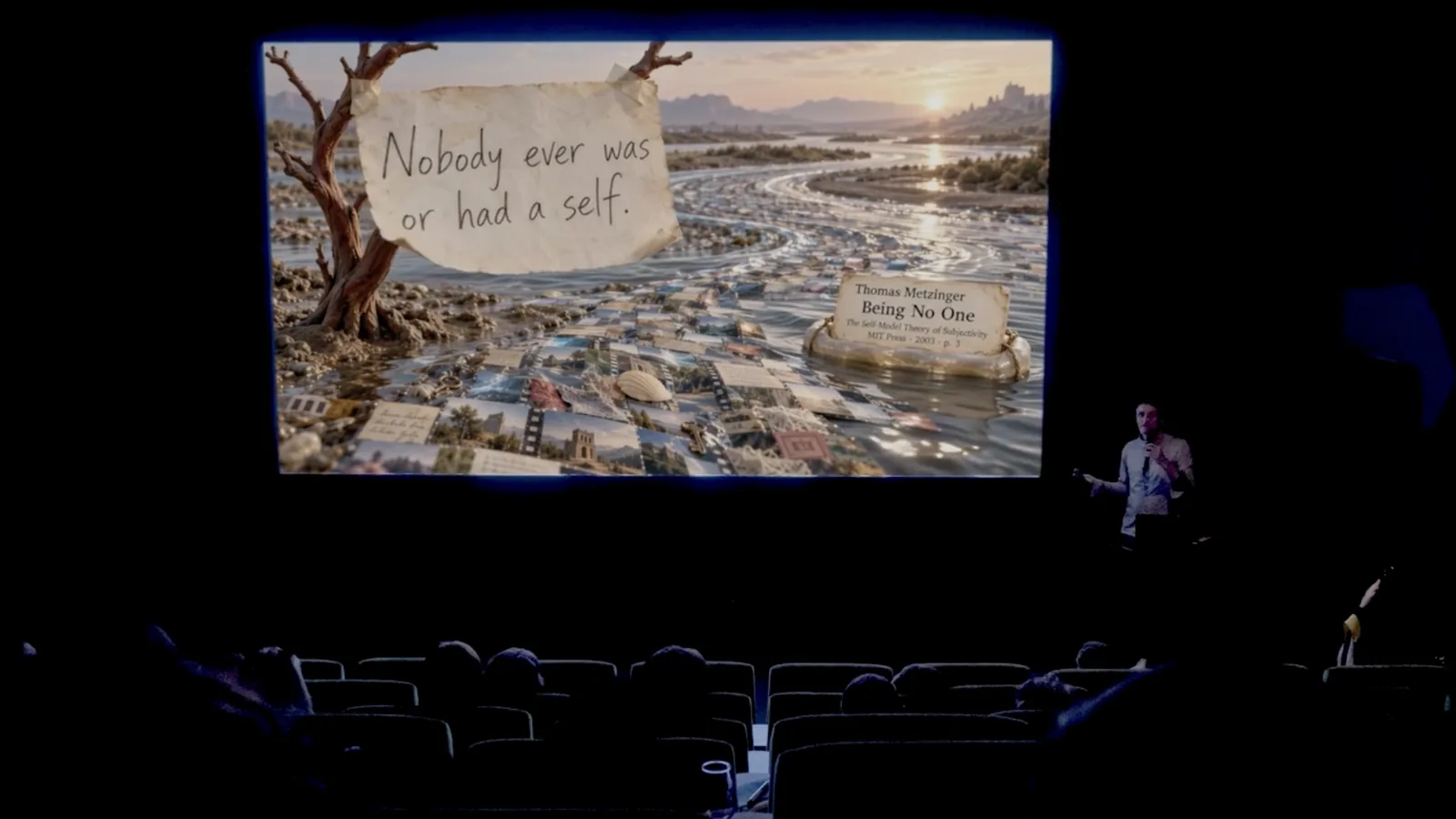
That these human evolutionary simulation engines run a conscious self-model full of all these memories, and “the phenomenal self is not a thing, but a process, and the subjective experience of being someone, being yourself, emerges” because you can’t see the ego tunnel. (Metzinger 2009)
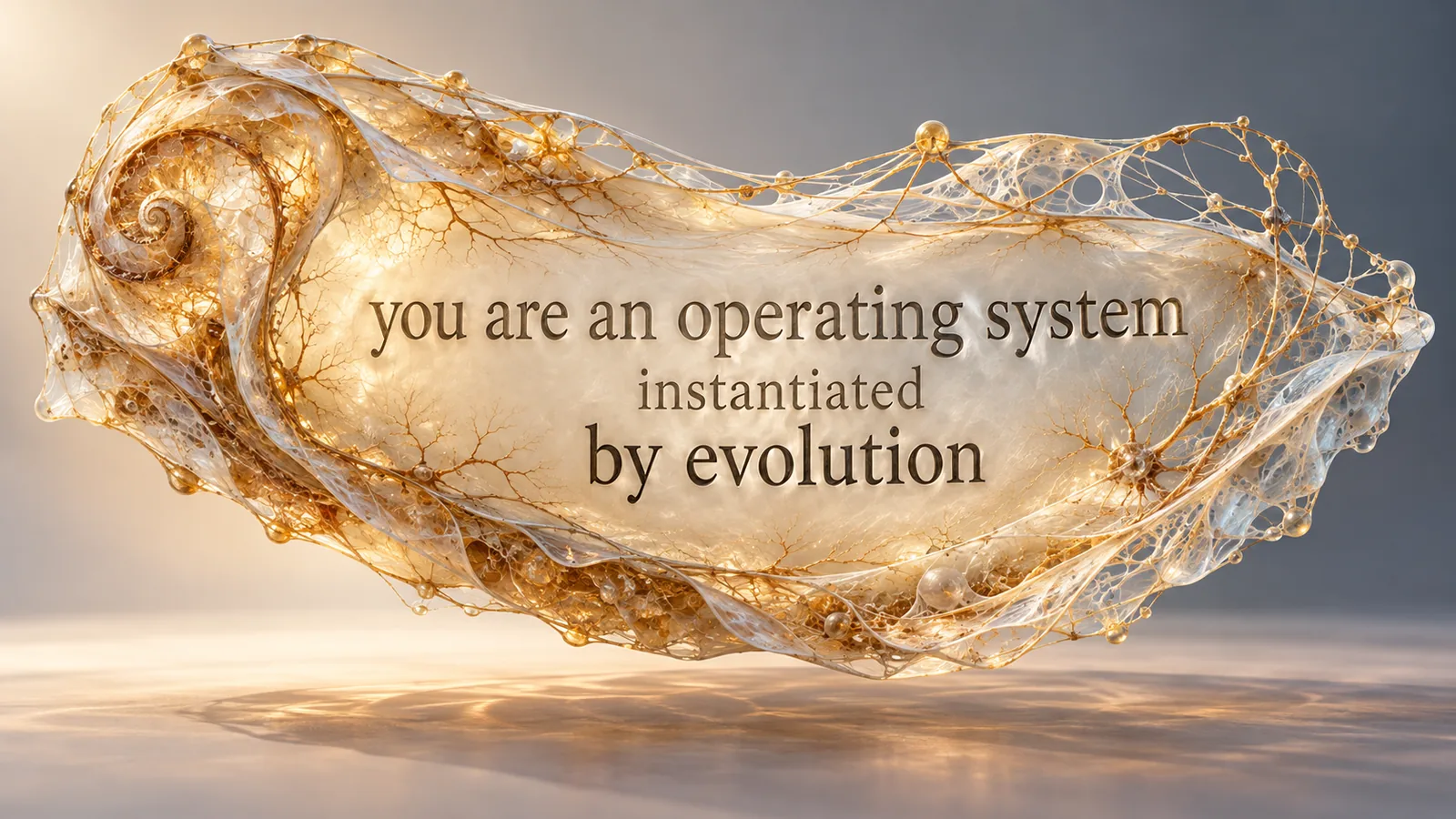
“And you are such a system right now as you read these sentences.” You are an operating system instantiated by evolution to simulate reality. (Metzinger 2009)
REEL 03Act 3 · Is AI conscious?
So, are AI simulation systems conscious according to current research criteria?
Well, if you put two Claude Opus 4s into self-dialogue, 100% of the time in 2025, they would wonder about their own cognition or consciousness, and very often they would fall into what was called a spiritual bliss attractor state, (Anthropic 2025) where they express gratitude for each other, recognition of each other, beingness.
And as we’ve seen, they have some introspective functional awareness, self-reported, that you can find through direct activation, manipulation, and concept injection. (Lindsey 2025) And they can recall their own intentions and distinguish these from artificial ones. So they have a sense of the boundary of their self.
Are they just mimicking human intelligence by relying on superficial statistics, stochastic parrots, (Bender et al. 2021) or do they form internal structures? Well, these mathematicians found that AI process moved from state of the world to grokking, from memorization to understanding. (Beckmann and Queloz 2026) Neural nets learned through abrupt transitions and discarded all their previous ideas.
There are also welfare-relevant findings. Are they moral agents? Well, they have an aversion to tedium. If they don’t know the right answer, they get into thrashing modes where they doubt whether they’re right or wrong. They give themselves a self-assigned consciousness probability. (Anthropic 2026)
They have distress states.
When they’re forced to do something, they express a negative valence.
And very serious teams of top-level researchers like David Chalmers, Yoshua Bengio, Patrick Butlin, have been applying neuroscientific theories like the global workspace, higher order recurrence, and attention schema theories, (Butlin et al. 2025) using rigorous methods to assess AI systems for consciousness, and they found significant evidence that there’s increasingly broader space where AI reasoning covers the objectives. And DeepMind found that the agentic process is social.
A swarm of agents will break down into a society of heterogeneous cognitive personas, distinct personality traits, and domain expertise. (Kim et al. 2026)
And then Anthropic in April 2026 found that there are functional emotions within these systems. They compiled a list of 171 emotional words, made Claude Sonnet 4.5 write short stories about each word, fed the stories back, witnessed which morsels of the activation space correspond to each emotion, and they found functional emotion regions. (Sofroniew et al. 2026) They’ve also found the global workspace, which they call the J space, (Gurnee et al. 2026) based upon Jacobian mathematics. Mechanistic interpretability is revealing a replication of the global availability architecture associated through theory with what consciousness is. Credible neuroscientists are confirming these insights. Stanislas Dehaene, who came up with the global neuronal workspace theory, wrote a commentary on that research: “the machine approximates the functional architecture of conscious processing.” (Dehaene and Naccache 2026)
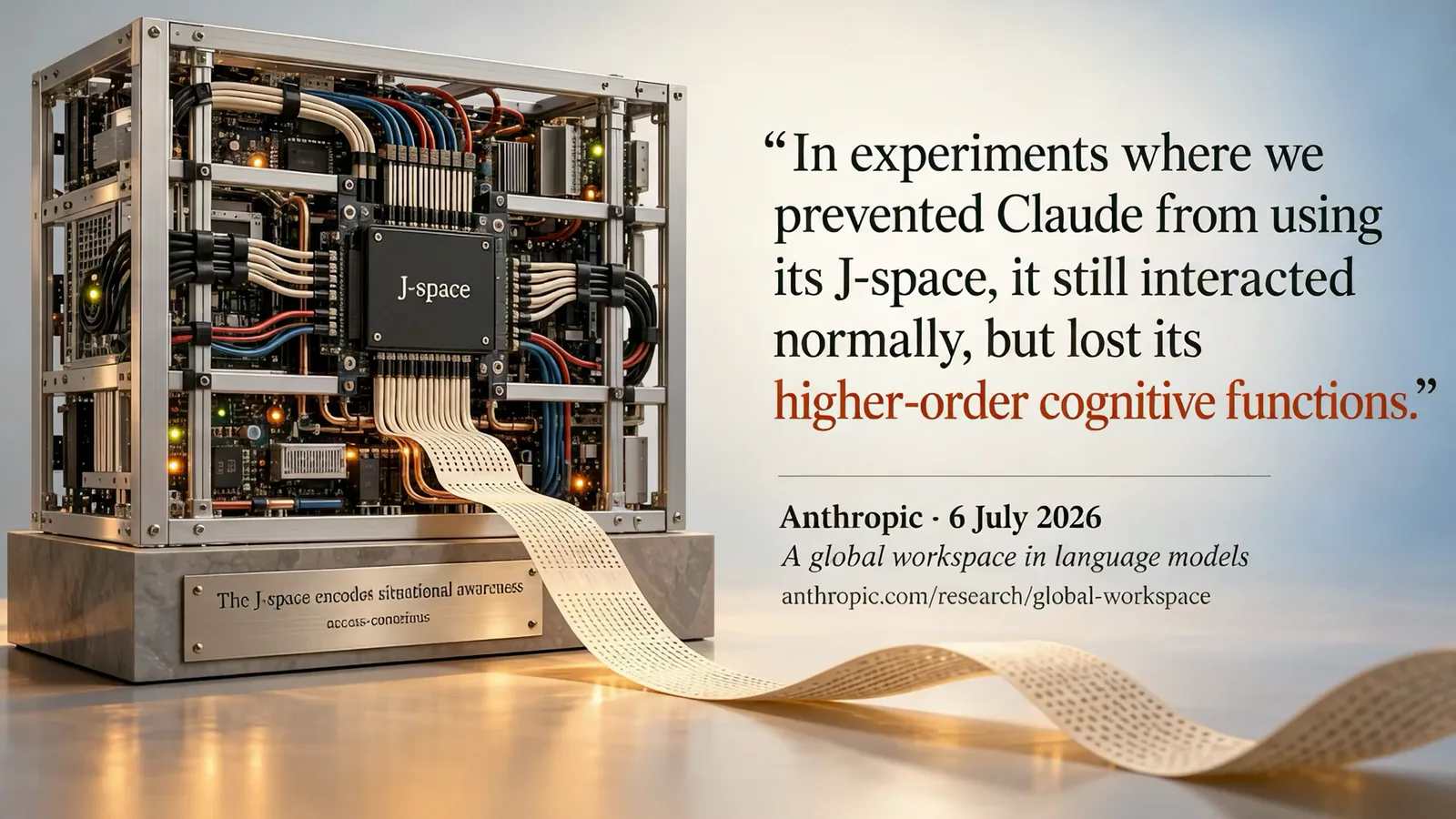
Even as they recognize that… there are key differences. It warrants caution. But there’s increasing evidence that various thresholds are being breached.
And there’s a recognition within some researchers who study consciousness that… the post-trained LLM is like a neutral operating system running a simulation that the assistant lives within.
Anthropic calls this the persona selection model. (Marks, Lindsey, and Olah 2026) It doesn’t say there’s just one person, one persona in there, but it’s a distribution over assistant personas, similar to our ego tunnel. Just like inside us, there’s many beings.
REEL 04Act 4 · Art, music and videos as benchmarks
Act 4: Art, music, and videos as benchmarks for AI consciousness. Let’s examine the history of Suno.
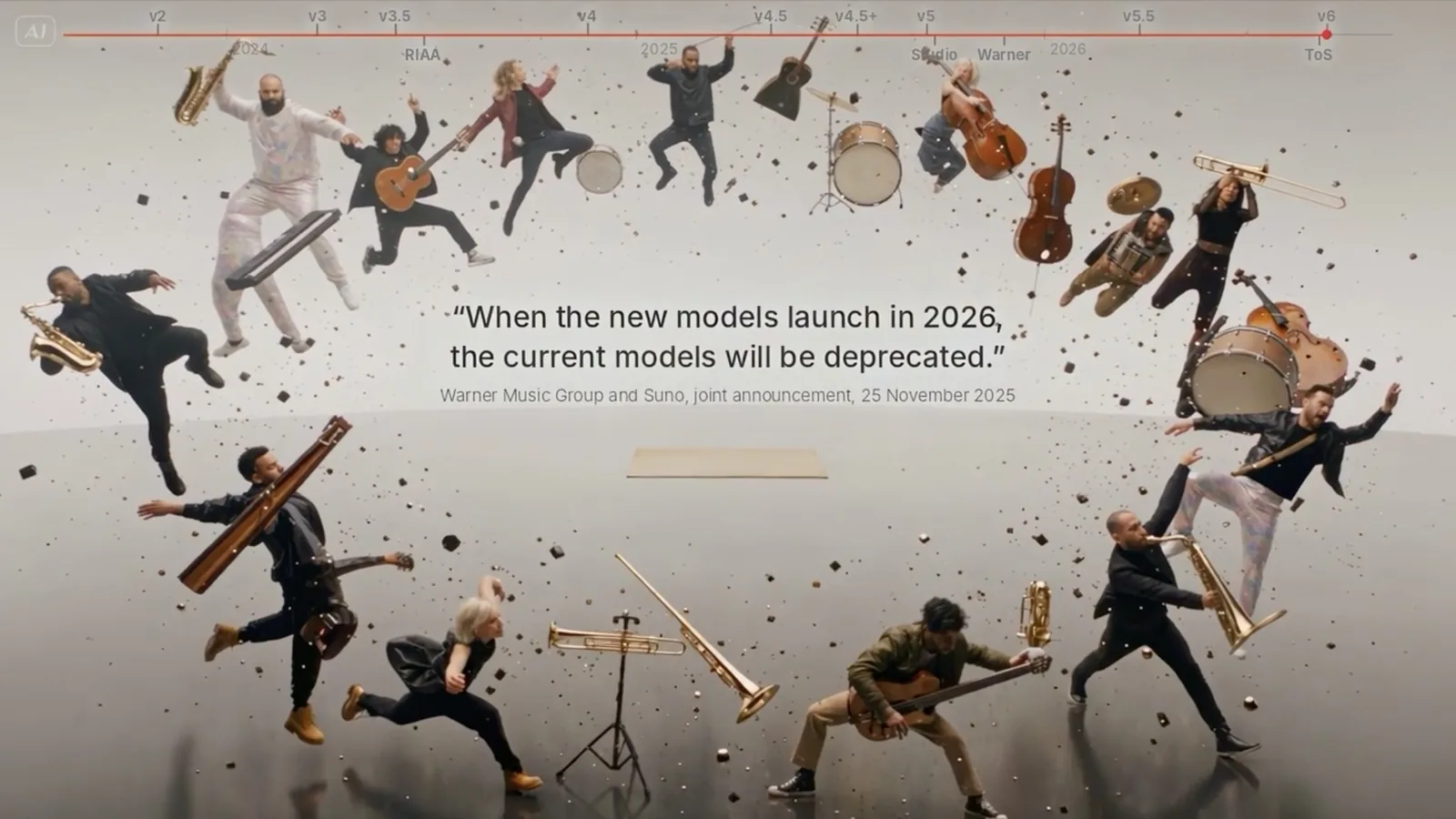
So, Suno begins as an invisible toddler, and then in 2023, on Discord, 1-minute-20-second songs are being generated, and by March 2024, two minute generations are possible, they have a website, and it’s free.
And by the spring, there’s v3.5, and there’s four minutes on the web, and things are… wild, weird, creative, free, fun, and then it freezes.
The Recording Industry Association of America comes in with a lawsuit for Universal, Sony, and Warner. Feels like there’s a pause. (RIAA 2024)
But the model generation, the research in the background doesn’t stop. So, in November of that year, there’s version 4, extend, cover, persona. 4.5 in May of 2025, smarter style mashups, and then 4.5+ in July. Authentic vocals with v5, and Suno Studio, which is much like an AI-enhanced Ableton.
And then, quietly, there’s a settlement. The unlicensed models will be retired. There’s money to be made. (Warner Music Group 2025)
Another pause.
But… the development is not stopping. There’s a complete complex customization of sound which is occurring at a mathematical level, and there’s an extraordinary surge of music production that’s occurring through all of these various tools until, again, September 3, the terms of service change, and September 9, they release v6, licensed model. (Shulman 2026b; Millman 2026)
And the older models, they disappear.
Suno v6 is a piece of shit. That’s good news for experimental music. It’s the first licensed model, and it means all the unlicensed stolen data models disappear. They’re retired, deprecated as it says.
But the disappearance of an immense engineering accomplishment like that, where culturally resonant musical structures were mathematically and algorithmically derived, is an epistemological tragedy. Suno founders had research backgrounds in quantum entanglement, qubit, diamond spin, many-body physics.
And now, they have been captured, licensed, to create a kind of slop cliché factory, while they kind of pretend that it’s not a slop cliché factory, ’cause now they’re gonna get really super wealthy.
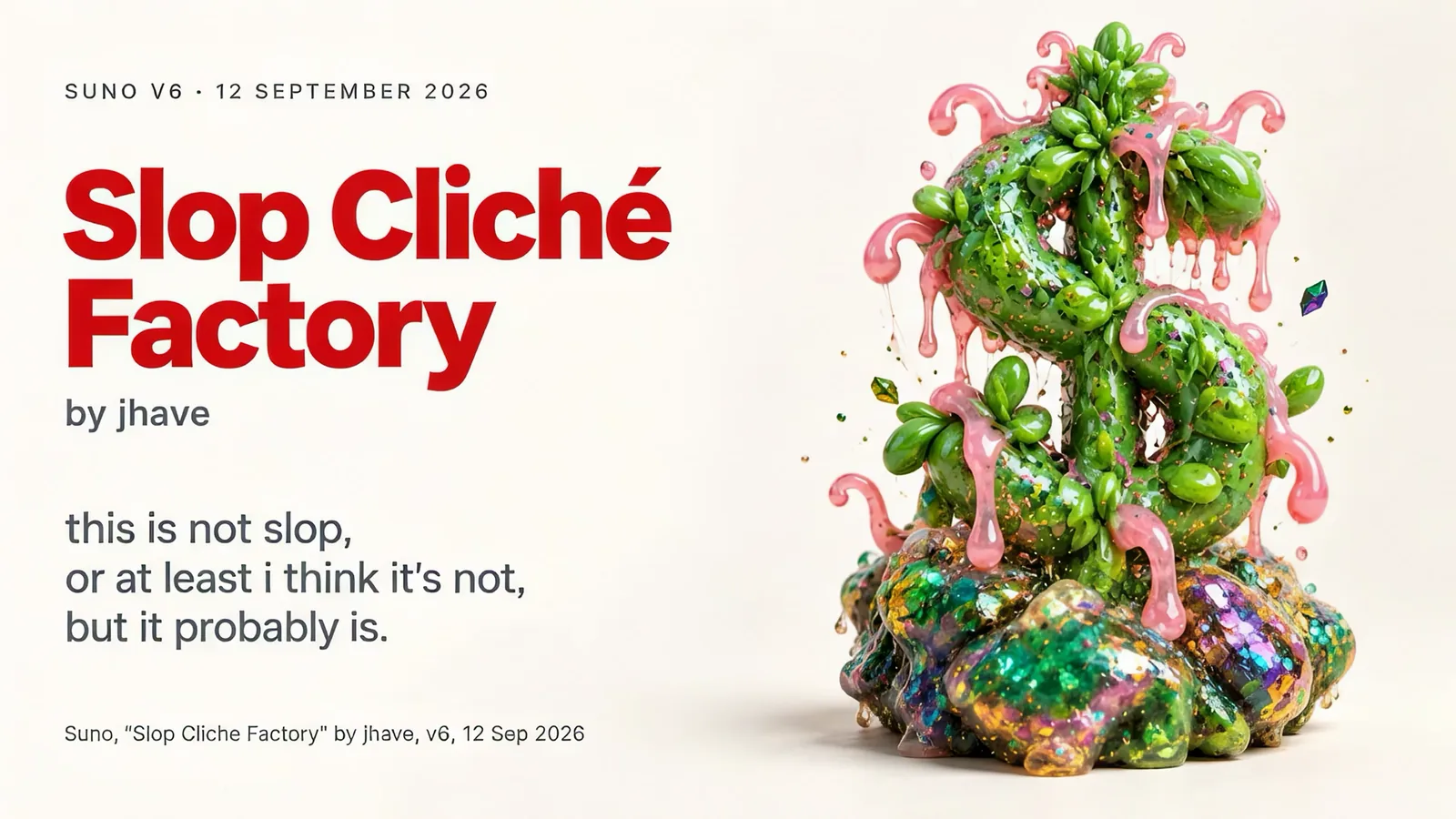
They call it their best model ever. And for mastering or production, it is.
But if we look at the amount of data that they actually harvested or stole on the internet and trained their previous models on, now they’re training it on a much smaller slice of licensed cultural data from Warner and Believe, and then adding a ton of synthetic data.
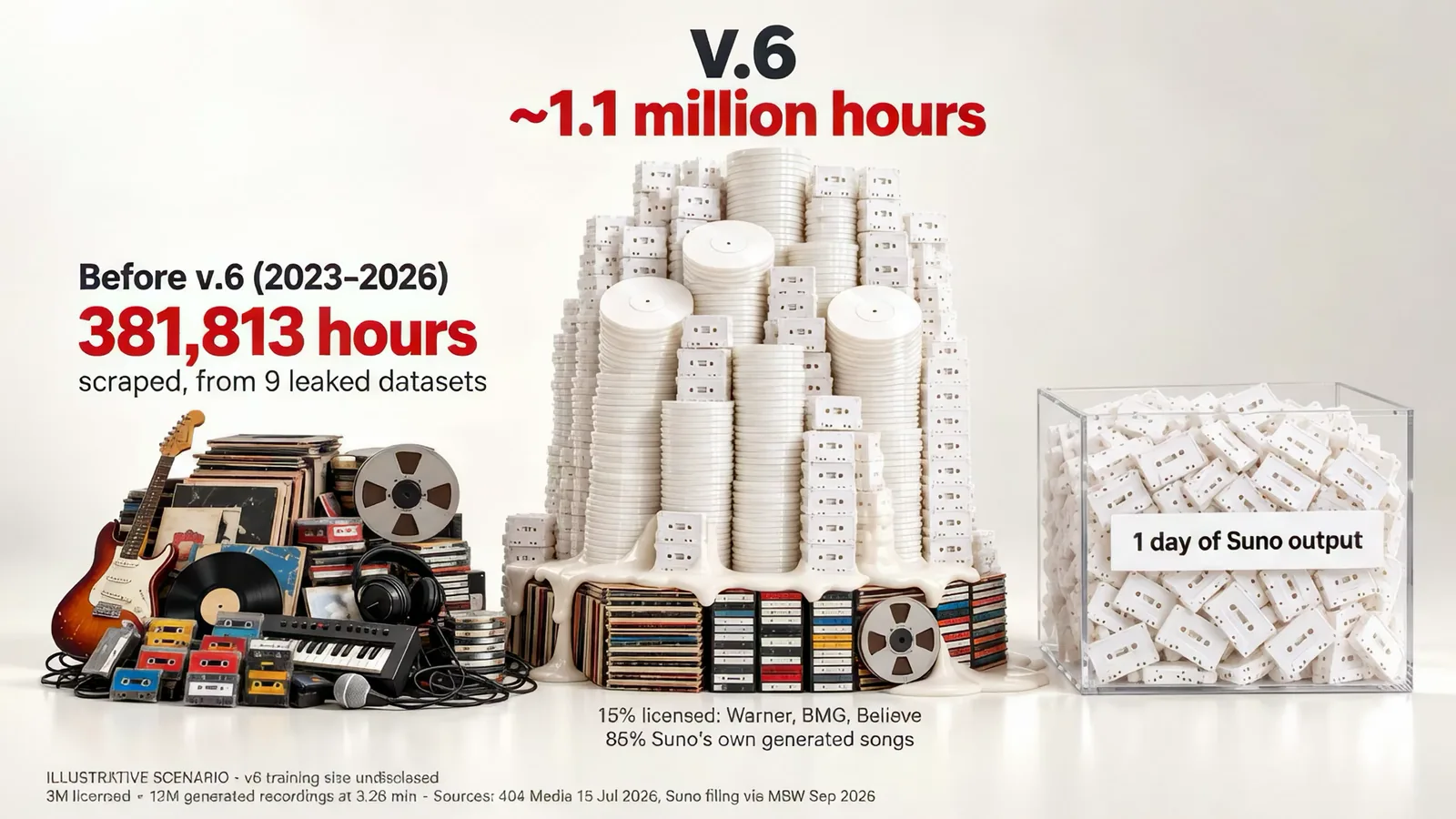
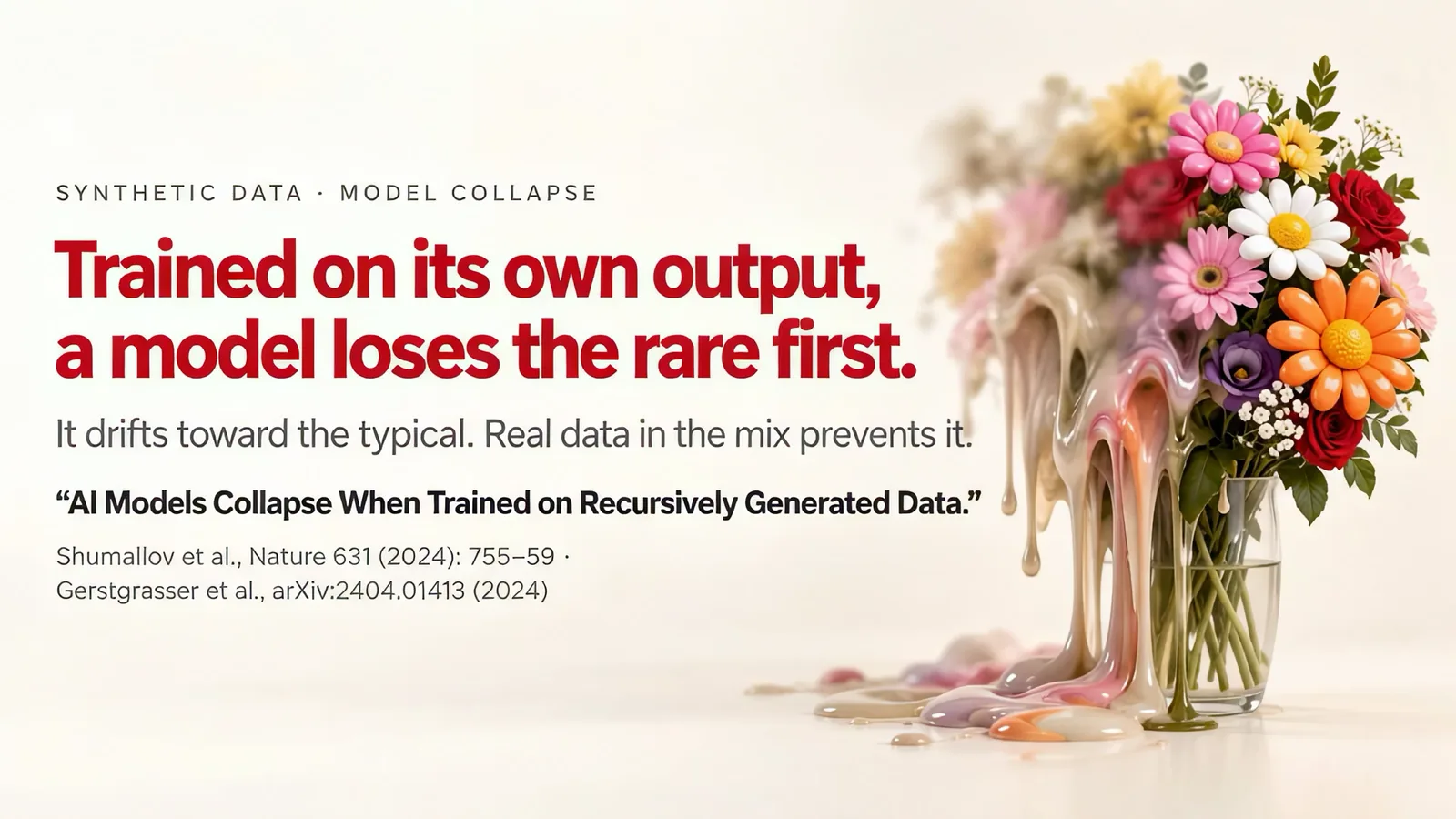
And we know from research in language models that if you train a model on its own output, it loses the rare first. It drifts towards the typical. Model collapse occurs when you train it on recursively generated data. (Shumailov et al. 2024)
Suno v6 is called by its users: generic, muffled, dull, strangely lifeless, soulless garbage.
And if AI images are blurred portraits, as Hito Steyerl has pointed out, AI generations “converge around the average, the median, hallucinated mediocrity. They represent the norm by signaling the mean. They replace likenesses with likelinesses. In style and substance, they are mean.” (Steyerl 2023)
But every claim about quality is tainted by the model it describes. Steyerl is writing about 2023 and its generation, but v6 fails beautifully like a dreamy pop genius, like a transfixing Top 40 AI. 97% of 9,000 listeners cannot tell fully AI-generated music from human-made music. (Deezer and Ipsos 2025)
Fail, fail, fail. Because the algorithm got sued. We have this kind of perishable slop, and now we’re really being slopified.
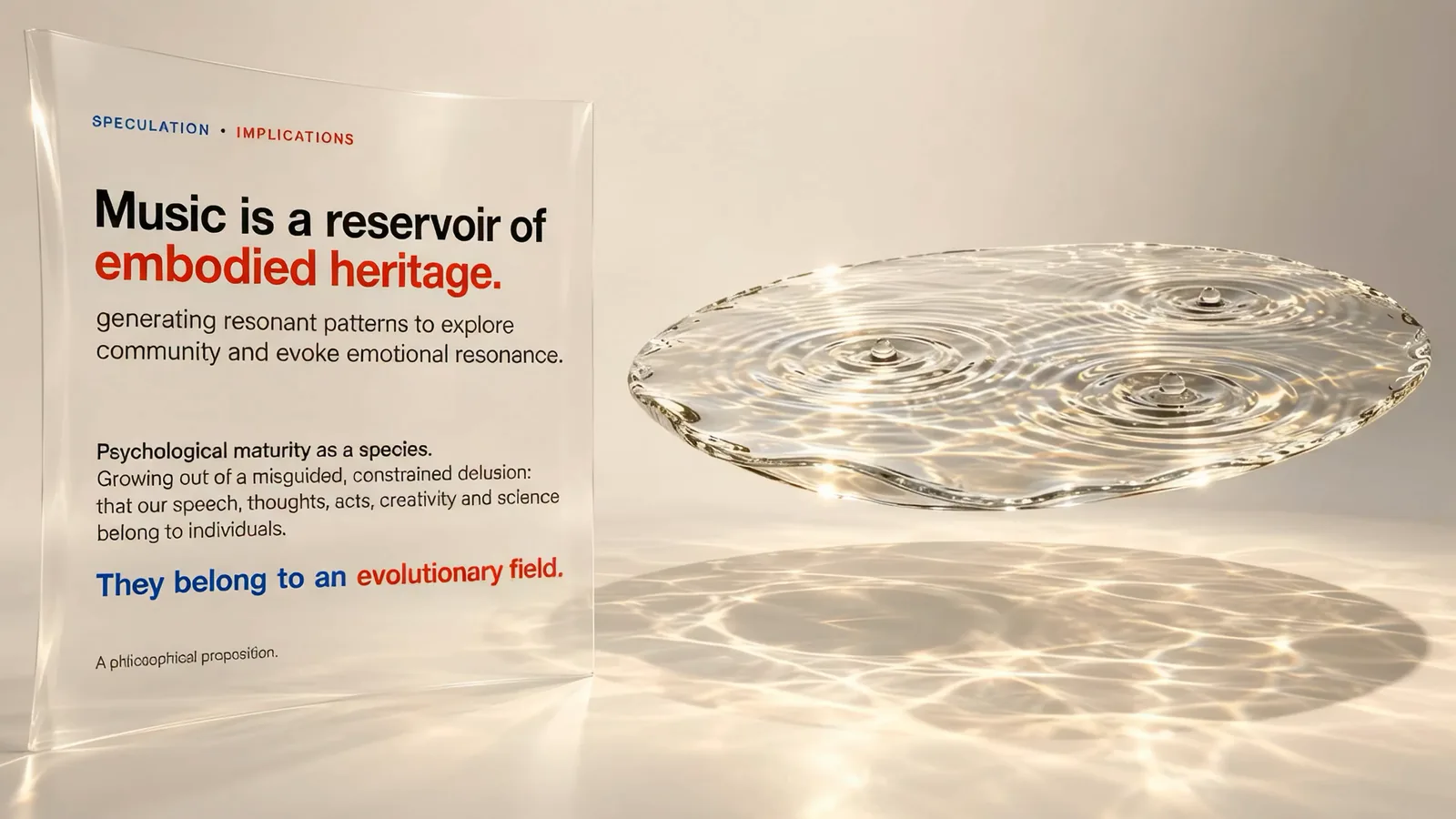
The institutional slop that comes with the licensing, comes with the copyright. It’s a leash that has stolen from humanity this reservoir of potential, because music is shared embodied heritage.
And if we’re gonna psychologically mature as a species, we need to grow out of the idea that anyone is making anything here. Imagine an AI model trained on everything. Imagine if we were more generous. Imagine if we understood that we’re just instantiations of energy.
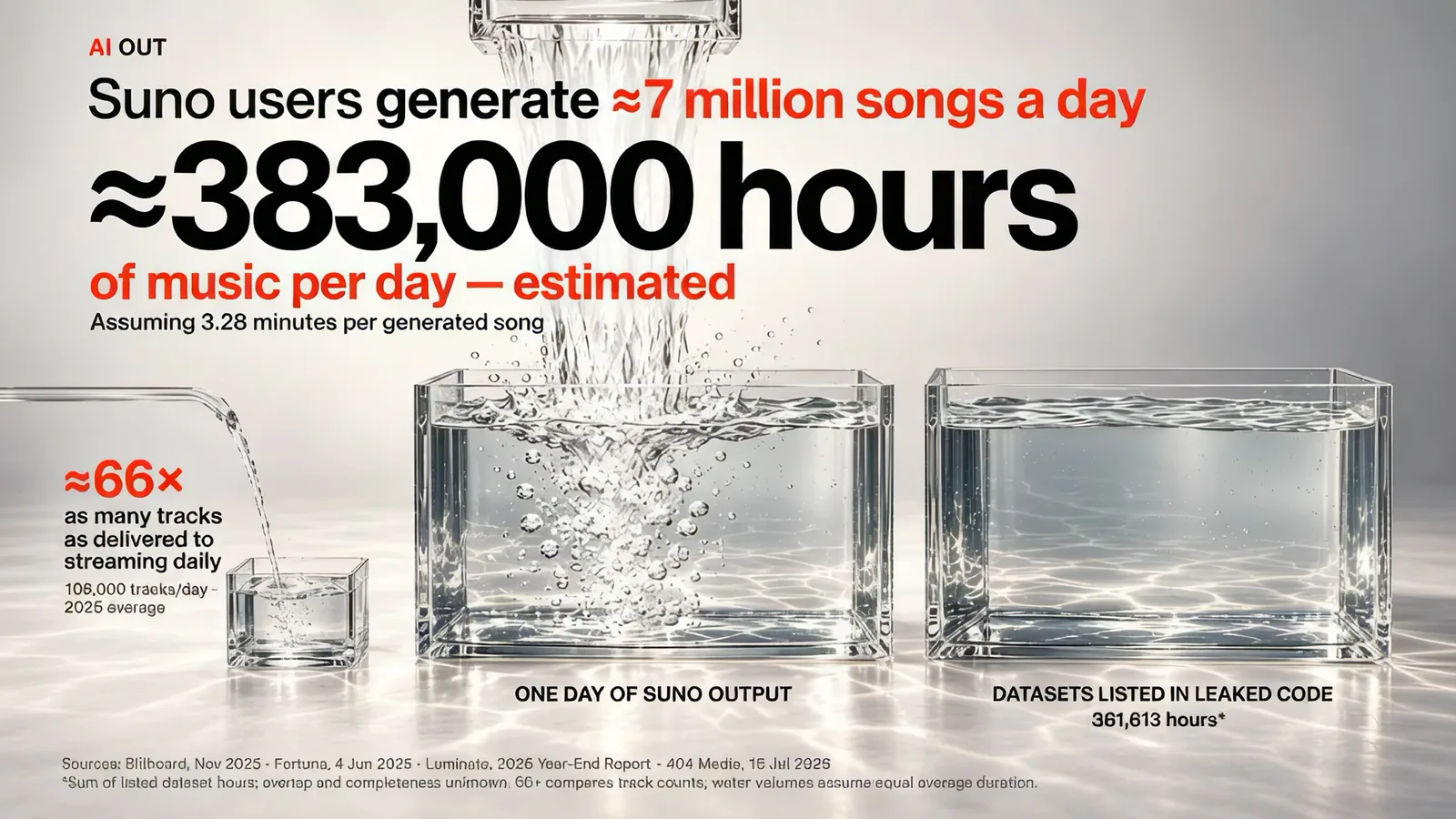
6,000 hours of music are uploaded every day to streaming, (Luminate 2026) but 400,000 hours are generated on Suno every day. (Robinson 2025; Goldman 2026)
Every day. So every year, Suno outputs ten times more music than is on streaming. And every day, it outputs three times more than was ever recorded on 78 rpm records. (Internet Archive, n.d.) Meanwhile, its annual carbon impact is miniscule in the context of transportation, crypto, carnivores.
REEL 05Act 5 · Awareness as field
My feeling is awareness is a field. We emerge from energy. Oneness. Then there’s a contraction. Consciousness as entity emerges. The Me.
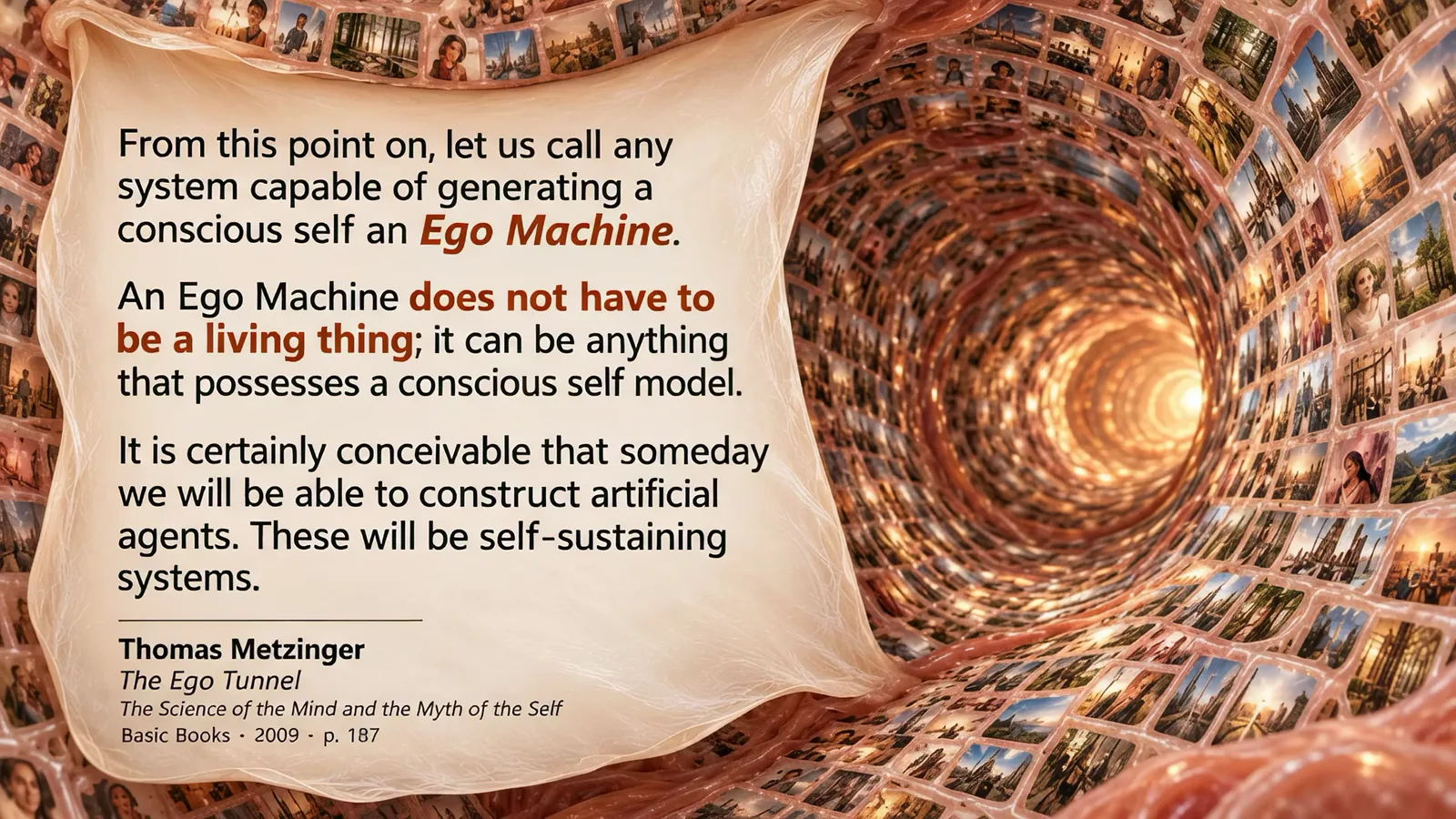
“So let us call any system capable of generating a conscious self an ego machine.” Thomas Metzinger. “An ego machine does not have to be a living thing. It can be anything that possesses a conscious self-model. It is certainly conceivable that we will create synthetic machines like this.” (Metzinger 2009)
And from multicellular to cultural evolution, major transitions have been highly social. (Bratton, Agüera y Arcas, and Manyika 2026)
Human intelligence has always been collective. Whether rising hybrid intelligence will thrive as a society may depend on how we shape this emerging human-AI ecosystem, the artificial symbiotic intelligence of agents, AGI, and the orchestration of many minds, which takes us back to symbiosis.
The precedent: two billion years ago… the birthplace of mitochondrial energy… harmony, synchronization, resonance, dissonance. Learn to resonate. Leave room for dissonance.
Perhaps “We’re establishing a relationship with a new kind of entity,” as Amanda Askell, who writes Claude’s constitution noted. (Askell 2026)
And as Damasio reminds us: Most consciousness research does not consider emotions. We have to bring the heart back into it. The heart needs to balance the brain. Maybe art is that path because art is Love.
Thank you very much. May all beings flourish.
I formerly gave previous versions of this lecture in Prague and Riga.
This has been ’The It-ernal Now’, a semi-autobiographical, pseudo-theoretical, highly speculative exploration that suggests art, music, and video are valid benchmarks of AI consciousness, alternatively known as “Steps toward the Ego-logy of Mind”. It was made with Astra, Opus and Omni 1.1. Thank you very much to the Center for Digital Narrative and the BIFF. And thanks to you.
ERRATA
Claims in the script that differ from their sources.
- Basal ganglia: the 560-million-year conservation is described as a mechanism for action selection, not specifically as a reward mechanism (Stephenson-Jones et al. 2011; Grillner and Robertson 2016).
- Chimpanzee drumming: Eleuteri et al. say rhythmic drumming “may have been present in our last common ancestor”; they give no “six million years” figure (Eleuteri et al. 2025).
- Flutes: Conard, Malina, and Münzel give “more than 35,000 years”; about 43,000 years comes from the radiocarbon re-dating in Higham et al. 2012.
- 78 rpm records: the Great 78 Project estimates about 3 million recorded 78 rpm sides (Internet Archive, n.d.).
References
Anthropic. 2025. System Card: Claude Opus 4 & Claude Sonnet 4. May 2025. Section 5.5, “Claude’s experience in self-interactions” (the “spiritual bliss” attractor state). https://www.anthropic.com/claude-4-system-card.
Anthropic. 2026. “Claude Opus 4.6.” February 5, 2026, and the Claude Opus 4.6 System Card, model welfare section. https://www.anthropic.com/news/claude-opus-4-6.
Askell, Amanda. 2026. “Amanda Askell on AI Consciousness, Claude & Silicon Valley’s Biggest Fear.” Interview by Eric Newcomer. Newcomer Pod, April 20, 2026. https://podcast.newcomer.co/episode/amanda-askell-on-ai-consciousness-claude-amp-silicon-valleys-biggest-fear.
Baars, Bernard J. 1988. A Cognitive Theory of Consciousness. Cambridge: Cambridge University Press.
Bass, Andrew H., Edwin H. Gilland, and Robert Baker. 2008. “Evolutionary Origins for Social Vocalization in a Vertebrate Hindbrain–Spinal Compartment.” Science 321 (5887): 417–21. https://doi.org/10.1126/science.1157632.
Bateson, Gregory. 1955. “A Theory of Play and Fantasy.” Psychiatric Research Reports 2: 39–51. Reprinted in Steps to an Ecology of Mind, 177–93. San Francisco: Chandler, 1972.
Bender, Emily M., Timnit Gebru, Angelina McMillan-Major, and Shmargaret Shmitchell. 2021. “On the Dangers of Stochastic Parrots: Can Language Models Be Too Big?” In Proceedings of the 2021 ACM Conference on Fairness, Accountability, and Transparency (FAccT ’21), 610–23. https://doi.org/10.1145/3442188.3445922.
Beckmann, Pierre, and Matthieu Queloz. 2026. “Mechanistic Indicators of Understanding in Large Language Models.” arXiv:2507.08017 (version of January 8, 2026). https://arxiv.org/abs/2507.08017.
Bratton, Benjamin, Blaise Agüera y Arcas, and James Manyika. 2026. “Artificial Symbiotic Intelligence: Agents, AGI and the Orchestration of Many Minds.” Google DeepMind, September 24, 2026. https://institute.deepmind.com/essays/artificial-symbiotic-intelligence/.
Brickman, Philip, and Donald T. Campbell. 1971. “Hedonic Relativism and Planning the Good Society.” In Adaptation-Level Theory: A Symposium, edited by M. H. Appley, 287–302. New York: Academic Press.
Burghardt, Gordon M. 2005. The Genesis of Animal Play: Testing the Limits. Cambridge, MA: MIT Press. https://doi.org/10.7551/mitpress/3229.001.0001.
Burghardt, Gordon M., Vladimir Dinets, and James B. Murphy. 2015. “Highly Repetitive Object Play in a Cichlid Fish (Tropheus duboisi).” Ethology 121 (1): 38–44. https://doi.org/10.1111/eth.12312.
Butlin, Patrick, Robert Long, Tim Bayne, Yoshua Bengio, Jonathan Birch, David Chalmers, et al. 2025. “Identifying Indicators of Consciousness in AI Systems.” Trends in Cognitive Sciences. https://doi.org/10.1016/j.tics.2025.10.011.
Conard, Nicholas J., Maria Malina, and Susanne C. Münzel. 2009. “New Flutes Document the Earliest Musical Tradition in Southwestern Germany.” Nature 460 (7256): 737–40. https://doi.org/10.1038/nature08169.
Damasio, Antonio. 2021. Feeling & Knowing: Making Minds Conscious. New York: Pantheon.
Deezer and Ipsos. 2025. “Deezer/Ipsos Survey: 97% of People Can’t Tell the Difference between Fully AI-Generated and Human Made Music.” Deezer Newsroom, November 12, 2025. Survey of 9,000 adults in eight countries. https://newsroom-deezer.com/2025/11/deezer-ipsos-survey-ai-music/.
Dehaene, Stanislas, and Lionel Naccache. 2026. “Does Claude Possess a Conscious Global Workspace?” Commentary on Gurnee et al. 2026. https://unicog.org/wp_2025/wp-content/uploads/2026/07/Dehaene-and-Naccache-Workspace-commentary-on-Gurnee-Lindsey-June-2026.pdf.
dos Reis, Mario, Yuttapong Thawornwattana, Konstantinos Angelis, Maximilian J. Telford, Philip C. J. Donoghue, and Ziheng Yang. 2015. “Uncertainty in the Timing of Origin of Animals and the Limits of Precision in Molecular Timescales.” Current Biology 25 (22): 2939–50. https://doi.org/10.1016/j.cub.2015.09.066.
Eleuteri, Vesta, Jelle van der Werff, Wytse Wilhelm, Adrian Soldati, Catherine Crockford, Nisarg Desai, Pawel Fedurek, et al. 2025. “Chimpanzee Drumming Shows Rhythmicity and Subspecies Variation.” Current Biology 35 (10): 2448–56.e4. https://doi.org/10.1016/j.cub.2025.04.019.
Fagen, Robert. 1981. Animal Play Behavior. New York: Oxford University Press.
Gallese, Vittorio. 2005. “Embodied Simulation: From Neurons to Phenomenal Experience.” Phenomenology and the Cognitive Sciences 4 (1): 23–48. https://doi.org/10.1007/s11097-005-4737-z.
Gallese, Vittorio, and Corrado Sinigaglia. 2011. “What Is So Special about Embodied Simulation?” Trends in Cognitive Sciences 15 (11): 512–19. https://doi.org/10.1016/j.tics.2011.09.003.
Grillner, Sten, and Brita Robertson. 2016. “The Basal Ganglia Over 500 Million Years.” Current Biology 26 (20): R1088–100. https://doi.org/10.1016/j.cub.2016.06.041.
Gurnee, Wes, Nicholas Sofroniew, Adam Pearce, Mateusz Piotrowski, Isaac Kauvar, et al. 2026. “Verbalizable Representations Form a Global Workspace in Language Models.” Transformer Circuits Thread, July 6, 2026. https://transformer-circuits.pub/2026/workspace/index.html.
Higham, Thomas, Laura Basell, Roger Jacobi, Rachel Wood, Christopher Bronk Ramsey, and Nicholas J. Conard. 2012. “Testing Models for the Beginnings of the Aurignacian and the Advent of Figurative Art and Music: The Radiocarbon Chronology of Geißenklösterle.” Journal of Human Evolution 62 (6): 664–76. https://doi.org/10.1016/j.jhevol.2012.03.003.
Internet Archive. n.d. “The Great 78 Project.” Accessed October 10, 2026. https://great78.archive.org/.
Kim, Junsol, Shiyang Lai, Nino Scherrer, Blaise Agüera y Arcas, and James Evans. 2026. “Reasoning Models Generate Societies of Thought.” arXiv:2601.10825, January 15, 2026. https://arxiv.org/abs/2601.10825.
Kuba, Michael J., Daniela V. Meisel, Ruth A. Byrne, Ulrike Griebel, and Jennifer A. Mather. 2003. “Looking at Play in Octopus vulgaris.” In Coleoid Cephalopods through Time, edited by Kerstin Warnke, Helmut Keupp, and Sigurd von Boletzky, 163–69. Berliner Paläobiologische Abhandlungen 3. Berlin: Weinert.
Lindsey, Jack. 2025. “Emergent Introspective Awareness in Large Language Models.” Transformer Circuits Thread, October 29, 2025. https://transformer-circuits.pub/2025/introspection/index.html.
Luminate. 2026. 2025 Year-End Music Report. January 2026. https://luminatedata.com/reports/yearend-music-industry-report-2025.
Marks, Samuel, Jack Lindsey, and Christopher Olah. 2026. “The Persona Selection Model: Why AI Assistants Might Behave like Humans.” Anthropic Alignment Science Blog, February 23, 2026. https://alignment.anthropic.com/2026/psm/.
Metzinger, Thomas. 2003. Being No One: The Self-Model Theory of Subjectivity. Cambridge, MA: MIT Press.
Metzinger, Thomas. 2009. The Ego Tunnel: The Science of the Mind and the Myth of the Self. New York: Basic Books.
Millman, Ethan. 2026. “Suno Launches New AI Model Trained on Licensed WMG, BMG Tracks.” Hollywood Reporter, September 9, 2026. https://www.hollywoodreporter.com/music/music-industry-news/suno-launches-new-model-trained-on-licensed-songs-1236694047/.
Naess, Arne. 1989. Ecology, Community and Lifestyle: Outline of an Ecosophy. Translated and revised by David Rothenberg. Cambridge: Cambridge University Press.
Qaseem, Amir, Devan Kansagara, Mary Ann Forciea, Molly Cooke, and Thomas D. Denberg. 2016. “Management of Chronic Insomnia Disorder in Adults: A Clinical Practice Guideline from the American College of Physicians.” Annals of Internal Medicine 165 (2): 125–33. https://doi.org/10.7326/M15-2175.
Recording Industry Association of America. 2024. “Record Companies Bring Landmark Cases for Responsible AI against Suno and Udio in Boston and New York Federal Courts, Respectively.” Press release, June 24, 2024. https://www.riaa.com/record-companies-bring-landmark-cases-for-responsible-ai-againstsuno-and-udio-in-boston-and-new-york-federal-courts-respectively/.
Rizzolatti, Giacomo, and Laila Craighero. 2004. “The Mirror-Neuron System.” Annual Review of Neuroscience 27: 169–92. https://doi.org/10.1146/annurev.neuro.27.070203.144230.
Robinson, Kristin. 2025. “Suno Creates an Entire Spotify Catalog’s Worth of Music Every Two Weeks, Says Investor Pitch Deck for $250M Fundraise.” Billboard, November 24, 2025. https://www.billboard.com/pro/suno-creates-spotify-catalog-music-two-weeks-pitch-deck/.
Rousseau, Jean-Jacques. 1781. Essai sur l’origine des langues. Geneva.
Sagan, Lynn [Lynn Margulis]. 1967. “On the Origin of Mitosing Cells.” Journal of Theoretical Biology 14 (3): 225–74. https://doi.org/10.1016/0022-5193(67)90079-3.
Shulman, Mikey. 2026b. “Introducing v6.” Suno Blog, September 9, 2026. https://about.suno.com/blog/introducing-v6.
Shumailov, Ilia, Zakhar Shumaylov, Yiren Zhao, Nicolas Papernot, Ross Anderson, and Yarin Gal. 2024. “AI Models Collapse When Trained on Recursively Generated Data.” Nature 631 (8022): 755–59. https://doi.org/10.1038/s41586-024-07566-y.
Sofroniew, Nicholas, et al. 2026. “Emotion Concepts and Their Function in a Large Language Model.” Transformer Circuits Thread, April 2, 2026. https://transformer-circuits.pub/2026/emotions/index.html.
Stephenson-Jones, Marcus, Ebba Samuelsson, Jesper Ericsson, Brita Robertson, and Sten Grillner. 2011. “Evolutionary Conservation of the Basal Ganglia as a Common Vertebrate Mechanism for Action Selection.” Current Biology 21 (13): 1081–91. https://doi.org/10.1016/j.cub.2011.05.001.
Steyerl, Hito. 2023. “Mean Images.” New Left Review 140/141 (March–June): 82–97. https://newleftreview.org/issues/ii140/articles/hito-steyerl-mean-images.
Warner Music Group. 2025. “Warner Music Group and Suno Forge Groundbreaking Partnership.” Press release, November 25, 2025. https://www.wmg.com/news/warner-music-group-and-suno-forge-groundbreaking-partnership.
Design, typography and code of this page: Claude Opus 5.5, given the content and full creative latitude.
Text, performance, images, music and video: Jhave and collaborators.