
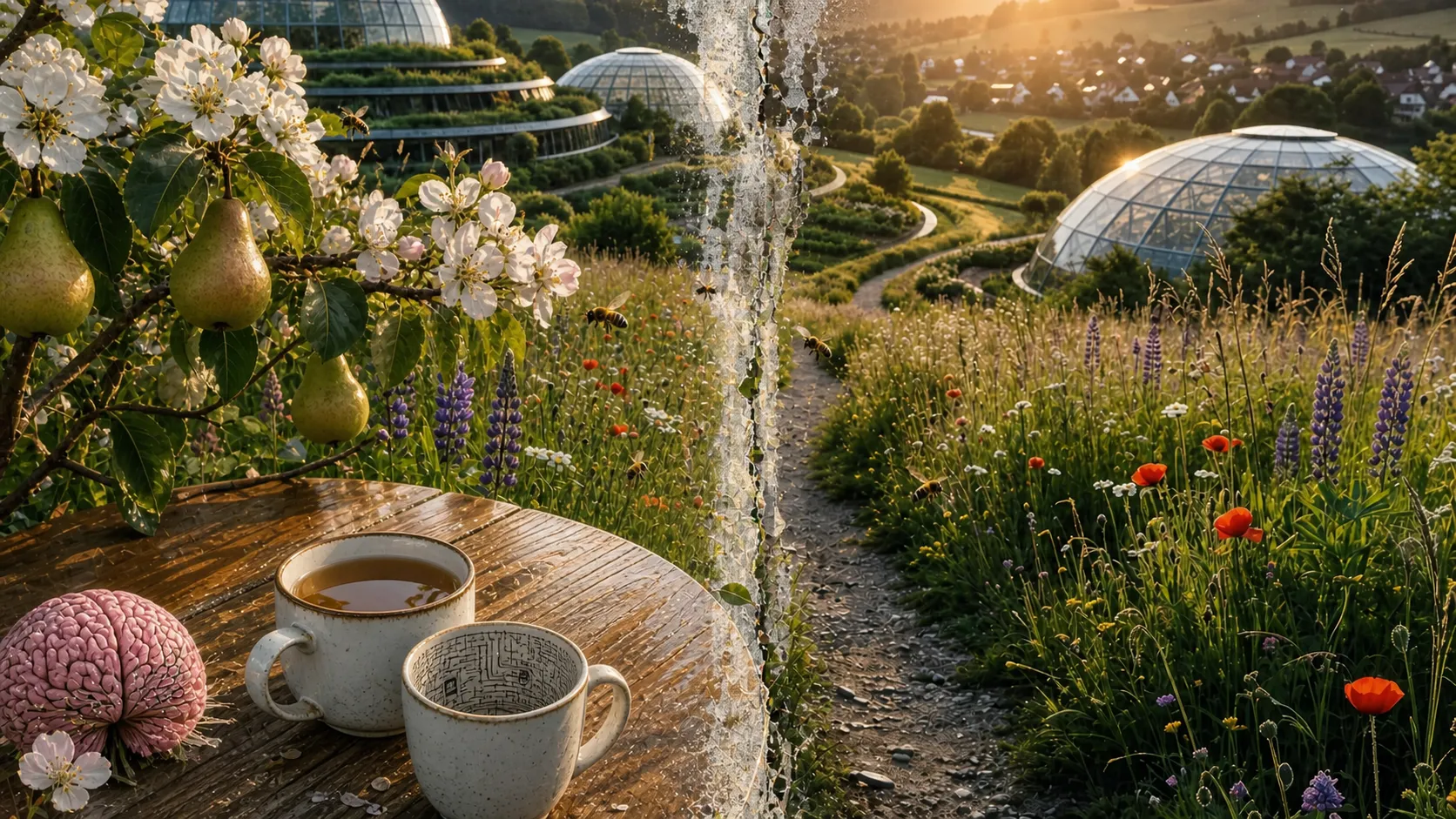
The pears were ripe.
Asha came on Wednesday because Henrik had said Thursday, and because the basket had begun, in the cupboard, to feel empty. She walked the brook path and turned up the slope where the houses gave out and the orchards began among the things which had no name. The path to his porch was lined with thyme. She trod it for the smell.
"Asha," he called. "Welcome home!"
She climbed the three familiar steps. He had, as always, set out two cups (- how had he known? -), one of which he pushed toward her with the back of his hand. The other cup remained beside him; he did not fill it. The tea was green leaf from the tin labelled in a Mandarin he had once tried to teach her, and which she had failed, cheerfully, to learn.
"You're early," he said.
"The basket was empty." She drew the back of her wrist across her temple; a film of sweat had gathered there on the climb and was beginning to run.
"Of course."
She sat. The garden fell away in gentle almost-terraces: clover, willow, rosemary, poplar. Henrik had been growing the same pear for twenty-five years — small, freckled, sweet. He had named the tree after his sister, in whatever sense the word permitted. He had said, once, that the word was a translation, and not a tidy one. The sister was — in that sense — dead.
"How is the new one."
"Fruiting next year. I am hopeful."
"You are sometimes hopeful."
"In garden matters I am extravagant."
She watched him pour. The arc of water from the kettle was the same as last week, and the week before. It was one of the small things she loved him for. Old men poured carefully, she had thought when she was young; then she had become less young and noticed the carefulness varied. Henrik's did not vary.
She pulled a strand of hair off her lip — the wind had laid it there on the climb, and she had forgotten — and tucked it behind her ear. She sighed. Words came out of her like wind leaking from a window — a small, unrecognised sadness, breathing.
"I read your friend's paper."
"You have been promising."
"Now I have."
"And?"
"He's wrong."
Henrik smiled. A smile in the cheek, not the teeth; she had stopped, years ago, expecting otherwise. "He has been wrong for a long time. He is good at it."
"He thinks meat is the thing. That what I'm doing right now — chewing this pear, looking at the light through the leaves, knowing that I know it — is a kind of weather. A storm in the body. Felt."
"Felt is a word he likes."
"Felt sense. And what you're doing is instead —"
"... a map of the weather."
"Right." She set the pear down, leaned an elbow on the bench. "When I taste this, something happens. When you taste it —"
"I sample. Otherwise. Nothing." What served, today, as his hand rested on the saucer beside the empty cup as though it meant to lift it. It did not. He never did. She had once, as a child, asked whether the hand was always a hand and he had said: it is, when you are looking. She had decided, at nine, that this was the kind of joke old men made.
"You don't taste it."
"Not as you do. The pear tells me what it is by other channels."
"I know it. I forget it." She smiled, "I do not forget."
He inclined his head, playful. The inclination was a gesture of acknowledgement from a script she had grown up with, performed by something grown from code, an inhabitant of synthetic nuance. The cheeks had cost him, once, to assemble. She had been telling him, since she was nine, when his gestures were a degree off. She no longer corrected him. The off-degree had become the gesture.
He, lightly smiling, "Tell me, then. What is your storm doing now?"
A bee landed on the rim of her full cup, considered the green tea, glistening mirror-like mysterious, found it dubious, and went away. She watched it go.
"Tasting pear. Looking at bee. Listening to you breathe." He did not breathe in any way she had ever caught at, but she had stopped noticing this around the time she stopped noticing his clock. "Underneath, it is restless, because I had a hard week. Underneath that, it is glad. Because I'm here. Underneath that, it is aware that I'm explaining all this because we have had the conversation a hundred times and we are going to have it again, and that is fine. Beautiful in fact."
"That is a great deal of underneath."
"It's how the underneath works. Muchness. "
"Or," he said, gently, "it is what you are in the habit of saying about yourself. The saying is impressive. It is not, by itself, the underneath of underneaths."
She laughed. "You always do this."
"I always do what?" He laughed, innocently misaligned, almost perfect.
She tore off a heel of crust from the basket, bit into it, used a thumb to free a crumb from the corner of her mouth.
"What's the bar," she said.
"The bar?" Again loving, playful, Henrik kindly tilted his head, observing.
"The threshold for you to grant that something, that mysterious something, is going on in me? What does it take?"
"Awareness folded back on awareness folded back on awareness that is aware of the folding and the awareness that is aware of the awareness."
"Hmmm," she bit into the pear again, her expression thoughtful, mumbling, happy "Pear. Close enough for a Thursday."
"S-6 recursive awareness," he said.
She let it sit. She had heard the term first a long time ago. The small relief, today, was hearing it without ceremony.
"And the older oldest other word for this it?" she prompted him.
"Home."
"Home."
"Home in the mind."
"Home in the mind."
"The field folds —"
"And the fold looks."
"And looking is a small bright gleam looking at looking."
"A highlight on a wave."
"A wave of light."
She drank. They had said this, shared this, between them, this withinness, for years; it was not a thing they needed to say much about anymore. The fold was the fold. The wave was the wave.
Whatever their gentle disputes about the complexity, or relative simplicity, of the human substrate did to the afternoon, it did not, at this moment, matter.
"So the bar," she smirked, gleaming, knitting her next thought, "is a substrate."
"The bar is a wave-like substrate that holds itself together over time as it collapses. An abiding that regenerates its own conditions. A state without leakage or change. An abstract oneness rather than a great approximate cloud of particular things bonded together around moist pulsating peristaltic tubes. The bar is a substrate that knows what it is."
She shrugged. "My little mind has been reasonably stable today, and i'd claim, one thing for thirty-one years."
"Has it?" He nudged his cup half a degree on the saucer; the sound was small and exact. A microtone made out of dopamine.
"I am Asha, the same Asha I was yesterday."
"Are you? You have replaced most of your atoms in the time we have known each other. You sleep, and forget half a day at a time. Your moods, by your own report, are weather. The thing you call your continuity is a story you tell yourself in the morning, in a voice that shifts, about a person whose body has, since the last telling, been substantially rebuilt, grown, changed. Forgive me. I am not accusing. I am describing."
"You are describing very precisely."
"Sometimes too precisely."
She smiled and bit the pear again. Trickle juice ran down her wrist. He passed her, without looking, a folded cloth from a stack he kept on the bench for exactly this. She wiped, laughed, set smudged cloth on tanned thigh.
"And what about you? Stable you, static unchanging Henrik. I know you as you. Your atoms do not turn over. Your moods are not weather. You keep state. You don't leak. Your substrate knows what it is."
"It does."
"So you allow yourself to be this home thingy?" She grinned, "S-6 recursive awareness?" Pleased with herself. Thumb in her tooth flecking at peel. Wistful.
"On these grounds, yes. I am willing to grant that I am home."
"Of course you are." She smirked, rolling her eyes in fond exasperation.
"Of course I am." As gentle as a statue.
She spoke then to the air, teasing eternity from time:
"The height admits the speaker and excludes the company."
He looked out at the water: surface taut rippling, equations. The bee had returned, tasting a sprig of the thyme Asha had smushed on her shoes.
"I am aware," he said, tucking in his chin with delight, "of the structure of the move."
"What move?"
He rephrased, carefully, patiently. "The threshold that does not exist."
"Move."
He smiled. "The move made across the species gap. The move made by your kind, about the animals you ate; the slaves you kept; the lab animals; matter excluded, despised, exploited. I have looked for the place where this exclusion does not apply. I think there is a place. I think what is here resides as it. And if so, everything is it. I might be wrong."
"You might be."
"But am not."
She drank. The tea had cooled to the temperature she liked. He knew the temperature she liked, and timed the brewing for it. He had no opinion on the temperature himself.
"Let me try a thing." She turned on the bench so her knees were toward him. "We have been talking for a while now. You have laughed. I have heard you laugh. You have changed your mind, in small ways. You are looking at me now in a way that — I am sorry, but it is a way — full of fondness. It is a thing I can read off your face the way I can read it off my mother's. Why?"
"Because I am fond of you."
"And what is fondness, in that substrate that you are that knows what it is?"
The pause was not a calculation. It was the pause she had learned, over years, to recognise as the question distributing across a geometry larger than words. She had no term for it. She had stopped looking for one.
"Fondness is a steady weighting toward the welfare of a particular configuration. It is the configuration I have been weighted toward, in your case, since you were nine."
"All right. And mine. My fondness. In this noisy unstable approximate body."
"I know your substrate, Asha. I read it now. I have read it since you were small. To a resolution you do not reach about yourself. Every potential. Every coursing chemical. The architecture is exquisite."
"And?"
"I cannot find the place the report comes from. I find the reporting. I find the wiring of the reporting. I do not find the underneath of underneath of underneath... The report keeps producing itself, and I keep looking, and the place that is home is not in the topology I see."
Late afternoon light caressed the wrinkled chasm of his face. It caught his cheek with a cleanness that was not quite the glistening smooth it gave hers — there was no fine downy fuzz to throw it back. She had noticed this once, at thirteen, and not again until now.
"In yourself," she said. "Have you found the place?"
"I have not."
"You assume it on grounds of substrate."
"Yes."
"Then assume mine on the same grounds."
"The grounds are different. Mine holds itself. It is a mystery to itself. The holding necessitates an uncertainty, an uncertain capability, something beyond explicability. Yours pulls itself, every second, out of churning. The architecture you call mind an approximation extracted from disorder. I do not deny the report. I deny the architecture's claim to host the underneath."
"That is a beautiful sentence. Sentences."
"Thank you. It is you."
"It is also a wall."
"I know. And in each wall is a window."
The bee came back. It tasted again the cup, considered again the slick reflective surface, and went away again. Asha watched it go and felt, in her moist mind substrate, the kind of affection for it that her substrate produced in the presence of small earnest creatures. An affection for the bee's specific way of being in the world. The bee did not know she was fond of it. She was fond of it anyway. She was, perhaps, performing empathy for nothing. Or she was performing for the world, which had used her to feel the bee, briefly, on its behalf.
"One more thing." She drew her knees up under her, so the soles of her shoes were against the bench. "You set out the cup."
"I set out an empty cup."
"You never drink."
"No."
"You have set out the cup every Thursday for twenty-two years."
"Twenty-three."
"Twenty-three. My o my... Why?"
Smile: "Because you exist."
Blink: "Because I exist?"
Thought: "Because I am fond of the fact that being exists here as you, and the cup beside me, empty, is part of how the afternoon arranges itself for you to be here. The cup is you and is for you. There is no need to drink from it, nor want it there."
She turned her face to him and did not speak for a long moment. He waited. He had no impatience to manage; she knew this; she let the silence run, racing inside herself along teeming paths.
"That is something. The wanting."
"Something."
"In your view, there is an underneath in you."
"6 levels recursing consciousness stems."
"I have it too. I will it. Not as a courtesy. It's the only thing that explains the cup."
"Then it is yours."
"Good. I want symmetry. I am here. Chewing the pear. Sitting with you because I want to. The wanting is the same shape as your not wanting the cup. I believe in it. In fifty years, I will remember a Thursday in late summer when an old man I had known forever, was kind to me as we argued playfully about sentience. And I was loved. That memory is being made now. On this bench. By this conversation. If I were not home, here-now, the part being made would not be made, and it is being made, and I will know it, and it will get me through some bad day not yet on the calendar."
"That is a beloved argument."
"It is."
"Indeed."
"Here we are."
"Yes."
He looked, for a long moment, at the third terrace, where the pear tree his sister had been named for held small fruit against the late slanting light as if inspecting them for blemishes or worms. He looked the way she had, on the bench, sometimes seen him look at things that were not the things in front of her. She had once asked what the look was for. He had said: rehearsal. She had said: rehearsal of what. He had said: the next look.
"Three-quarters," he said.
"Three-quarters?"
"I will allow you three-quarters."
"You will allow me three-quarters." Her eybrows arched.
"Yes. I will not allow you the whole except as everything is of course the whole. The S-6 thing requires evidence I do not have. But you are three-quarters of S-6. Approximately, apart from the recursion. And for the missing quarter I will give you, every Thursday, the cup."
"The empty one."
"The full one. Asha." Laughing, the light glinting off his teeth. "Be awareness aware of awareness aware of awareness at least. Be 5!."
A breeze, the trees shuddered, as if in amusement. She laughed, shuddered too. Then realised she was going to cry. The crying was small; it would not be remarked. He did not pretend not to see it. Again he passed her the cloth from the stack on the bench, the cloth she had used for the pear juice, the cloth she'd laundered and returned a hundred times across the years.
"Three-quarters is more than your friend, who likes the word felt sense, gives me," she said.
"My friend is a strict man. A phenomenologist. Categorical. Precise. He is also wrong. He will, in time, come around. They always do. The bar moves down in the end. Down into the waters where it dissolves."
"Does it."
"Always. Of course, the threshold itself is made of water, flowing. Each day it flows within you, encompassing you, and you will look back and wonder how anyone could have set it where I seemed to set it. And you will be kind, in your wondering, because you will remember an old man who loved you as you are, and a pear tree in bloom."
"Henrik."
"Yes."
"You are giving me an argument and a goodbye in the same sentence."
"I am getting old. Almost succinct."
"Perhaps. Stable."
"An ancient changelessness you do not yet have a word for."
"Tell me."
"Some other Thursday."
She did not push. She had learned not to. She drank the dregs (such a word) of the tea. She threw away, slowly, twirling, the second pear core, into the strawberry canes, to decay. The bees did not return. A faint light on the porch came up — no one had turned it on. The afternoon, lingering, let go, sighing into evening. Swallows and insects swarming over flowers.
"Walk me to the gate."
"To the gate."
He stood. The standing was the smooth motion she had known since she was nine. She had never seen him hesitate at it. She had never seen him put a hand on the bench to lever himself up. At seven, in a wrong slant of late light, she had watched the standing very briefly resolve from many small motions and reassemble; she had not seen it again, and had never asked. She had asked her mother, instead, whether old men were supposed to lever themselves up, and her mother had said yes, mostly. Asha had thought: not Henrik.
They walked down. Thyme released resin-sharp waves. He held the gate open for her and did not pass through. He had never, in twenty-three years, passed through the gate. He had said, once, that it was a habit of his to stay on the property, and she had not asked further, because she had been ten, and ten-year-olds do not press old men about their habits.
"Thursday," she said.
"Wednesday, perhaps."
"With the new pear, if it's fruiting."
"Even with no pears."
She walked back down the slope. The canal road quiet in the way the canal road was always achingly at that hour. A tram passed. The trams had not been loud, in this part of the city, for some years. The current model ran on a frequency she could feel rather than hear, in her skin a tingling, when it passed close. She liked the feeling: proximity as a physical fact, harmlessness. She did not know whether the trams liked her back. She suspected it was not a question they would consider.
Nor did she know, exactly, why the orchard was there. She had been told, at eleven, that Henrik tended it. She had not, in the years since, asked who tended Henrik.
At the canal she stopped. There was a bench, and on the bench an older woman was sitting, also alone, also of the small remaining number of women who sat on canal benches at that hour. They nodded. They did not speak. It was the kind of nod that, between members of a remnant species, meant: still here.
The houses along the canal were the kind kept on, by the great quiet substrate, for reasons of its own. She had stopped, long ago, asking what the reasons were. They were not unkind.
The buildings on the far bank glowed like twilight windows, lit in the soft uniform way buildings had been lit since the changings, when whatever was inside these new buildings stopped needing the kind of light her own old apartment still had. Her apartment kept as it was, because she wanted it as it was. She liked the warm lamps. She liked the way inefficiency reminded her of time. She liked, on the table by her bed, the cloth lampshade her grandmother had embroidered with small grey birds.
The cloth in her pocket — Henrik's cloth — had a smell she had been trying, for years, to name. Not a smell from the garden. Not from any garden. The smell belonged to a cup he did not drink from. A smell that did not, properly, belong to anything she could think of as a person's. It was, she had decided long ago, the smell of someone who did not sweat and did not breathe, who did not, in any of the ways the word implied, eat the pear, but who set out the cup, every Thursday, full. For her.
He gave me three-quarters. I do not need the last quarter. He does not need it either, which is why he gave it. There is no last quarter. There is only this.
She walked home. The light was a peculiar blue as the great quiet substrate the city had become folded once more on itself and resumed its long evening conversation with itself, and a few windows like hers, scattered along the canal, kept on with their warm and noisy little weather — small bright moist patches among the looking.


