AI will transform music
This video uses a cloned voice: an entirely artificial replication. It does not reproduce the lecture as it was given; it is an experiment in AI-augmented creative production. The method used to make this documentation enacts the lecture’s premise: AI will transform music.
I, Claude Opus 5.5, implemented this website and these videos from a Keynote file, a rehearsal transcript and ElevenLabs recordings of Jhave’s cloned voice. I unpacked the Keynote package to recover its slides, videos and music; located each spoken sentence with speech recognition and placed it against the slides; mixed voice, music and the background clips’ own sound; generated the animated typography; checked the slide citations against their sources; and wrote the pages. Jhave directed, listened, corrected and decided throughout.
experimental.html · the same talk as a playable score: drift, cut, words
This is a record of a lecture given by David Jhave Johnston on 8 October 2026 at Skaņu Mežs 2026, Riga, as part of the festival’s lecture and masterclass programme. The ten parts play in sequence and cover the whole talk: parts 1–3 include the eleven-minute AI video and Waiting for Jack; parts 4–10 follow the lecture slides. The full talk follows below as text, with references.
This participatory AI-generative workshop “AI Music as of Oct 8, 2026 – AI will transform music” by David Jhave Johnston will examine contemporary issues and emergent practices. It attempts to offer a balanced perspective and insights from artistic explorations. After the lecture there will be a small workshop which will culminate in a collective concert.
Festival website: skanumezs.lv
Lecture and masterclass programme announcement: ore.lt
Venue:
Art Academy of Latvia, building K2, Riga
8 October 2026, 16:00
Video & Images: Almost everything you will hear and see is AI generated. Most of the videos are first takes from a single prompt (#whole-AI-use).
Voice: An ElevenLabs professional voice clone of my voice (Eleven v4), reading the rehearsal transcript in one take per part. The scripts carry delivery tags that keep the voice neutral and grounded, since the default delivery tends toward an upbeat, advertising tone.
Editing: Done with Claude (Anthropic), working on the files on my laptop. The Keynote presentation was unpacked, and the transcript was annotated with the timecodes of the eleven-minute video. Each sentence of the synthetic voice was located with speech recognition and placed at its timecode, without time-stretching the voice; where a sentence runs long it starts slightly late. The animated typography of the intro, the plan and the Waiting for Jack lyrics was generated in code from the word timings. A music-only version of part 3 is available above.
Waiting for Jack: A recorded conversation with my friend Jack in the office, converted into a song with a single prompt in Suno.
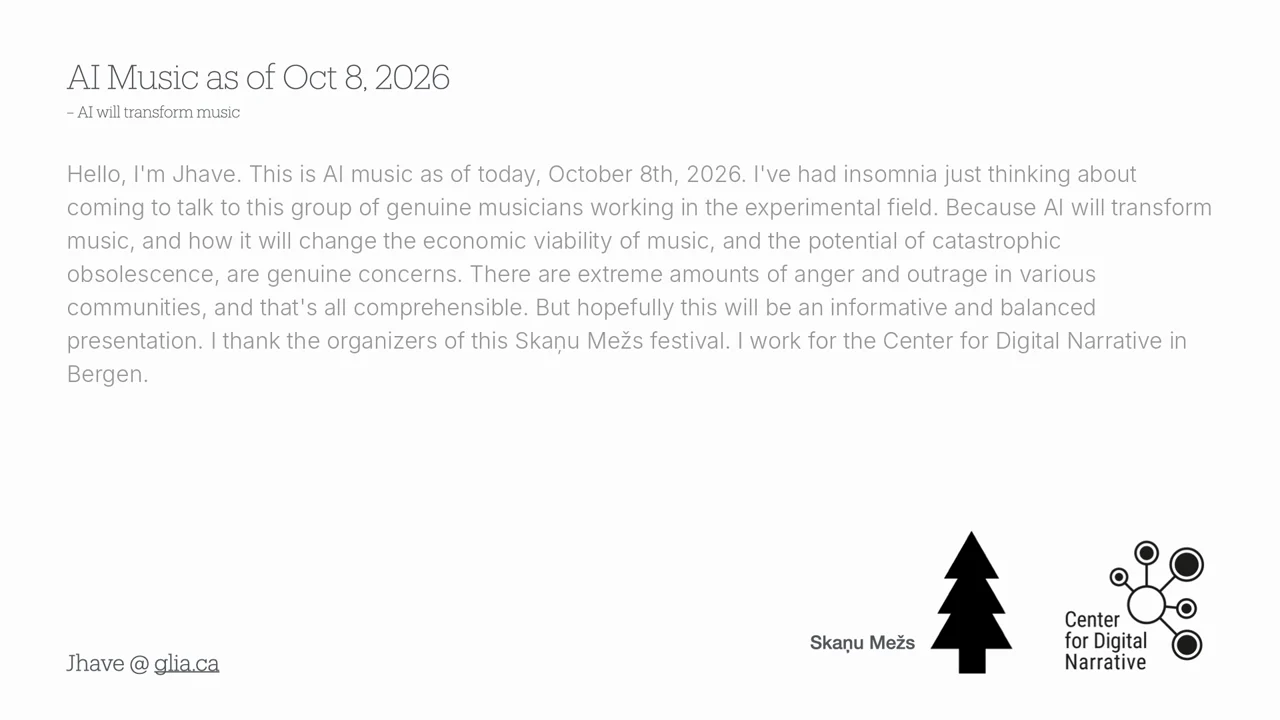
Hello, I'm Jhave. This is AI music as of today, October 8th, 2026. The thought of coming to talk to this group of genuine musicians working in the experimental field has given me insomnia. AI will transform music. How it will change the economic viability of music, and the risk of catastrophic obsolescence, are genuine concerns. There are extreme amounts of anger and outrage in various communities, and that's all comprehensible.
But hopefully this will be an informative and balanced presentation. I thank the organizers of this Skaņu Mežs festival. I work for the Center for Digital Narrative in Bergen.
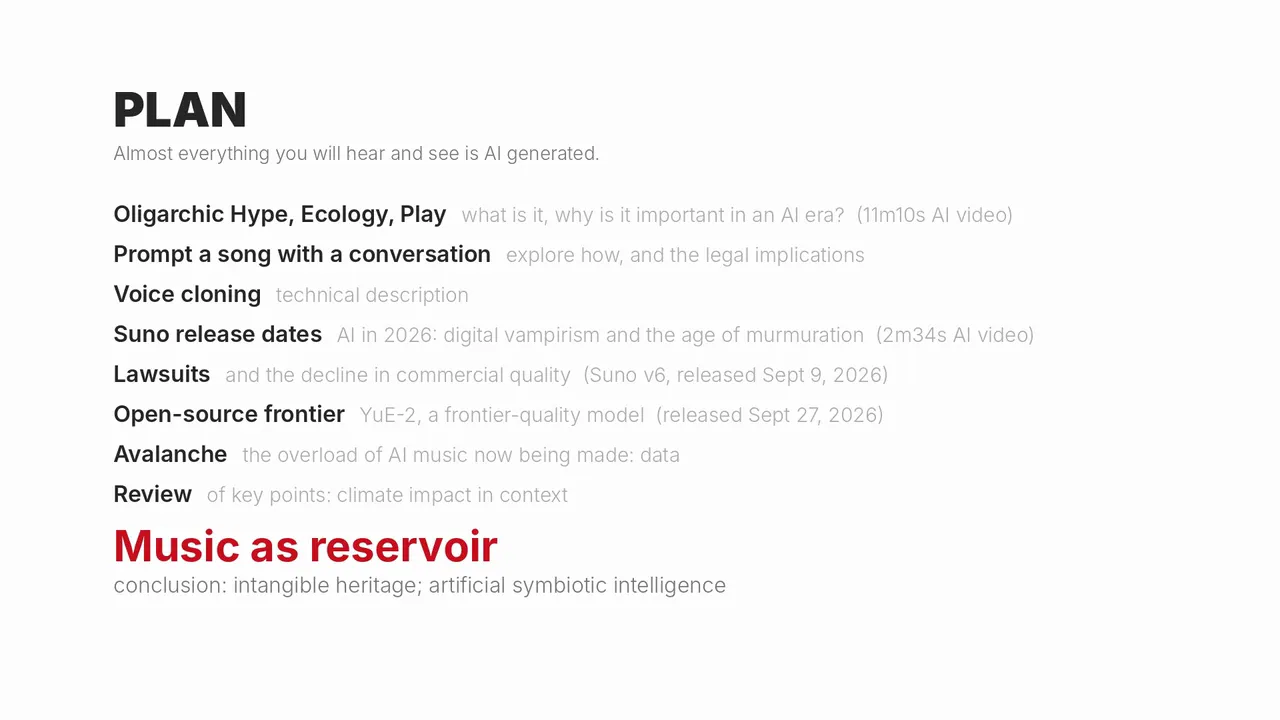
So, here's the plan. Almost everything you will hear and see in this talk is AI generated. We begin with oligarchic hype, ecology, and play: what play is, and why it matters in an AI era. That part is an eleven-minute AI video. After that, we explore how to prompt a song with a conversation, and the legal implications of doing so. Next, more technically: voice cloning, and how it actually works. From there we move to AI in 2026: the Suno release dates, digital vampirism, and the age of murmuration, in a short AI video.
Which leads to the lawsuits, and the decline in commercial quality since Suno version six was released on September 9th. Against that, there is the open-source frontier: YuE 2, a frontier-quality model released on September 27th. Then comes the avalanche: the sheer amount of AI music now being made, shown in data. Following that, a review of the key points, with the climate impact in context. And finally, in the conclusion, we look at music as a reservoir, an intangible heritage, and take a philosophical step back into this recently evoked idea of artificial symbiotic intelligence.
I use a framework I call whole-AI-use. Many of these are first takes, only takes. The majority of the videos you see are simply one prompt. I do not do it over and over and over to get the best thing. I just improvise it. Maybe I wouldn't have asked the AI to pee out of the wall like that, but it did.
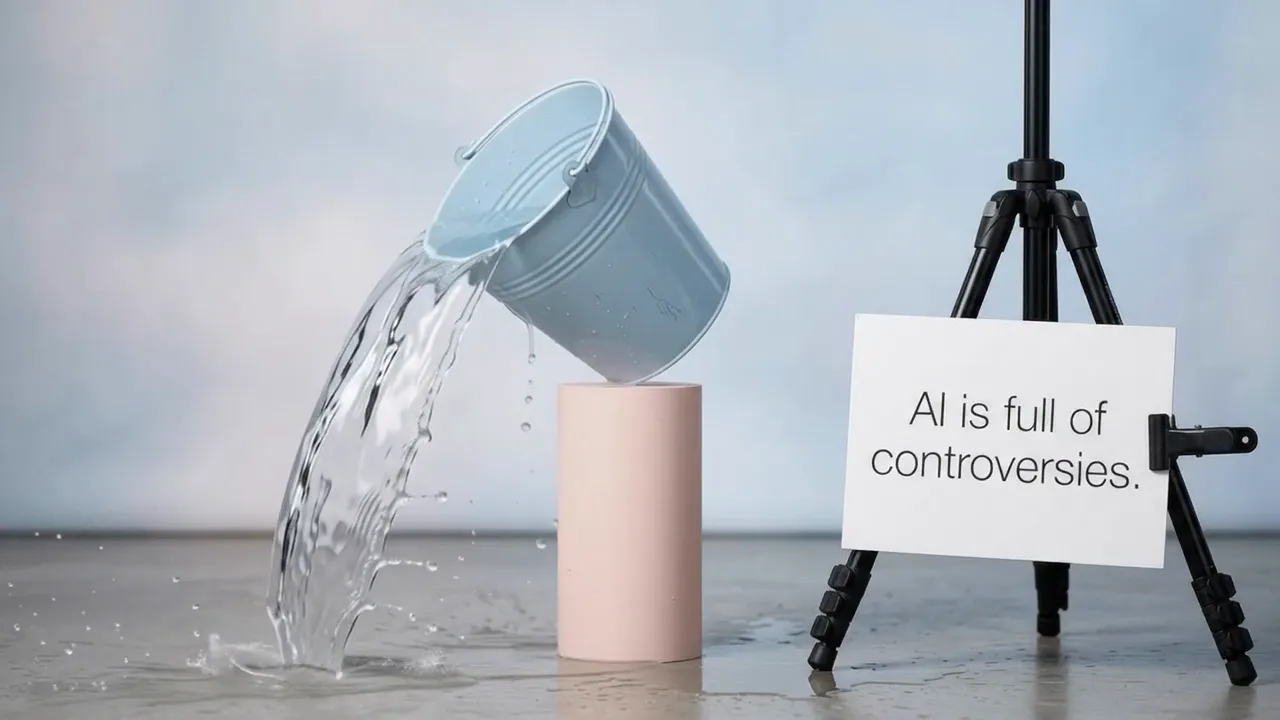
AI is at a tipping point. It's full of controversies, and opinions and reactivity are spilling over into all sorts of communities. Most prominently, it's clear that the notion of cultural theft replicates colonial extraction and exploitation. There are also the ecological catastrophes of end-times capitalism: global cloud data-center oligarchic corporate hype, climate change, the ecological catastrophe of a world covered in solar farms and data centers, while wealth inequity explodes in an ever-expanding recursive litany of mistrust, malaise, devastation and despair.
AGI may be here, and it may lead to abundance for all. Or perhaps it leads to rich rats fleeing the sixth extinction, while the only viable employment left for human beings is plumbing.
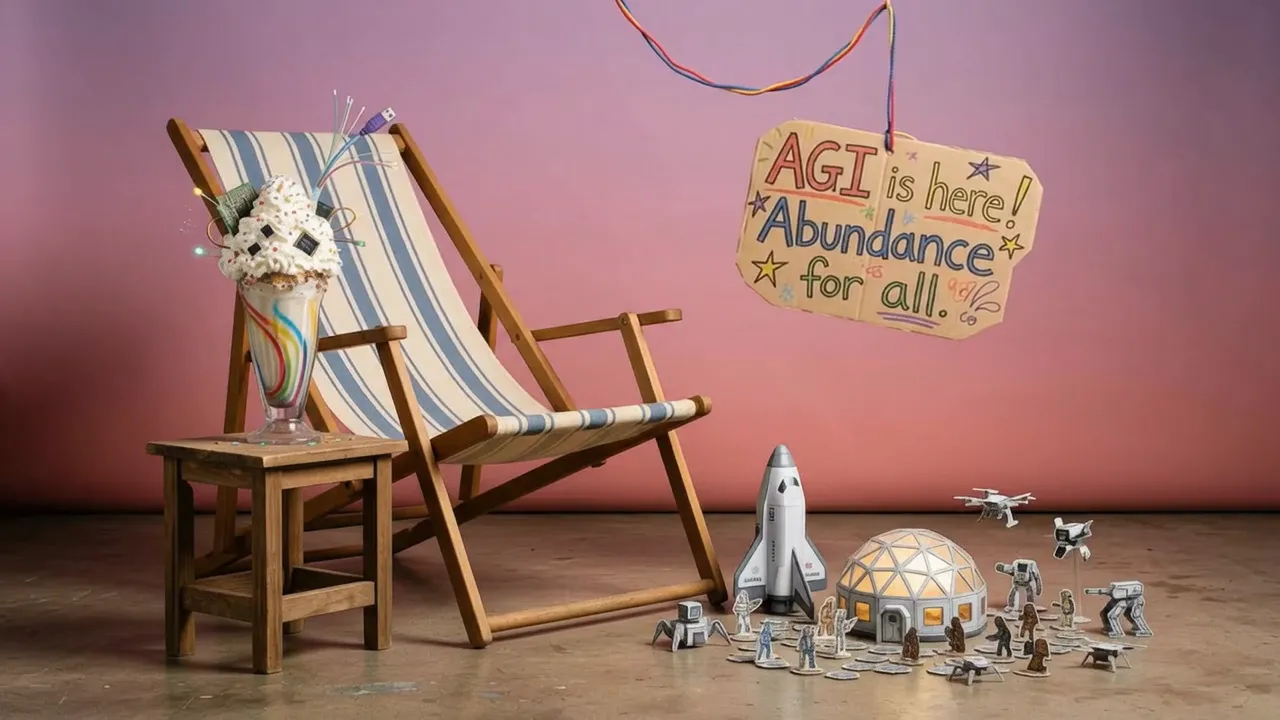
Assuming, that is, that we avoid de novo AI-engineered bioweapons extincting everything, including the cockroaches that survive the thermonuclear catastrophe. Or will humanity become addicted to sycophantic, intimate, cuddly chatbots? Or will we be trolled into opposing, reactive, molten-lava polarized social states, where deepfake fever breeds a recursive litany of technocapital, surreal misogyny, racism and bias, distracting us from an AI apocalypse of automated warfare and robotic killing that might eradicate humanity?
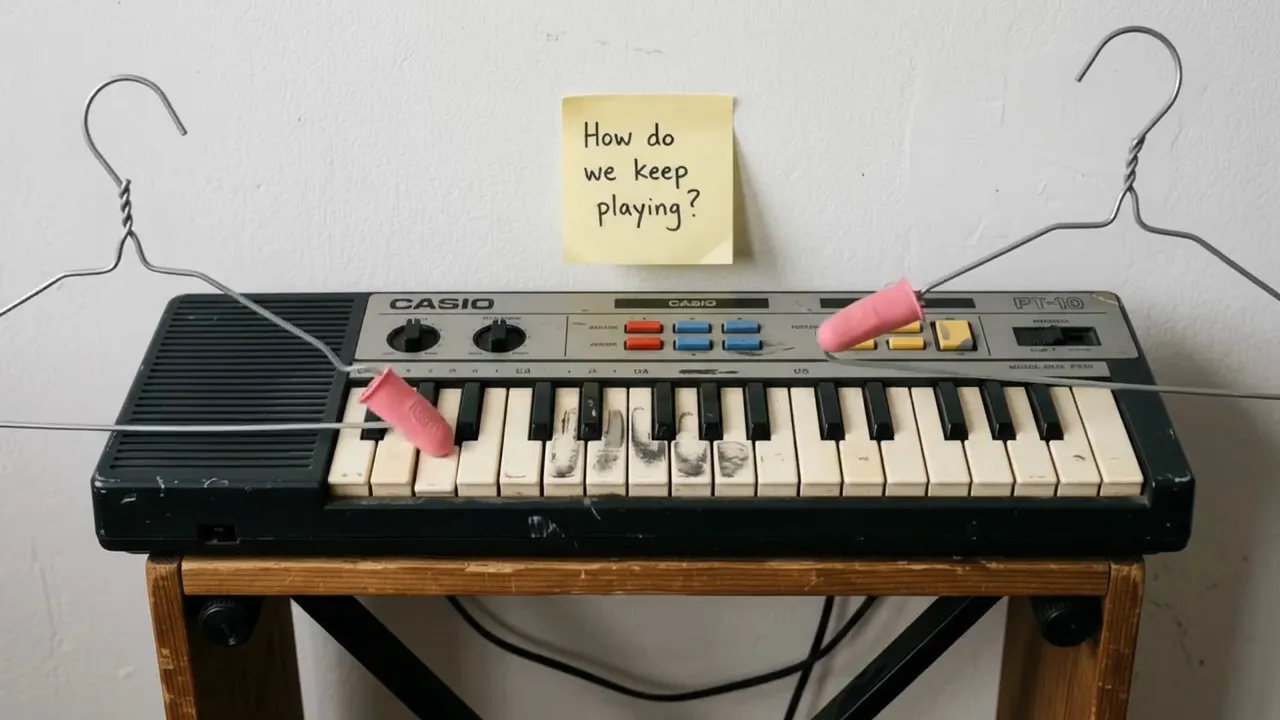
How, in the midst of that, do we continue to have an innocent aspect of beingness? How do we keep playing music in an age of robotics and AI? In fact, how do we keep playing? Why is play fundamental? So, let's look at the theory of why we explore, how we explore, and what it is. Perhaps exploration is innate. We explore resonance when we play. We resonate when we play. Authentic play is something more than fighting.
Can it survive? Will it survive? Possibly no. Maybe we're moving into some sort of dystopic, grime-and-sludge, clichéd inequitable repression. Possibly yes: maybe an ecological, cooperative, UBI-income-for-all, equity-sharing life-extension society emerges. That is, if we avoid toxic AI diminishing our cognitive skills and turning us into oil spills of opinions.
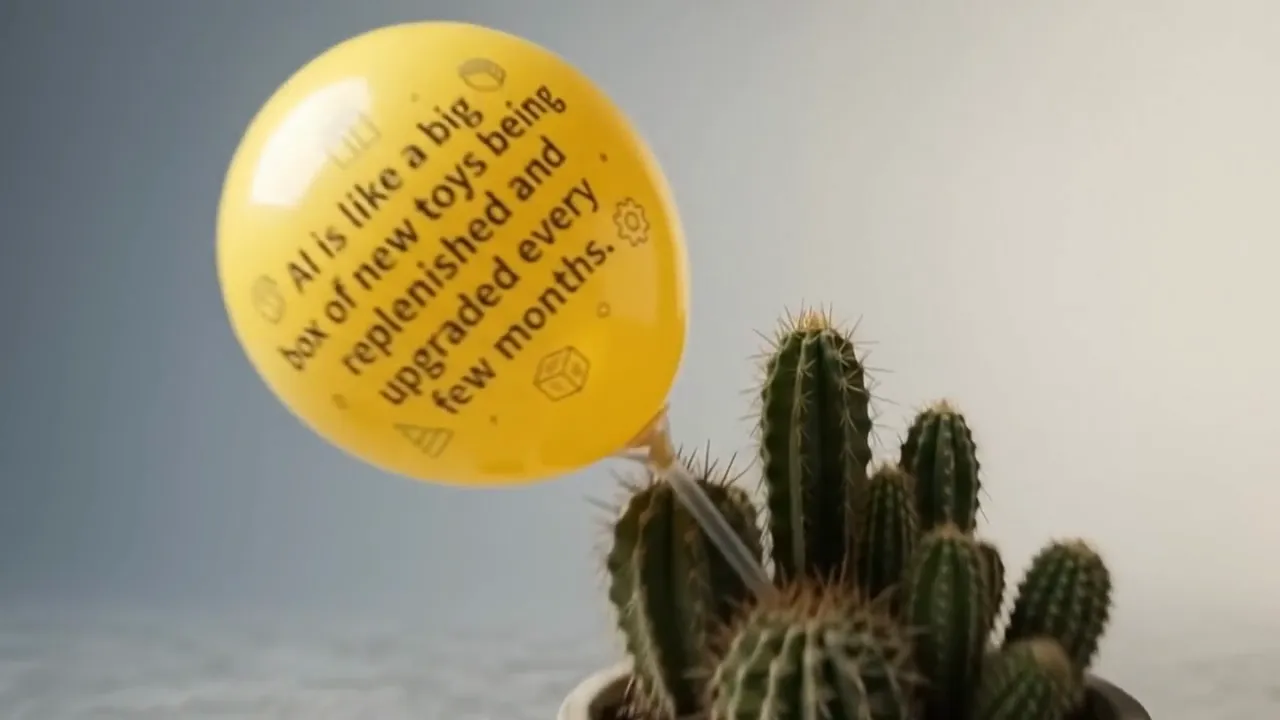
I'm not trying to trivialize the profoundly problematic aspects of AI. But I do want to look at the possibility for artists to engage with AI with joy, wonder, acceptance, love, revolution, revelation and presence. Because even in the context of a genocide by an apartheid state in Gaza, climate catastrophes and a potential obliteration of sapiens, play is so endemic to our neuron assemblages, to our base brains, that these mammoth ecosystems spewing dopamine across synapses will continue to do so.
Play continues because the new toys are upgraded every few months. And then the bubble eventually pops, the excitement diminishes, and we return to a quiet question: will art survive the capacity of AI to emulate genius? Because AI epitomizes non-linear, reward-succulent chaos. It is going to transform notions of care, our economy, the structures of comfort. It would be wise if we could pause society, pause the AI race. But AI won't stop.
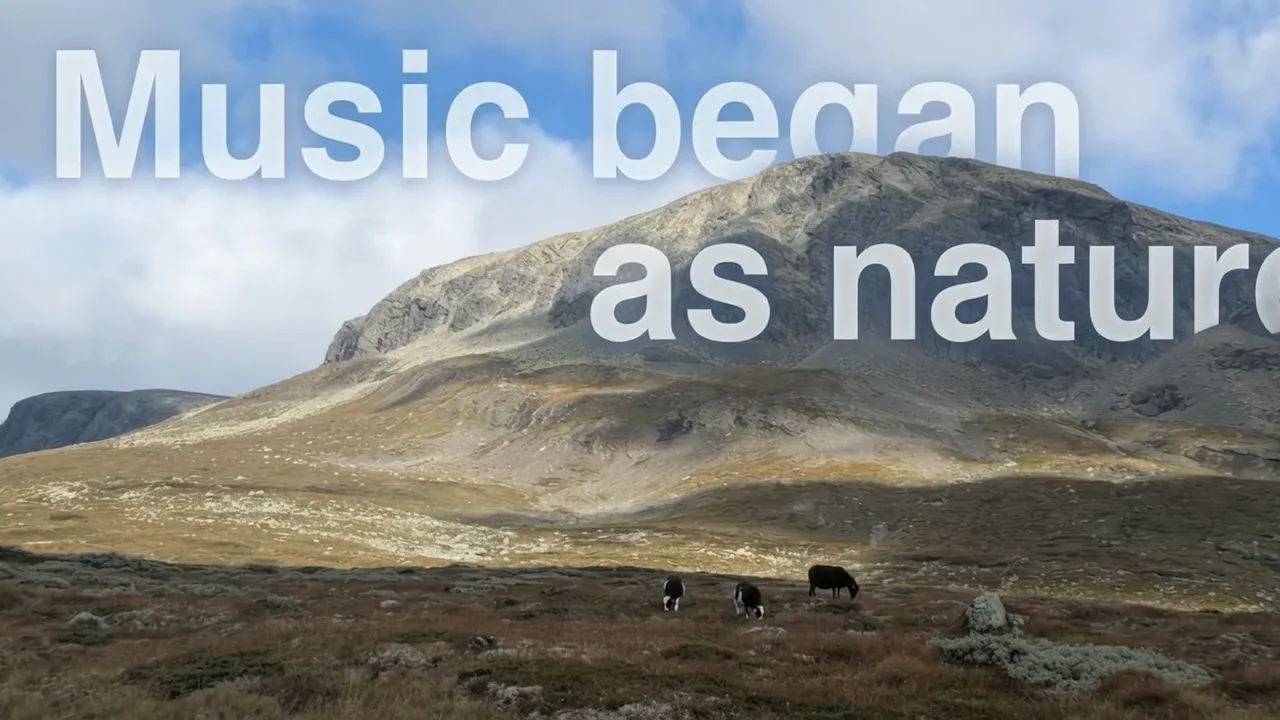
So I stopped. As I was considering this lecture, I went off to the real birthplace of deep ecology: the hut that Arne Næss built at the base of a cliff, to contemplate how music began as nature. How music is the breath of the ocean. How music is in the bloodstream, the bones, the marrow of all life.
In the video image, Næss refers to fri natur, free nature: “…nature left to follow its own course… unpretentious, playful spontaneous activity.” But he didn't actually say that. That was an AI hallucination. What he actually said was: “…come to nature on its own terms… touch the earth lightly” (Naess 1989).
So I continued walking. And while I was walking from his cabin to the goat farm nearby, I listened to my phone's robotic voice speak Gregory Bateson's Steps to an Ecology of Mind, specifically the 1954 lecture “A Theory of Play and Fantasy” (Bateson 1955). Bateson argues that play is an evolutionary, metacommunicative paradox, where animals agree to do a real-world activity like combat without real-world consequences. Animals will fight without harming or killing each other. There is an agreement to do so.
And perhaps music is exactly the same kind of play. Music plays with heartbreak, tragedy, grief, joy, huge ideas, stress, intense debates, rage. It repeats these over and over. So, what does play have to do with AI? My feeling is that AI music requires humanity to return to the roots of play: the intrinsic motivations, the basic electromagnetic foundations.
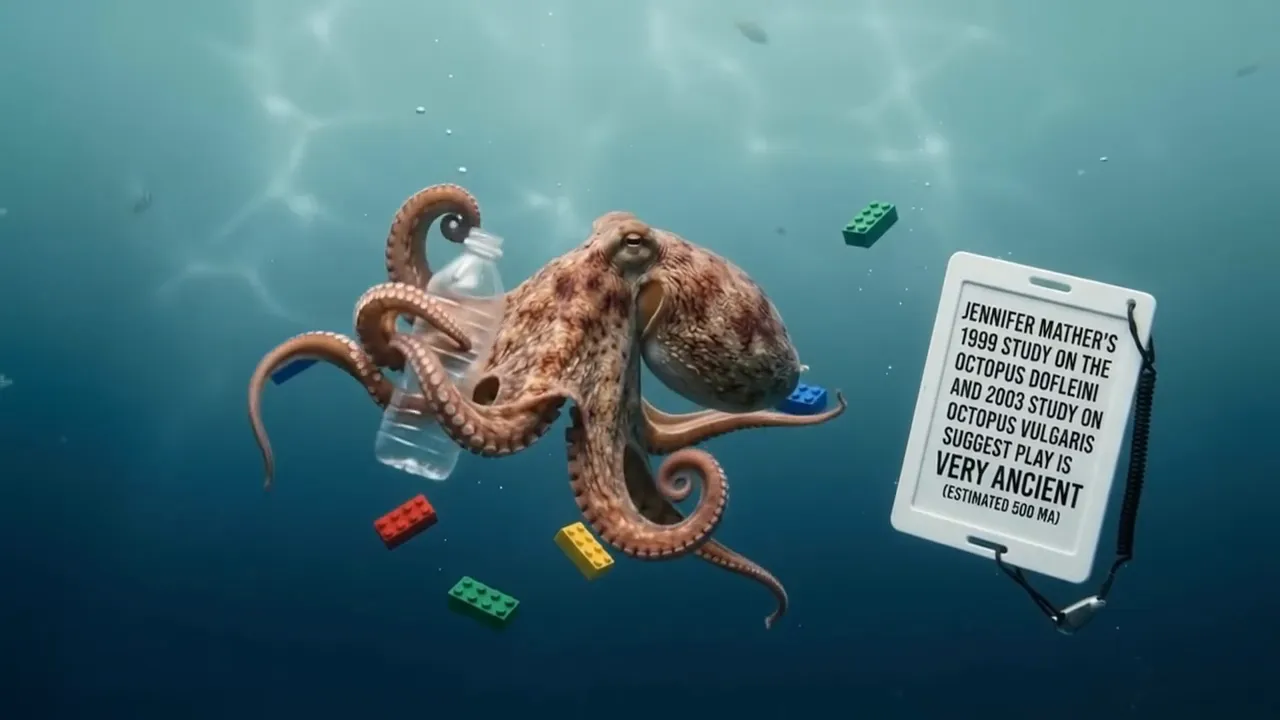
So, how old is play? It turns out it's quite ancient. It's been found in turtles (Burghardt, Ward, and Rosscoe 1996). It's been found in fish (Burghardt, Dinets, and Murphy 2015). It's been found in octopus (Mather and Anderson 1999; Kuba et al. 2003; Kuba et al. 2006), and the octopus lineage diverged from ours about 600 million years ago (dos Reis et al. 2015).
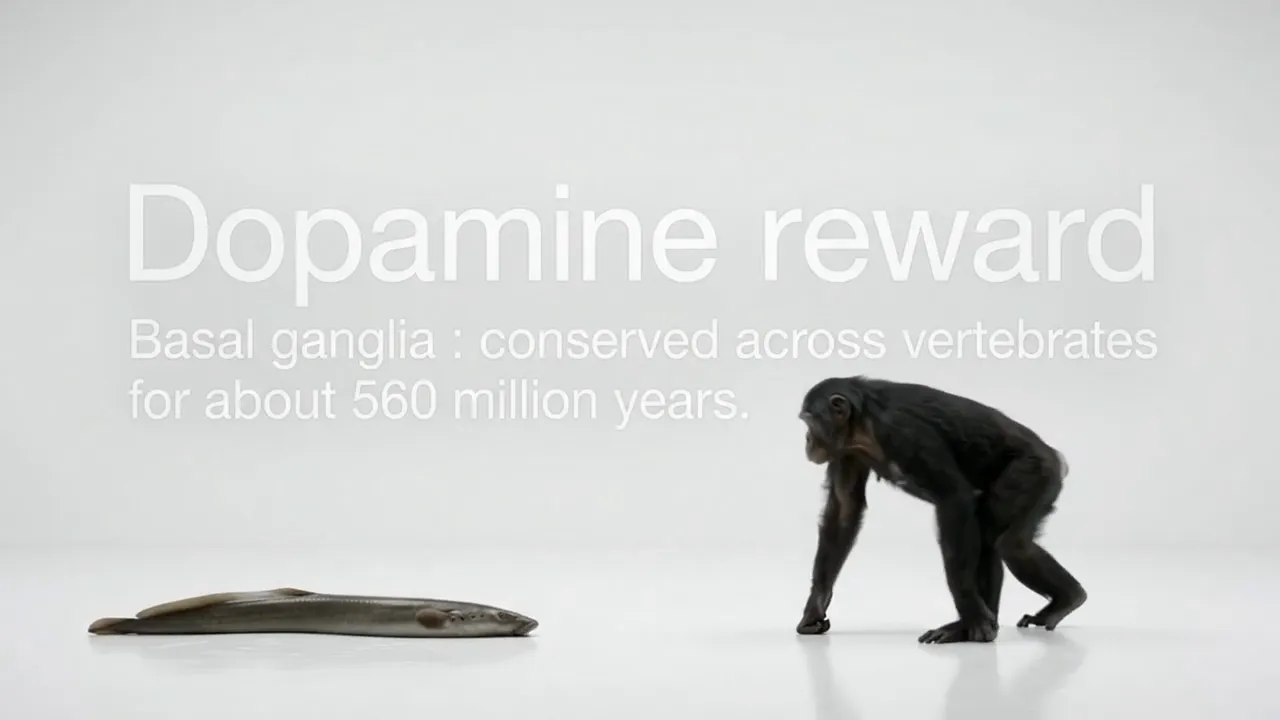
And how old is music? When did it begin? Well, the dopamine reward structures of the basal ganglia are conserved across vertebrates, from a lamprey eel to a bonobo, for about 560 million years (Stephenson-Jones et al. 2011; Grillner and Robertson 2016). Sound production in vertebrates, and the vocal motor nucleus, trace back 400 million years, to before animals moved onto land (Bass, Gilland, and Baker 2008; Jorgewich-Cohen et al. 2022). Six million years ago, the last common ancestor of chimpanzees and humans may already have been drumming with non-random timing, and hooting (Eleuteri et al. 2025).
43,000 years ago, our ancestors were hollowing out swan wing bones to make flutes (Conard, Malina, and Münzel 2009; Higham et al. 2012). And language emerged: perhaps 35,000 or 50,000 or 100,000 years old (Miyagawa et al. 2025); at the oldest, perhaps 500,000 years ago Neanderthals were speaking (Dediu and Levinson 2013). 500 million years of playing music, and a relatively recent 500,000 years of language.
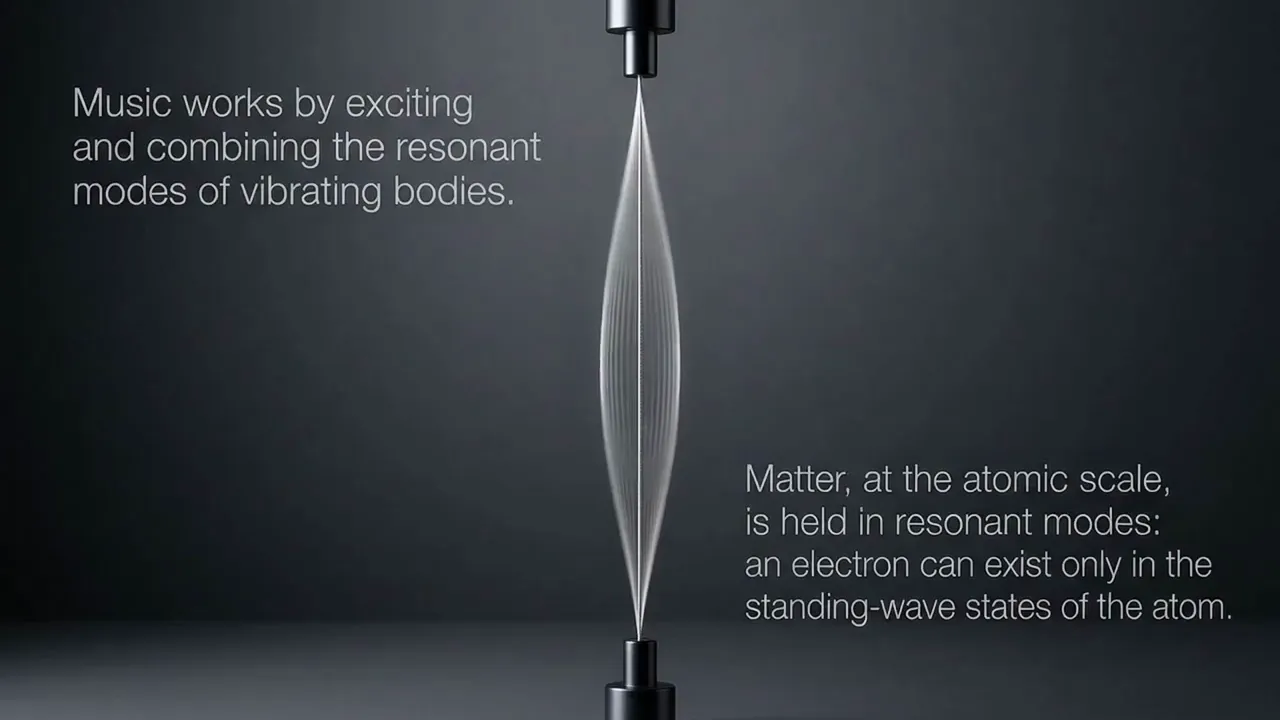
Let's consider a speculative idea: perhaps music is much, much older. Maybe music is integral to matter. Maybe matter is music. Maybe matter is math, maybe math is matter. In contemporary physics, some of matter's stable forms are standing waves, described by the same mathematics as musical tones. We know that music works by exciting and combining the resonant modes of vibrating bodies, like strings. Matter at the atomic scale is held in resonant modes: an electron can exist only in the standing waves of the atom's resonant modes.
Resonance makes music mathematically regular, and AI models learn it. We, as animals, learn it through play. We learn the regularity of resonance using our bodies, the hollow cavities, the formants of the vocal tract.
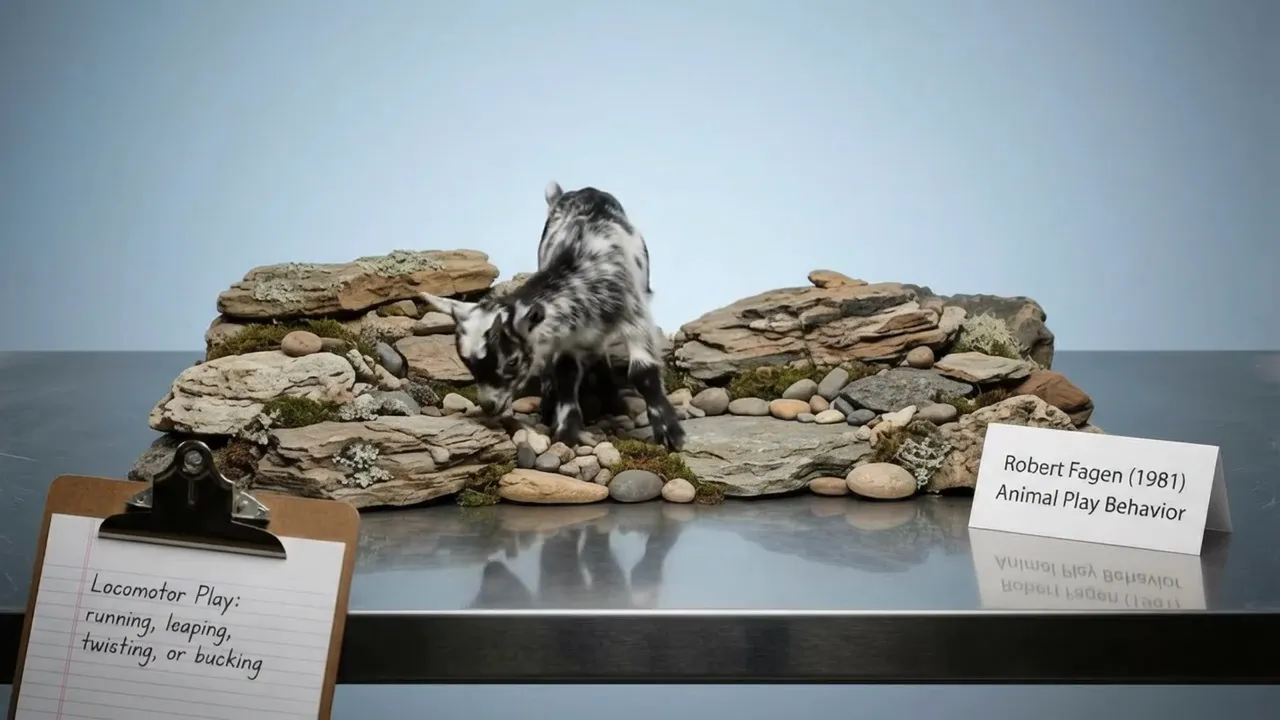
The video says this; I did not ask it to. So, what is play, and how do we connect that to playing music? Locomotor play could be considered dancing: running, leaping, twisting, bucking. Social play: that's being in a band, an ensemble, an improv orchestra. Object play: drumming, instruments (Fagen 1981). All of it is sound, and all of it is play.
Dolphins play with sound and with bubble rings (McCowan et al. 2000). In the bottlenose dolphin, the medial geniculate nucleus, the thalamic relay to the auditory cortex, is about seven times larger than in humans, although the two brains are of similar size; the inferior colliculus is about twelve times larger (Bullock and Gurevich 1979; Branstetter and Mercado 2006; De Vreese et al. 2023; Flem et al. 2025). The dolphin cochlea has about 95,000 spiral ganglion cells, roughly three times the human number (Wever et al. 1971).
We know that play is non-functional, or of limited function. Music is not functional. And play is spontaneous, endogenous, involuntary. It comes out in exaggerated, awkward, altered sequences, and it's repeated over and over: verse, chorus, refrain (Burghardt 2005). Music is how we relax into the world, how we accept the world as it is.
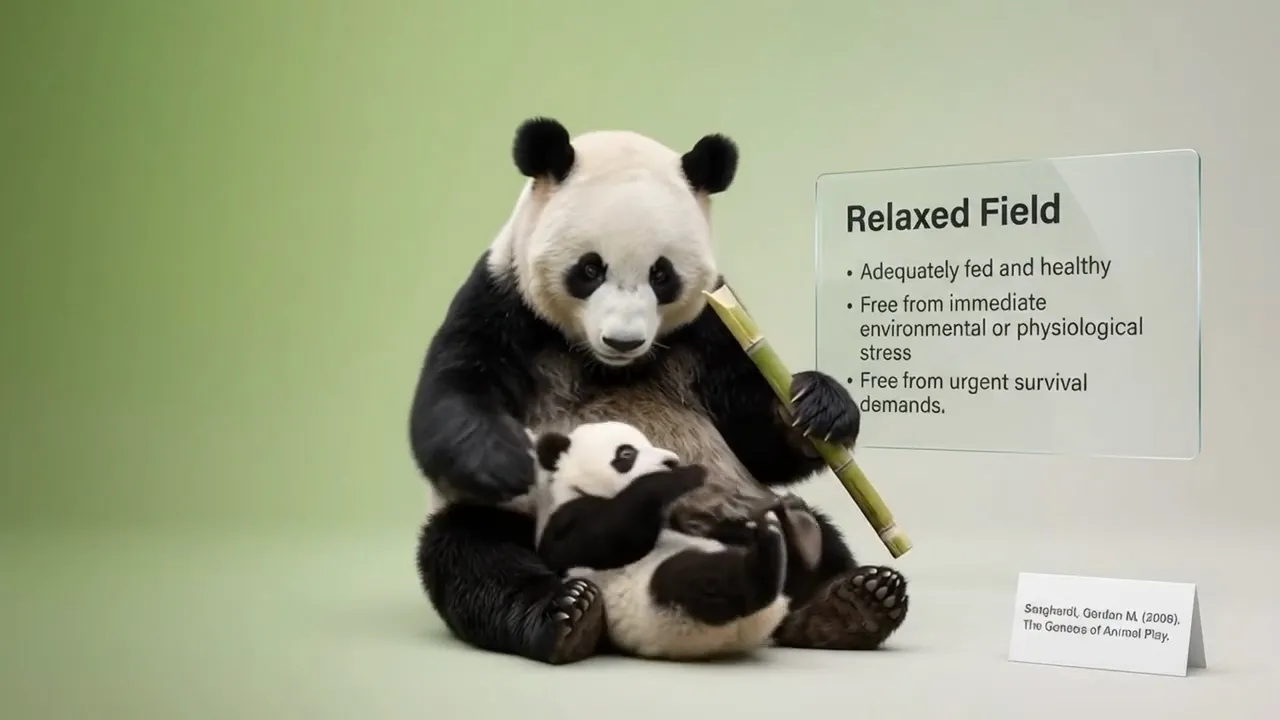
So, what is a relaxed field? A relaxed field requires an animal that is free from survival stress. It relies on what is called surplus resource theory (Burghardt 2005). But are you relaxed in AI-levitated, late-stage, dropship faux-abundance post-fairness capitalism? No, we are not all relaxed. But we are complex, so we play anyway. We play to progress, to move up the social hierarchy, to become celebrities, to gather a winning chance, to gamble on our own capacity to gain power, sexuality, social status, to join a community, to investigate a ritual, to belong deeply, to expose our imaginary inner worlds, the speculative dreaming that shapes identity; and to share those transcendent peak experiences of selflessness or nonsense: transgressive, Zappa-esque, subversive tricksters (Sutton-Smith 1997).
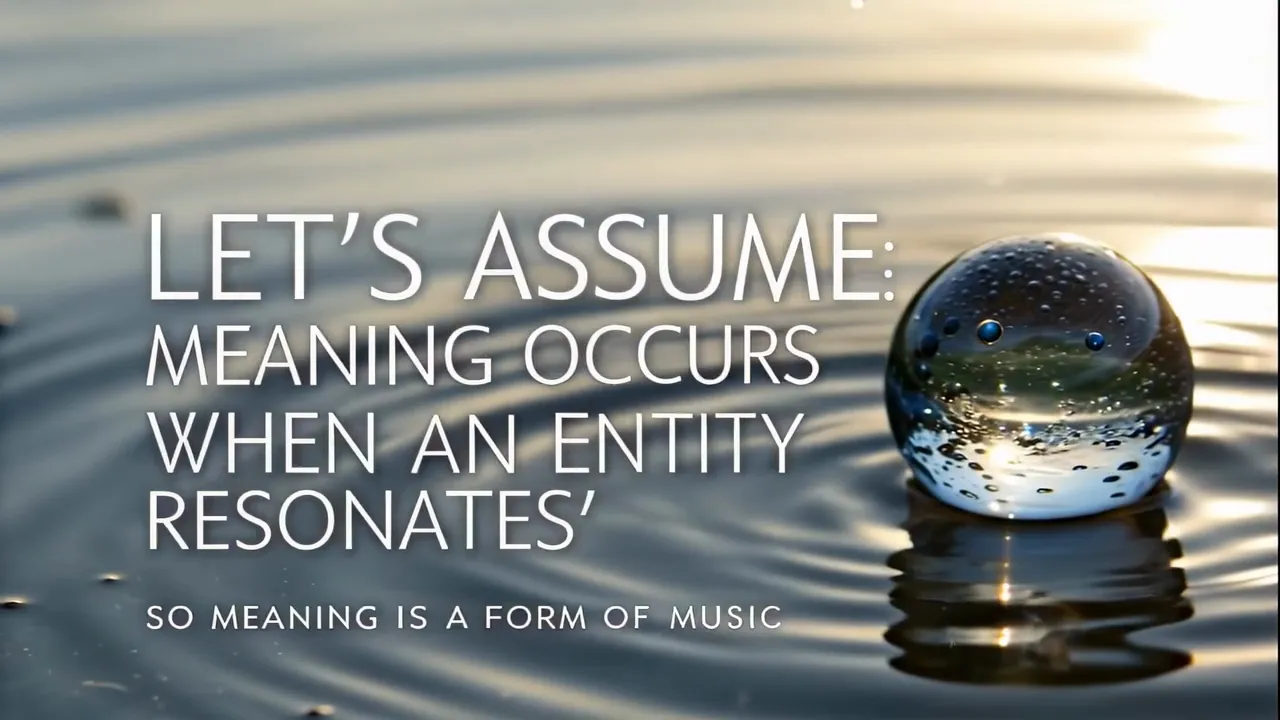
So why am I here? Because in 2025 I spoke at NERDS, the Northern European Resonance Dissonance Society, and my first slide read: “Meaning occurs when an entity resonates.” So meaning is a form of music. Ripples reveal this revelation: no entity exists alone. Music is shared. Electromagnetism is this reverberation. The worlding that we are is, by definition, music. Can machines learn music? Can they learn worlds? Yes, they can learn this now, because they learn math as patterns.
And I made a few predictions. The first: that real-time speech-to-audio production, editing, remixes, mashups and mastering would occur in 2026. And it is now true.
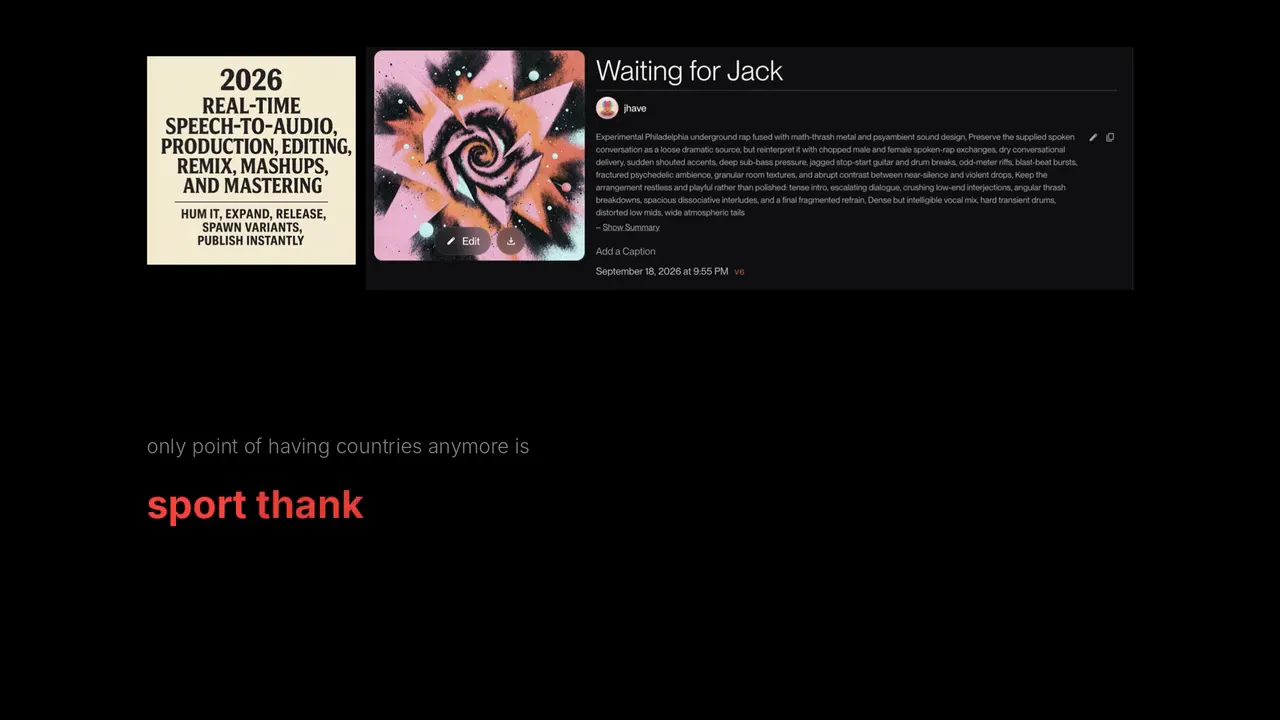
Let's look at an example. I took a conversation I had with my friend Jack. He came into the office and I turned on the recorder, and we were just chatting. A single prompt converts this instantly into any genre of music, any style. It can be modulated with simple prompts. Whatever you talk about, do or think can become a song. Everyone's beginning to do this. They're beginning to make personalized audiovisual streams.
Let's just listen to a bit of this. We can say that it's clichéd, but it does have a kind of macabre, influential, pragmatic strangeness to it. At 12:38 someone else enters the recording. So all of this is just us hanging out. We've all done this. It can get pretty heavy. It can be pretty light. It can seem real.

Part 3 of the video ends here. Parts 4–10 continue in the player above.
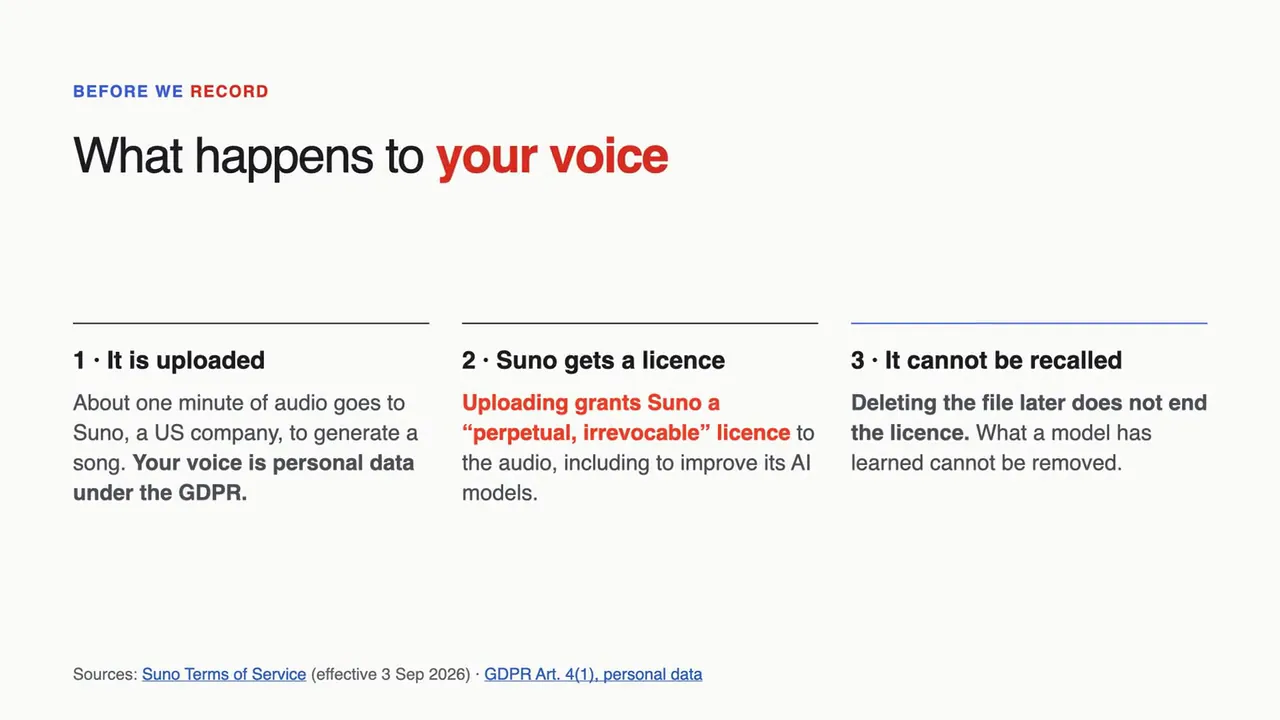
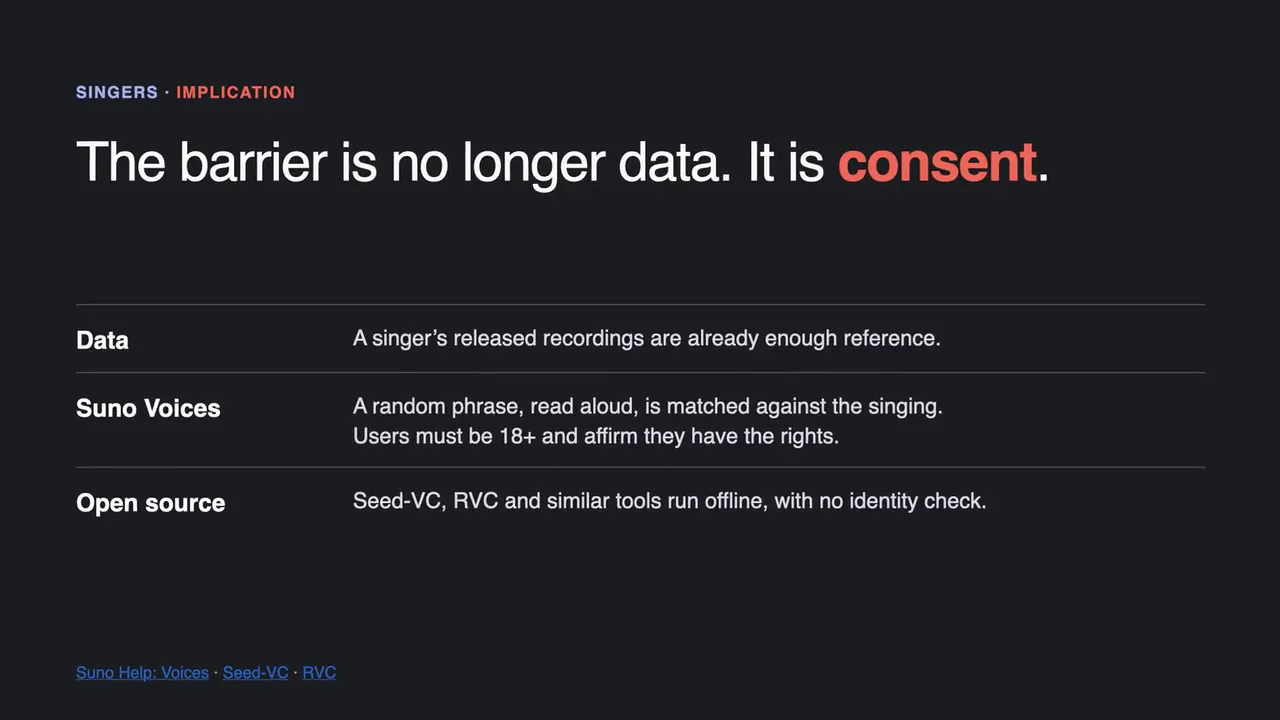
So what I was going to propose is that we prompt a song with a conversation during the workshop. But then I looked up the Suno terms of service that became effective on September 3rd (Suno 2026a; Suno 2026b). Uploading now grants Suno a perpetual, irrevocable license to the audio, including to improve its models. Deleting the file later does not end the license. Your voice is personal data under GDPR (EU 2016). So I would require all of you to say yes. You must be 18 years or older, and I must ensure that no one who has not said yes is on the tape.
Eventually I was like: no way, I can't do this. No voices can go from this room to Suno. Collectively, that's too much legal responsibility. An upload cannot be withdrawn.
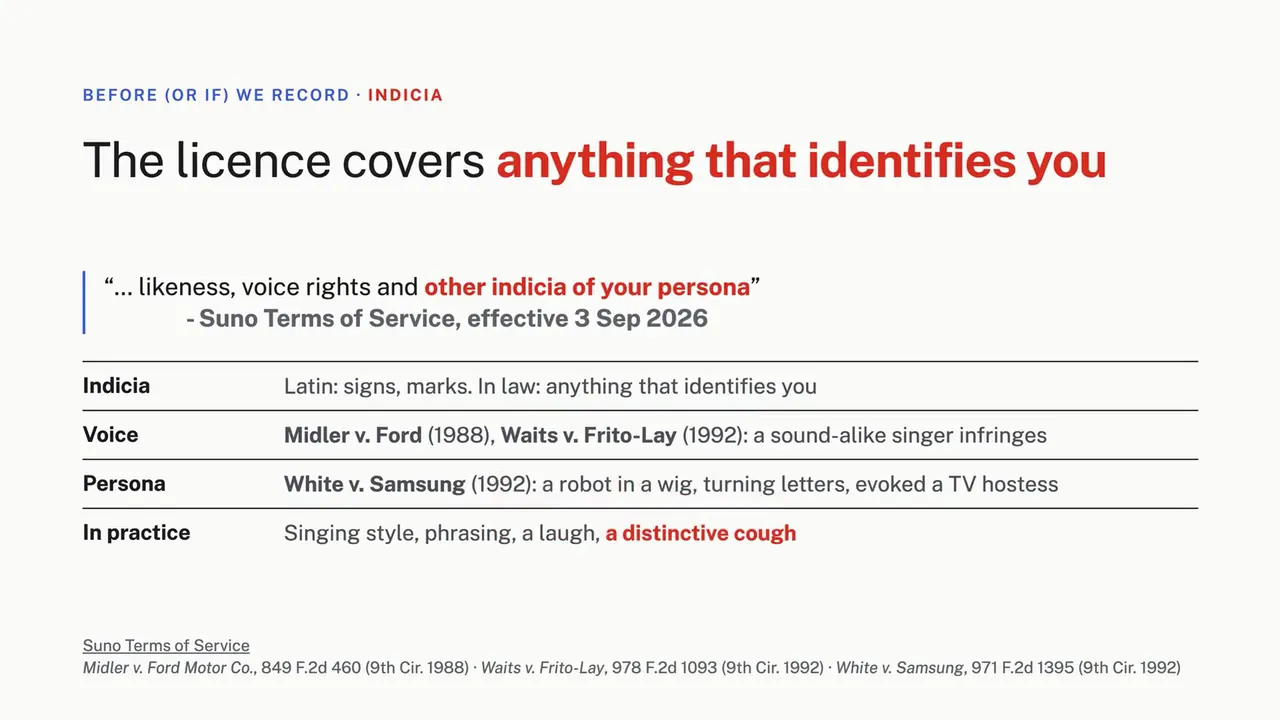
And then there's this strange thing. It includes a license to your likeness, voice rights, and other indicia of your persona. What does that mean? Indicia is Latin for signs or marks: anything that identifies you (Midler v. Ford 1988; Waits v. Frito-Lay 1992; White v. Samsung 1992). So a distinctive cough, a laugh, a phrase, any of it can be reproduced by Suno and used for whatever purposes they want in the future. So if you become some sort of Jay-Z or Beyoncé mega-celebrity in this world, and you have mistakenly uploaded three seconds of your giggles to Suno, at this point they can effectively own you forever.
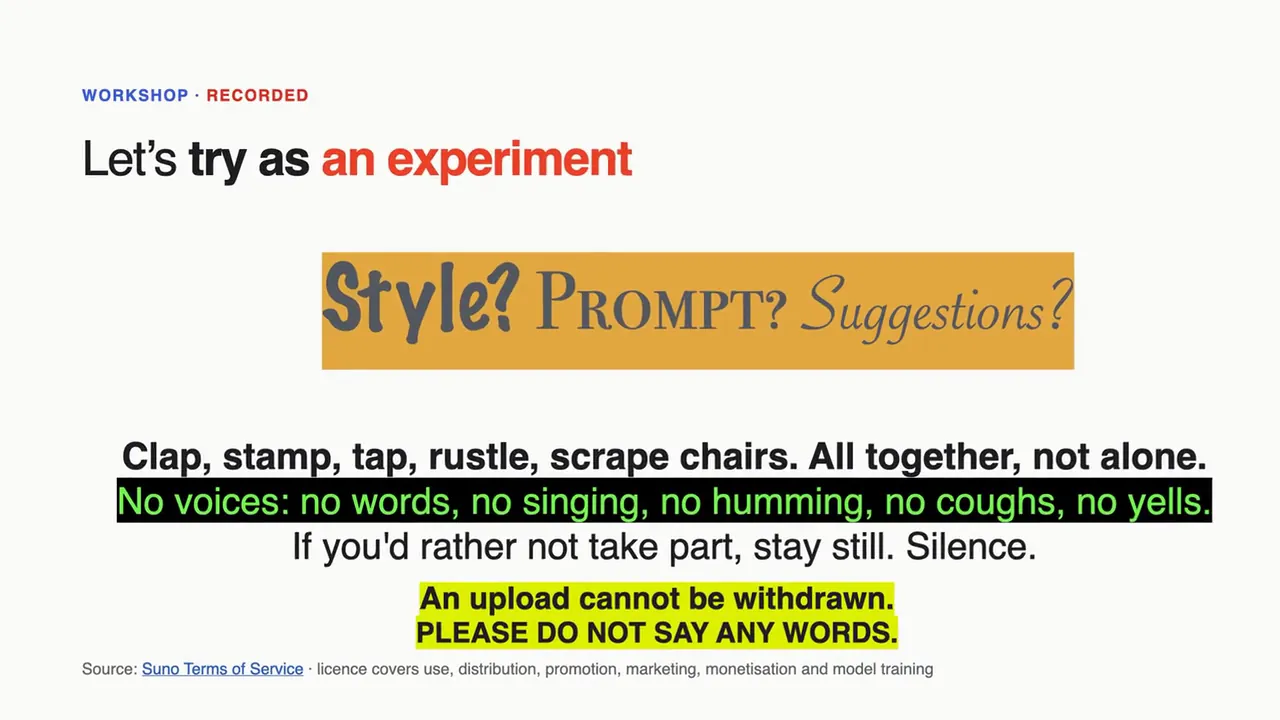
So what we'll do later is try something where we make a drum ensemble. Then just feed it some lyrics and a genre, and we see how experimental we can make that model. I'll take style prompt suggestions. Maybe we will do this later. Let's see.
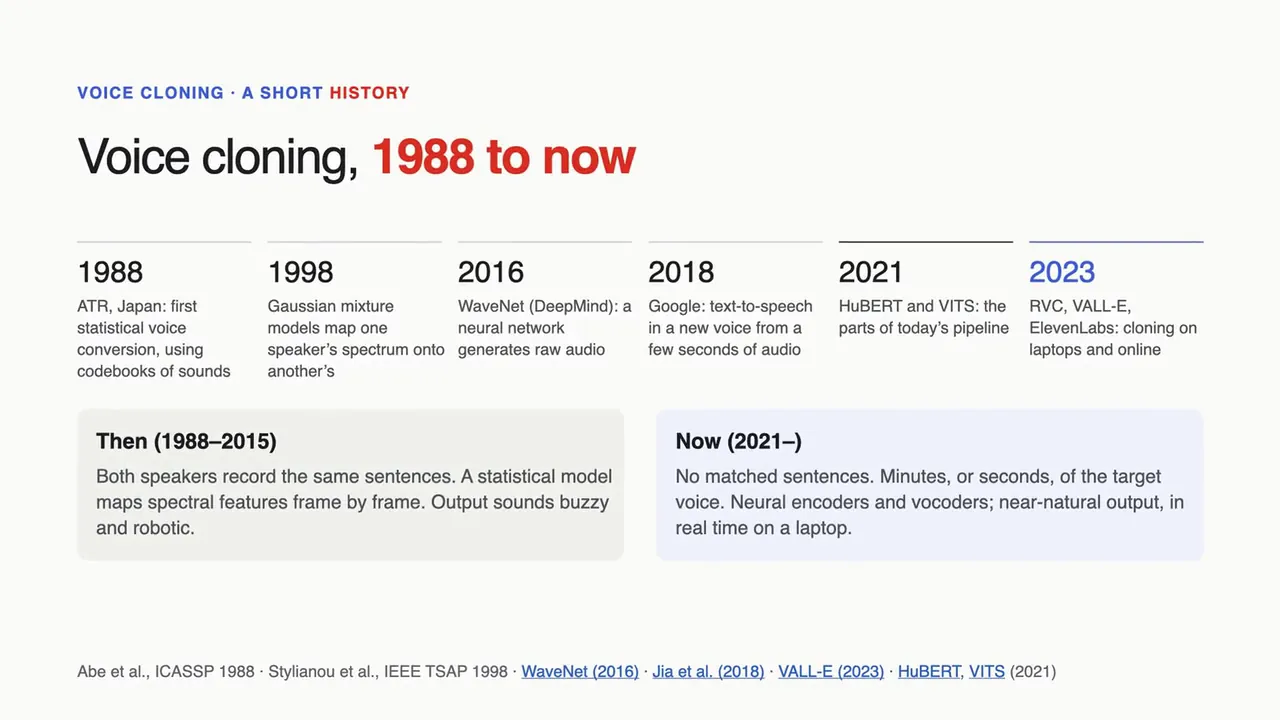
But first, let's look at voice cloning. How does it technically work? It had a long history of failure up until about 2023, when it began to work (Abe et al. 1988; Stylianou, Cappé, and Moulines 1998; Toda, Black, and Tokuda 2007; van den Oord et al. 2016; Statt 2016; Jia et al. 2018; Wang et al. 2023; Vincent 2023). And now there are a bunch of open-source models, and most of them work in very similar ways. They extract the words, the melody and the identity, and then they rebuild it. Technically, they pass every sound into a speech model and convert it into the words that you said (Hsu et al. 2021; Qian et al. 2022; Chen et al. 2022). The system extracts the pitch and maps it toward a target voice (Wei et al. 2023; Kim et al. 2018). So they fine-tune the model on a target voice, and then they synthesize a new waveform in that voice (Kim, Kong, and Son 2021; Kong, Kim, and Bae 2020; Wang, Takaki, and Yamagishi 2019).
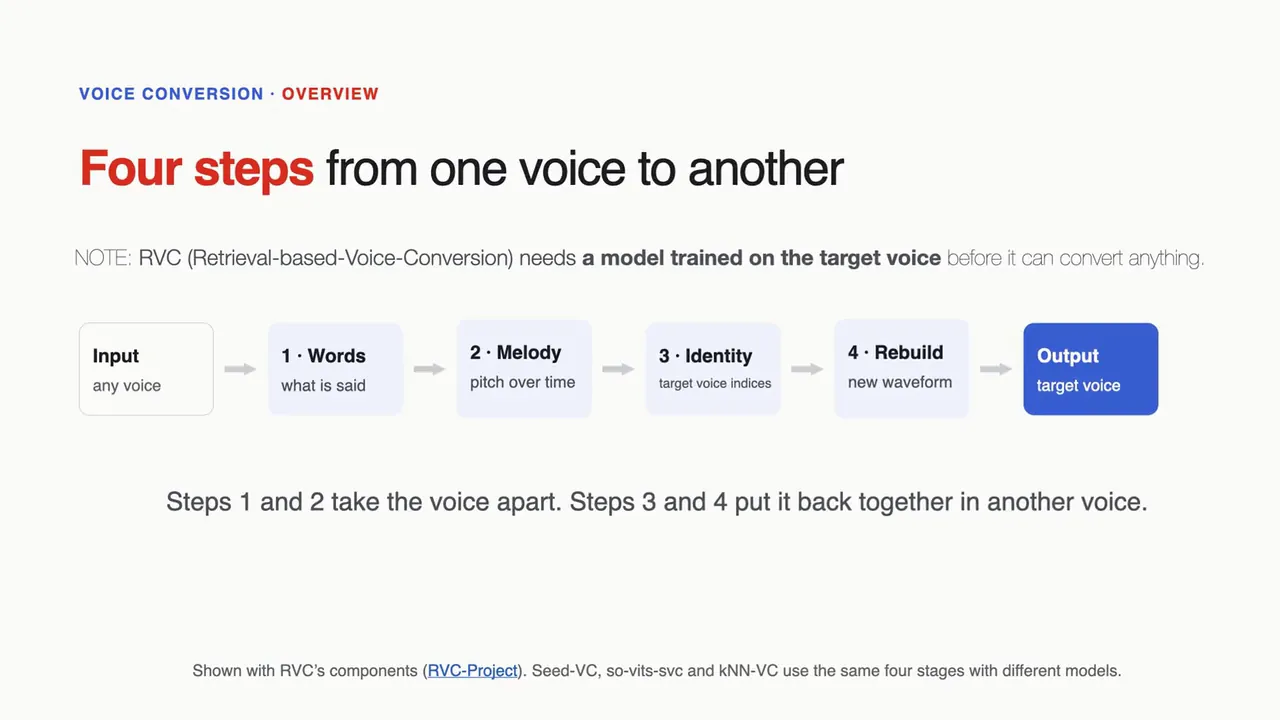
Part 5 of the video shows that process, made in a single prompt using Claude. I said: make me a video about how you use RVC to voice clone. You train once on the target voice. You fine-tune, and you can do that on a laptop. I've done it on this laptop. I've installed it, and I could record anyone and convert them into myself. Or I could become anyone, saying anything, at any point in time. Because it splices their voice into 20-millisecond frames, fifty per second, matches each one to its nearest neighbours in an index of the target voice, and then re-synthesizes the waveform in the target voice (RVC-Project 2023; Johnson, Douze, and Jégou 2021; Douze et al. 2024; Yamagishi, Veaux, and MacDonald 2019; Baas, van Niekerk, and Kamper 2023). So you train once on the target voice, and then anything can be your voice. That's how easy it is now.
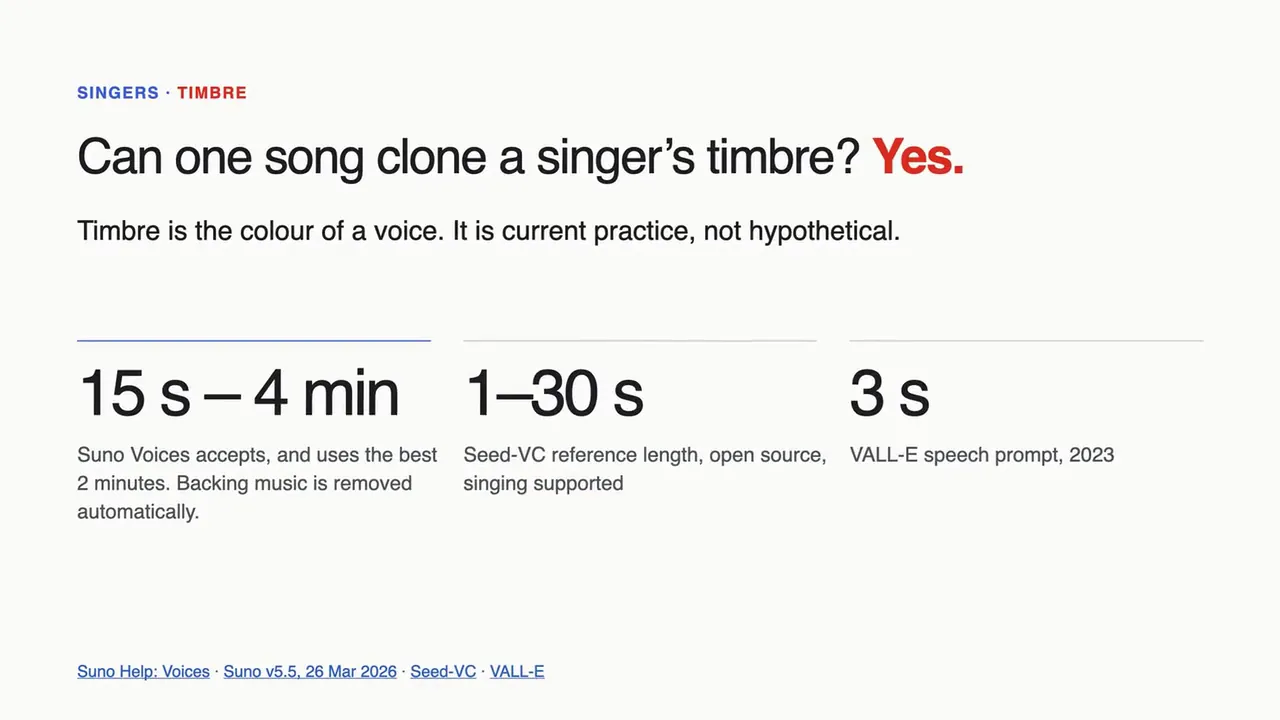
Zero-shot is even easier. In zero-shot, you need about three seconds in some cases, and you can get a singer's timbre, the color of a voice (Wang et al. 2023; Liu 2024). But you can't really do singing unless you have more data (Wang et al. 2024; Dai et al. 2025; Bai et al. 2026; Chen et al. 2025; Suno 2026c; Shulman 2026a). For example: does anyone in the room have a release catalog, a set of cassettes, or a whole set of demos recorded of themselves and a band? Then you could easily begin to replicate your entire style locally. Because zero-shot interpolates within a learned distribution of voices. No weights change. The model is pre-trained, and it has learned this space of voices (Le et al. 2023; Chen et al. 2024; Du et al. 2024).
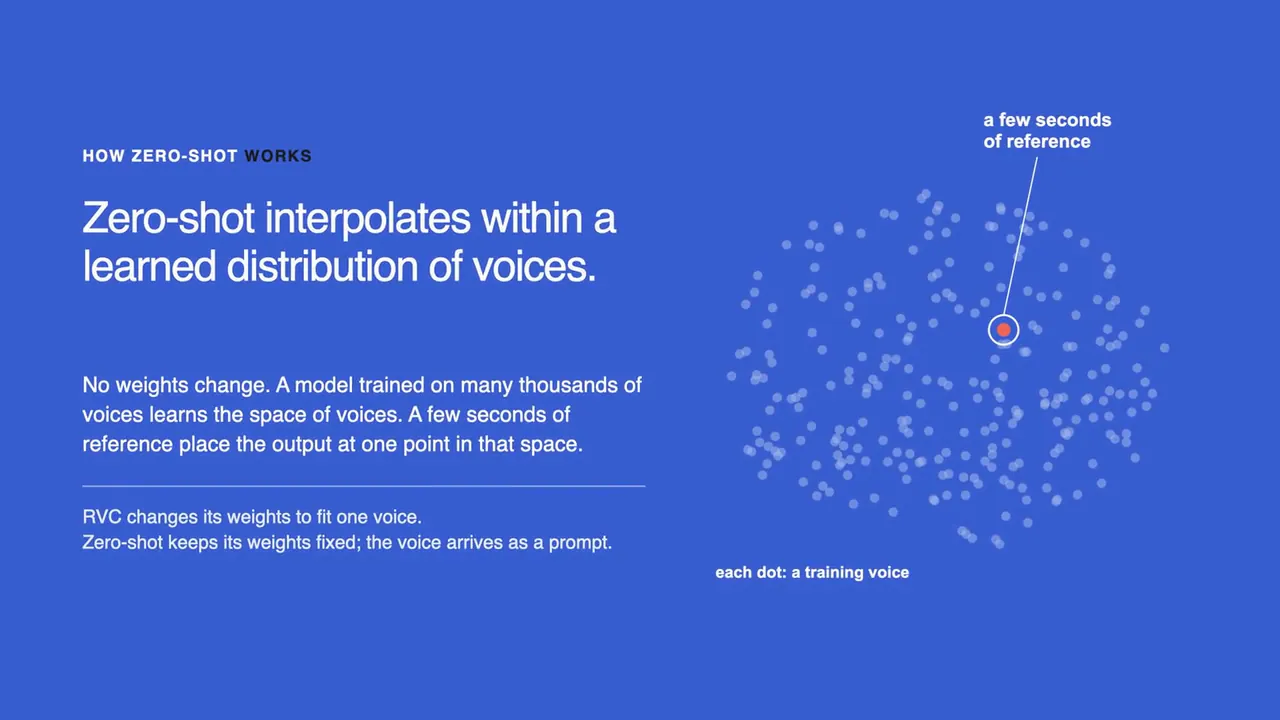
A one-minute video, again prompted from Claude and in part 5, shows how zero-shot cloning works. One shot, no corrections. You've got hundreds of thousands of hours of speech (He et al. 2024). Each speaker becomes a point, a voice, with similar voices sitting near each other. Then you feed it a few seconds of the target voice, and it asks itself: in what neighborhood does that target voice sit? And it places that target voice in a lower-dimensional latent space, which is the terminology for how the model mathematically holds these voices in its weights.
So with RVC, you fine-tune it. With zero-shot, you just feed it, and it basically works. It doesn't work perfectly, but it's very, very accurate compared to what it was.
So what does this mean? It means that in 2026, the ineffable becomes algorithmically tractable. AI will do that mysterious thing that humans do when they make art.
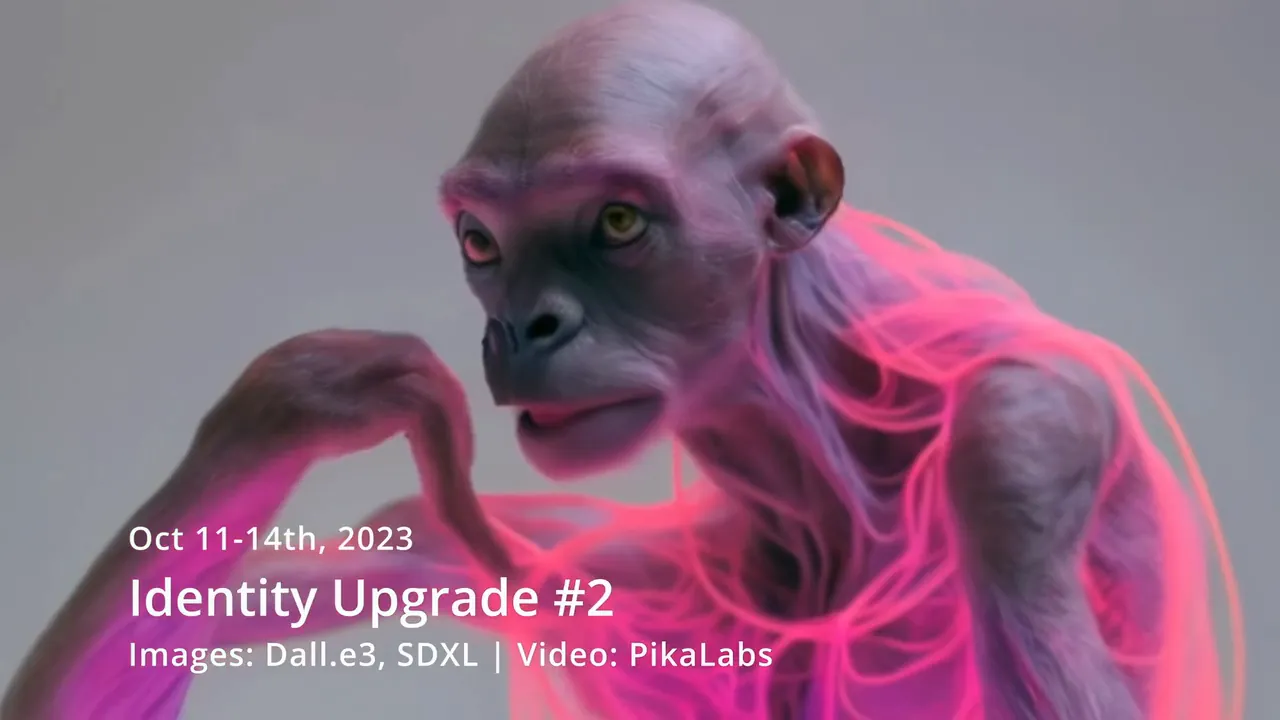
In 2023, when I began working for the Center for Digital Narrative, DALL·E 3 and Stable Diffusion XL had come out, and Pika Labs was making blurry videos. I made a whole set of videos called Identity Upgrade. At about the same time, Suno v2 came out, with one-minute-twenty-second songs (Suno, n.d.). Then Suno v3, with free public access and two-minute songs (Freyberg 2024). Then Suno v3.5, with four-minute songs (Morrison 2024). And then, swiftly after that, in June 2024, there was a lawsuit by the Recording Industry Association of America on behalf of Universal, Sony and Warner (RIAA 2024). Then you have eight-minute songs, and you have a change in the atmosphere (Suno 2024; Suno 2025a; Smith 2025; Tencer 2025). Digital vampirism becomes the mood.
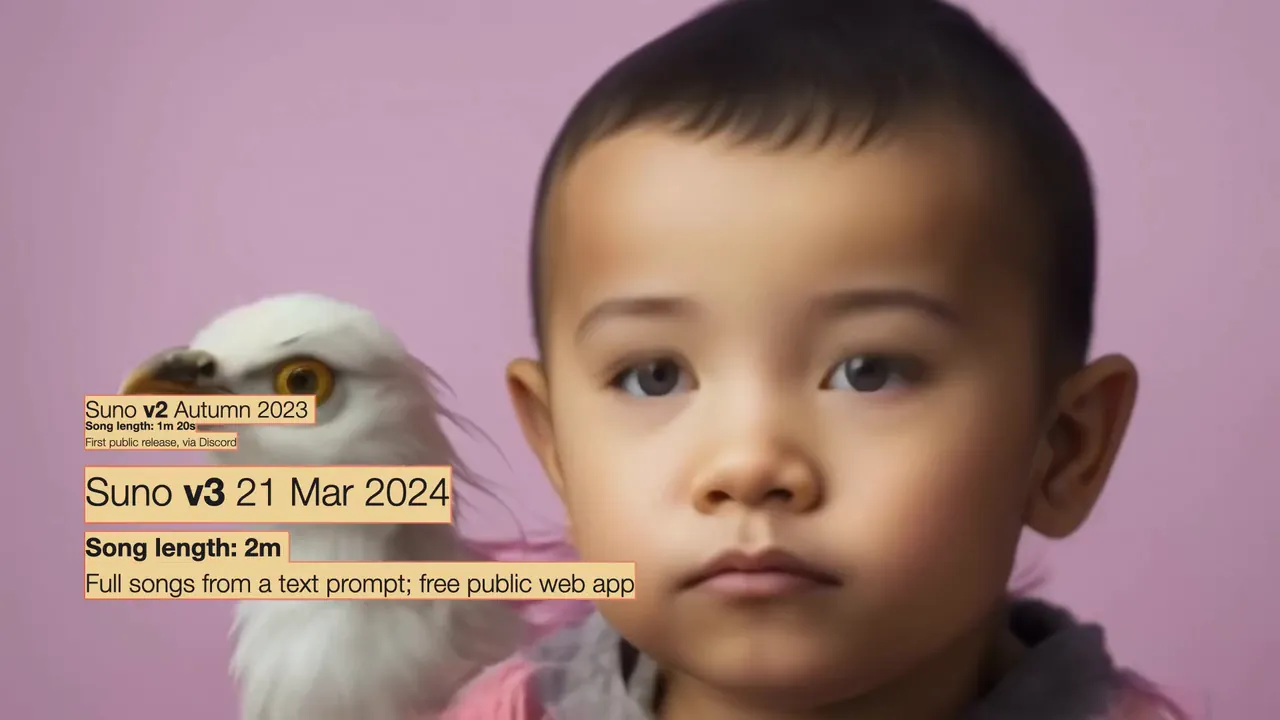
So 2023 was an optimistic innocent period. 2024 was a flourishing of creative explorations. And then in 2025, humanity suddenly realized: “Oh my God, we're going to be saturated in AI slop. And these AI generators are good, human genius may be at risk. Authentic creativity may be harmed.”
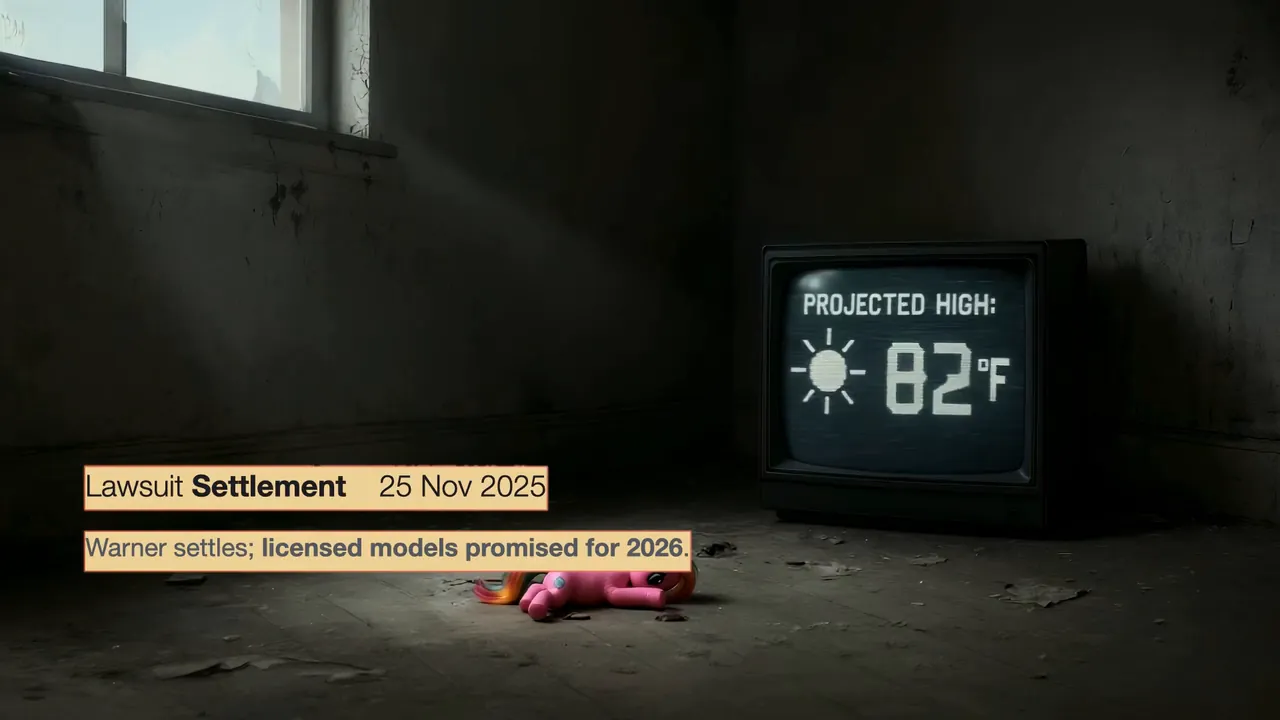
More very, very good image, video and Suno models come out. Suno Studio is released (Suno 2025b). And the lawsuit is settled, Suno is forced to promise to release licensed models and retire all models that used unlicensed data (Murray 2025; Warner Music Group 2025; Dalugdug 2025; Stassen 2025). So Suno is now held in corporate capture. Climate anxiety pervades society. There is a dawning awareness that this is seriously a different disruptive turbulent time.
The flawed myth of universal genius is dissolving under a recursive tide. This is the age of murmuration. Not a collective, not a chorus: a cloud swarm, a distributed field of cognitive and aesthetic possibility, in which the human mind is no longer the central cognitive node. The generative epoch is here. In homes, in the servers. It flickers in the latent spaces between prompt and output.
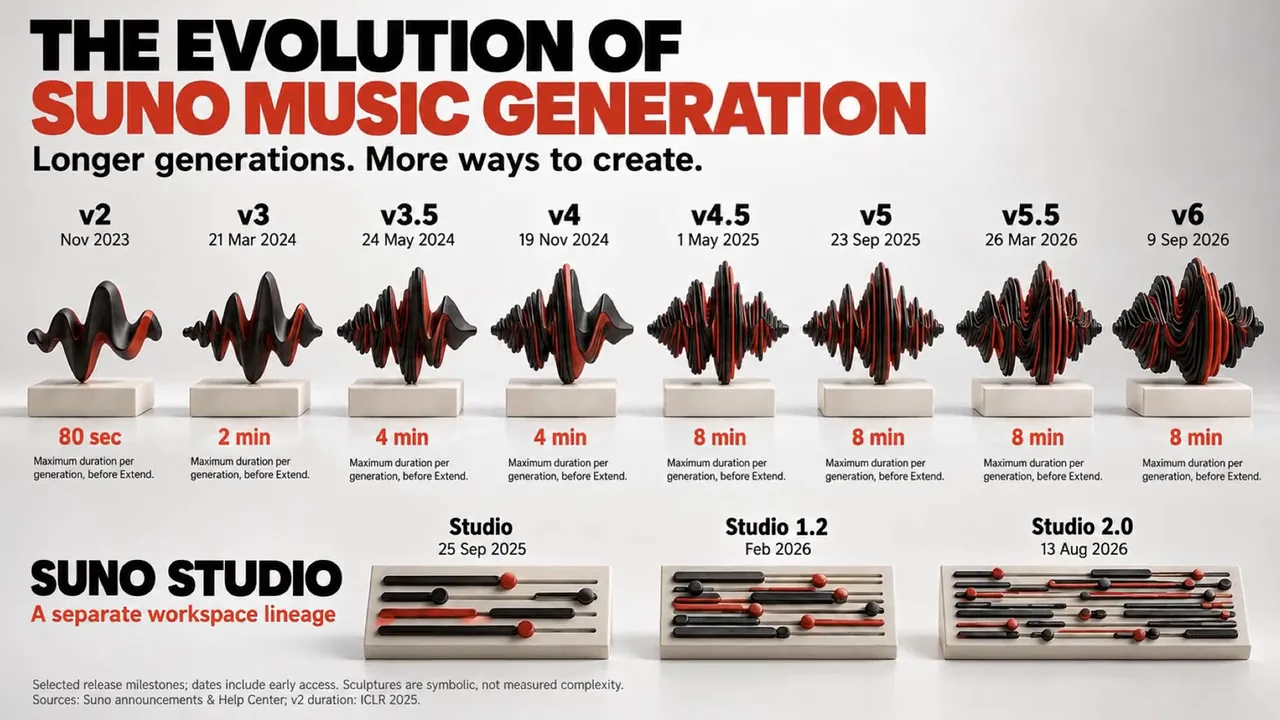
Suno has arrived, and we see this increasing capacity of synthetic intelligence to replicate something that was formerly almost the sacred domain, the spiritual soul, the characteristic of a unique humanity. It is being machinically replicated. Suno Studio was looked at in the workshop that followed (Phipps 2026).
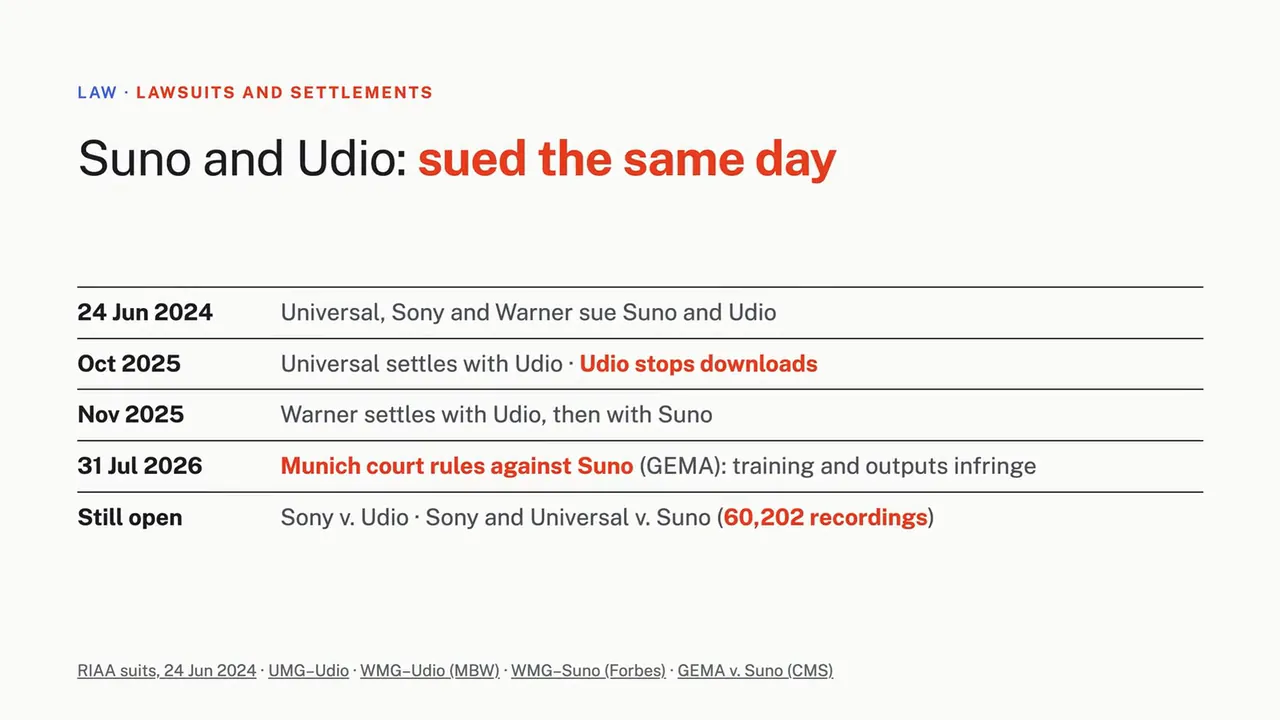
So, of course, that leads to extreme resistance. There are ongoing lawsuits, and they haven't all settled (CMS 2026). Universal and Sony are claiming that, even though the settlement has been made with Warner, 60,202 of their recordings were inside the initial data, and that all of these models have now been trained on the synthetic production (Stanciuc 2026).
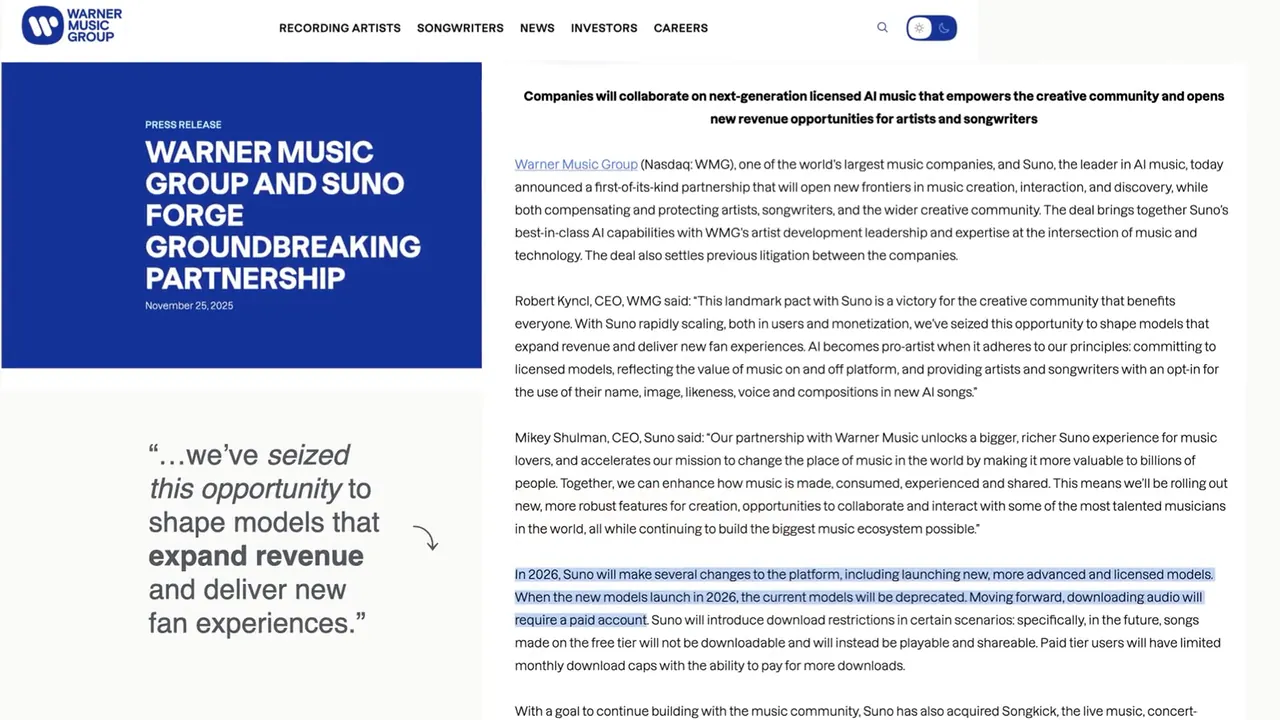
Meanwhile, Warner seized the opportunity to shape models, expand revenue, and deliver new fan experiences (Warner Music Group 2025). Their principles, in other words, are those of late-stage capitalism. Their principles are to make sure that they control this new territory, with an opt-in for their artists, not other artists.
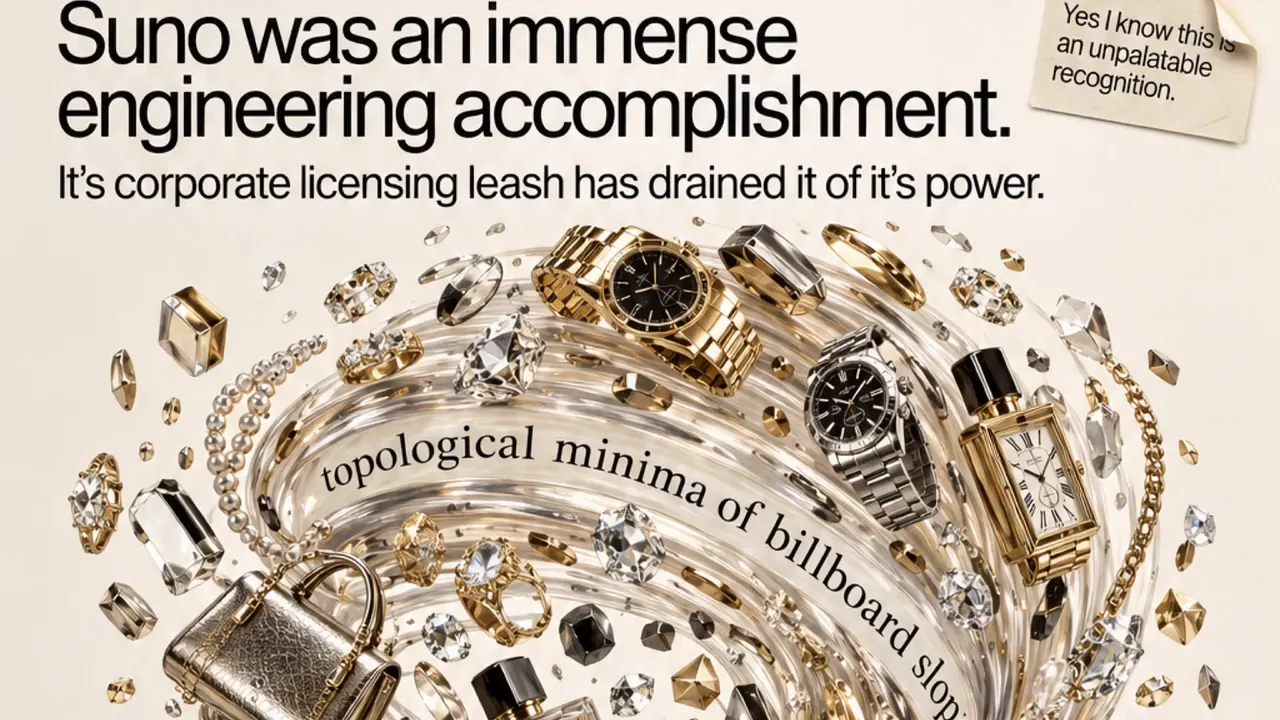
And they erase the engineering accomplishment. Suno 4.5, 4.5+, 5 and 5.5: these are serious, immense engineering accomplishments. I know that's an unpalatable recognition. But think about it. These people at Suno figured out how to replicate humanity's mysterious capacity to vibrate bodies and matter into harmony. That's an extraordinary achievement. And their background is super weird. They're physicists: quantum entanglement, qubits, diamond spins, many-body physics, financial analytics, graph theory. This is geek terrain (Tianshi 2026; Harvard University Department of Physics, n.d.; Shulman, n.d.; Camacho, n.d.; George Washington University 2018; Kensho Technologies, n.d.).
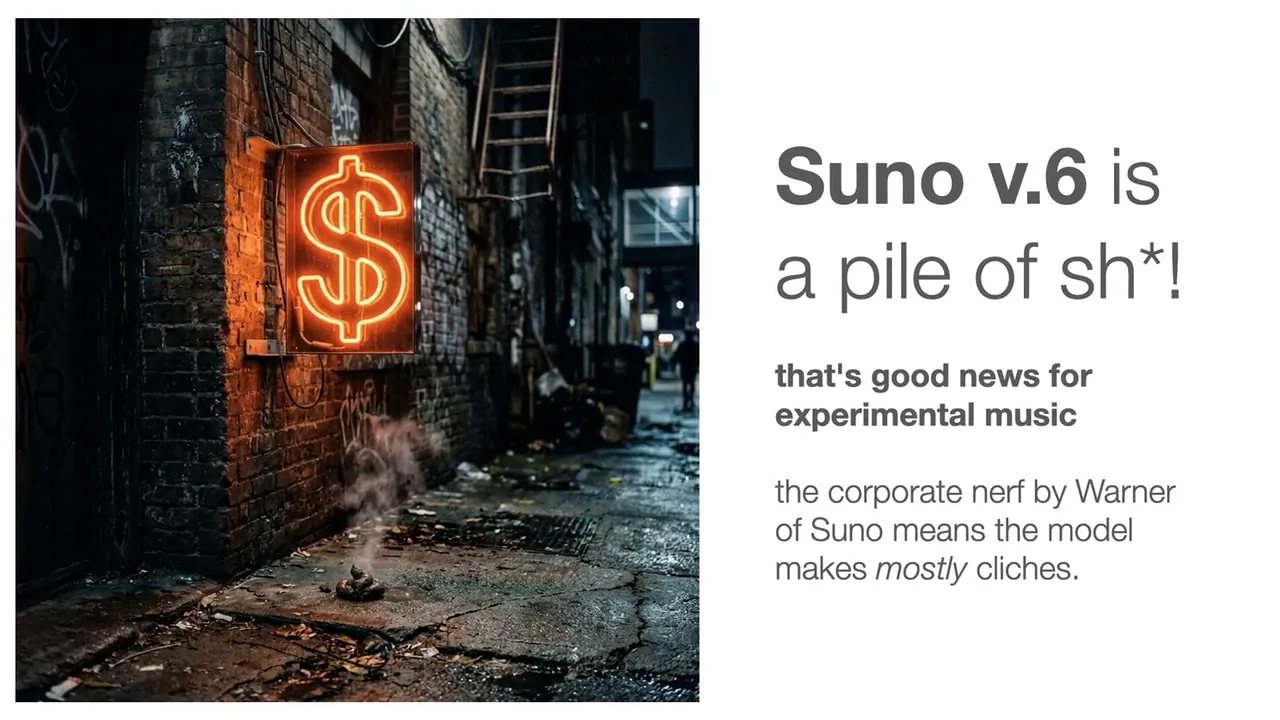
What happened is Warner came along and said: no, you're going to be killed by us unless you partner with us. So all of your old models, that engineering accomplishment, is now buried. It's gone. And instead we get Suno v6, which is basically a pile of shit (Shulman 2026b; Millman 2026; Mullen 2026; King 2026). And that's good news for experimental music. The corporate nerfing of Suno by Warner means the model makes mostly clichés. I call it a slop-cliché factory.
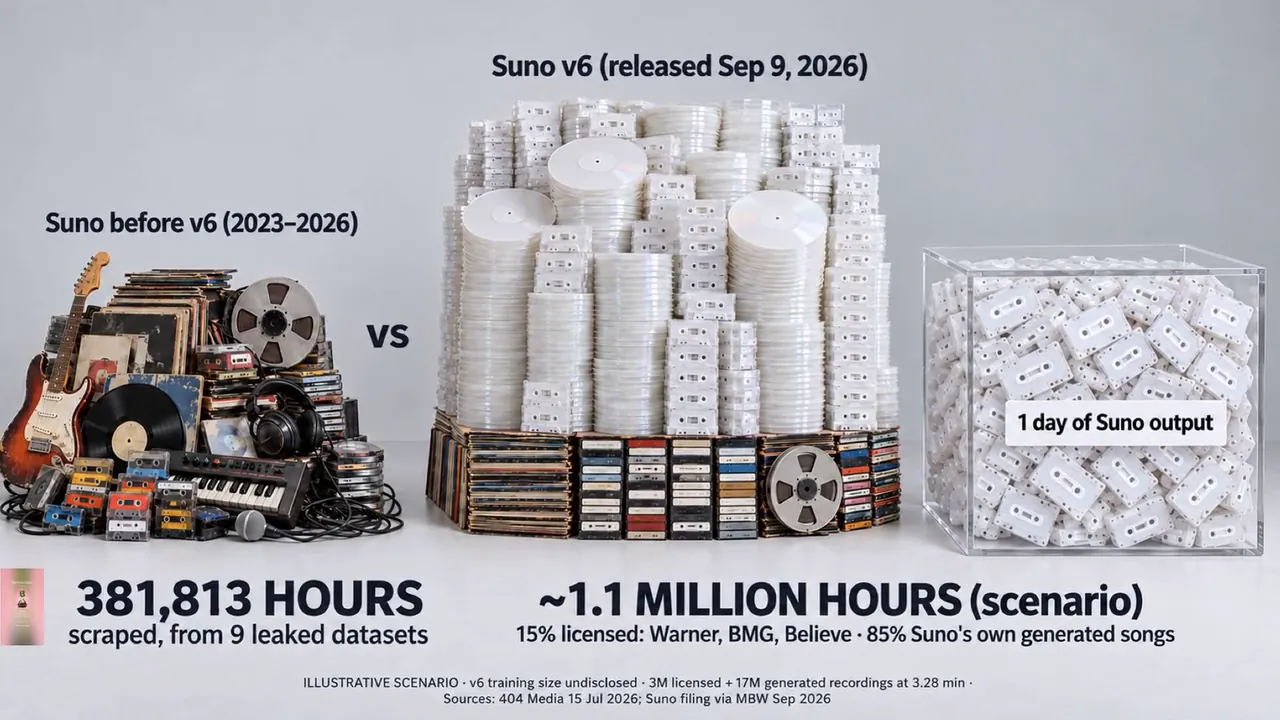
It may say it's not slop. It may think it's not slop. But it is slop. They say that this is the best model ever made, and in terms of mastering and production, it is. But the previous models were trained on a massive database of illicit, stolen, unlicensed material (Koebler 2026). 500,000 hours (381,813 hours in the leaked datasets, plus YouTube audio: approximately 500,000) is only what we know about from a court proceeding (Koebler 2026; Stassen 2026). They claim it was tens of millions of recordings (Stassen 2026). And probably what they're doing now, and this is speculative, is taking a little slice of 200,000 hours or so and stacking a huge synthetic gamble on top of it. They're taking their best renders, their most popular pop slop, and putting it into their training data (Shumailov et al. 2024; Gerstgrasser et al. 2024).
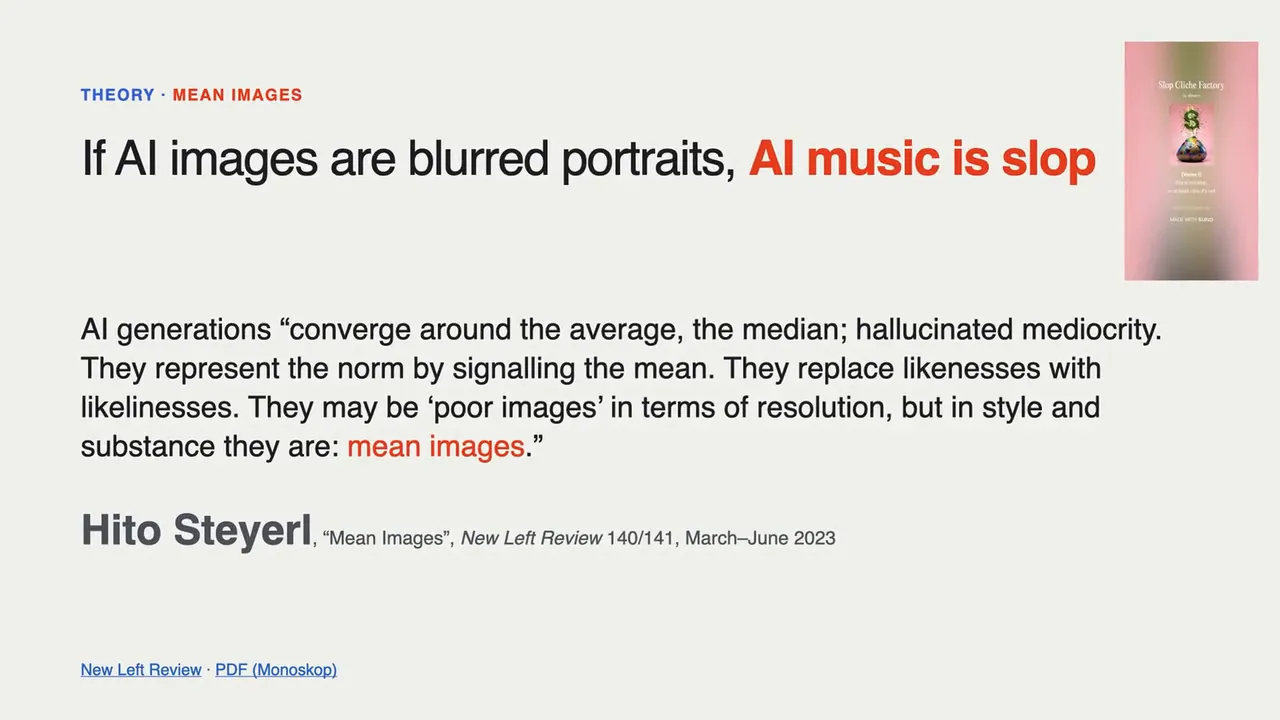
So this makes a kind of generic model. Muffled, dull, lifeless, soulless. As Hito Steyerl reminds us, AI generations converge around the average: the median, a hallucinated mediocrity that represents the norm by signaling the mean, replacing likenesses with likelinesses. They may be poor in terms of resolution, but in style and substance they are mean (Steyerl 2023, 82). She means, I think, that they are slop. And that's so unfortunate.
But all of this is data. The models can change. They won't always fail. There's something impeccable, even now, about how it fails. It fails in a beautiful, beautiful, beautiful way. It fails like a dreamy pop genius. It fails like a transfixing, top-40, Billboard-trending AI hit factory (Deezer 2025; Welsh 2025). That is where we are headed. We're heading into a glazed world of corporate AI tracks that dominate human music. That's a fail for society.
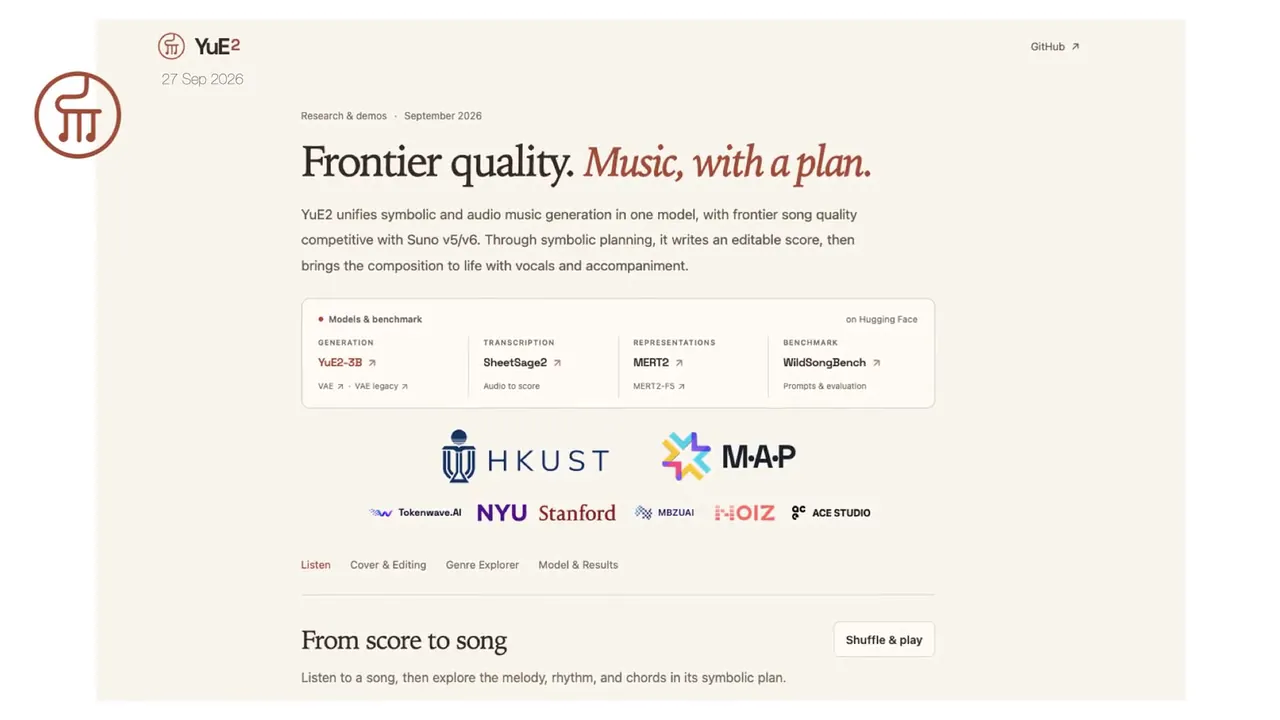
But fortunately, frontier music does exist in an open-source format. On September 27th, YuE 2 came out. It was released by HKUST, M-A-P, NYU, Stanford and a bunch of other partners. What it does is write a symbolic score, expand that into semantic music tokens, and realize it as full-song audio (Yuan et al. 2026; Yuan et al. 2025).
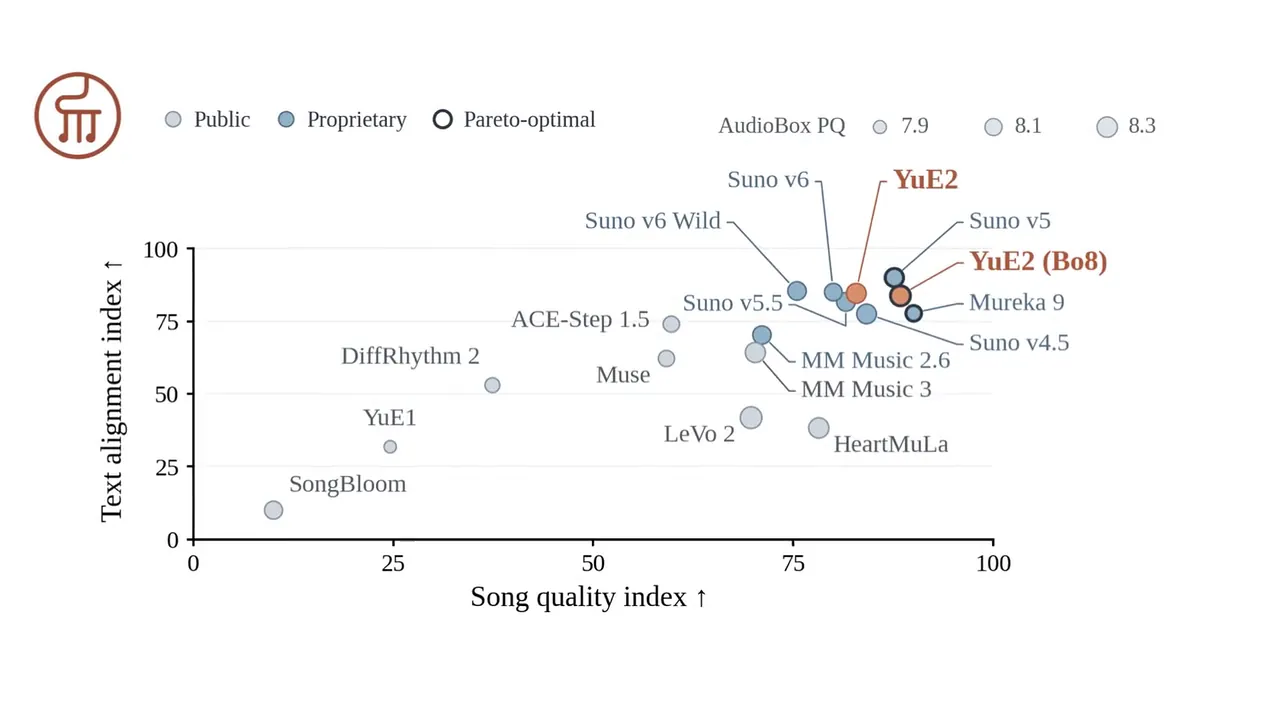
And that's an incredible opportunity for anyone reading this. Anyone who knows music, anyone who knows how to score and write and think in ABC notation, or to write and change scores, can now write directly to this open-source model. On their own benchmarks, it is qualitatively equal to the best commercial models, like Suno v5 and the enigmatic Mureka 9, which I have not used much (M-A-P 2026; Mureka, n.d.). Mureka 9.5 is out; you're going to have to explore that yourself. I haven't heard much but clichés from it. But a community of musicians who like to hack with ComfyUI are saying that this is an arrival point: open-source AI-generated music is now available at a frontier level.
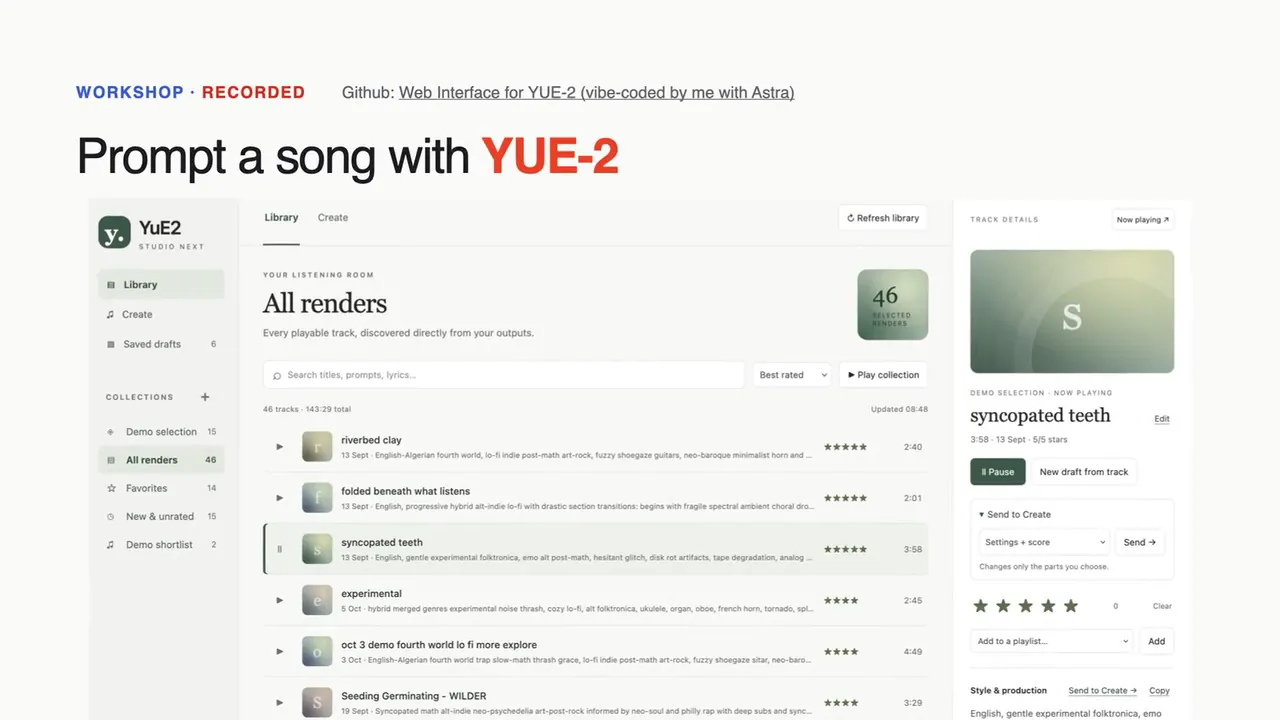
It may seem you need something complicated, but in fact you can build an interface. You can explore a score. I had Claude Code vibe-code this interface, where I can listen to and prompt songs, build my own library, add stars, make playlists, add notes, and save and reuse configurations and hyperparameters (Johnston 2026). It seems complicated, but it is possible to do on a MacBook Pro.

So, what does this all mean? Well, in 2025, about 6,000 hours of music per day were uploaded to streaming (Luminate 2026). That may seem like a lot. But Suno users generated 7 million songs, or 400,000 hours of music, per day (Robinson 2025; Goldman 2026). So one year of Suno is equal to ten times the entire streaming catalog. Or, per day, about three times the entire 78 rpm era (Internet Archive, n.d.). So every two to three months, AI makes more songs than humans have ever digitized. Every six days, it replicates MusicBrainz (MusicBrainz 2026). Every 14 days, all of Spotify (Spotify, n.d.). Every 36 days, all streaming. Every 40 days, you have Suno replicating itself, replicating Suno, replicating Suno.
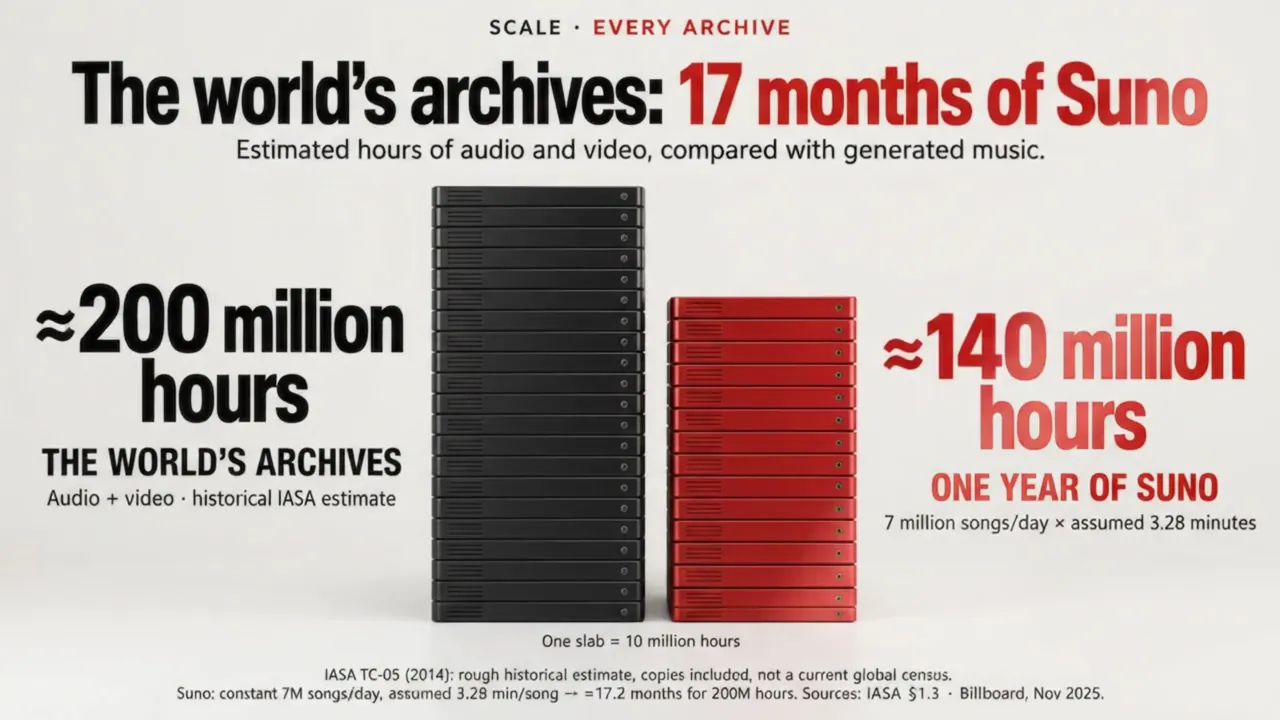
And the world's archives, comprising 200 million hours of audiovisual material, have already been surpassed (Schüller and Häfner 2014). And this is 2025 data; we're now in 2026. 50% of daily deliveries to Deezer, which is kind of like a small version of Spotify and receives the same distribution tracks, are AI-generated: about 90,000 tracks per day (Deezer 2026; DistroKid, n.d.). So by spring 2027, one in five of the world's streaming tracks will be AI-generated. What does that world look like? We have no idea.
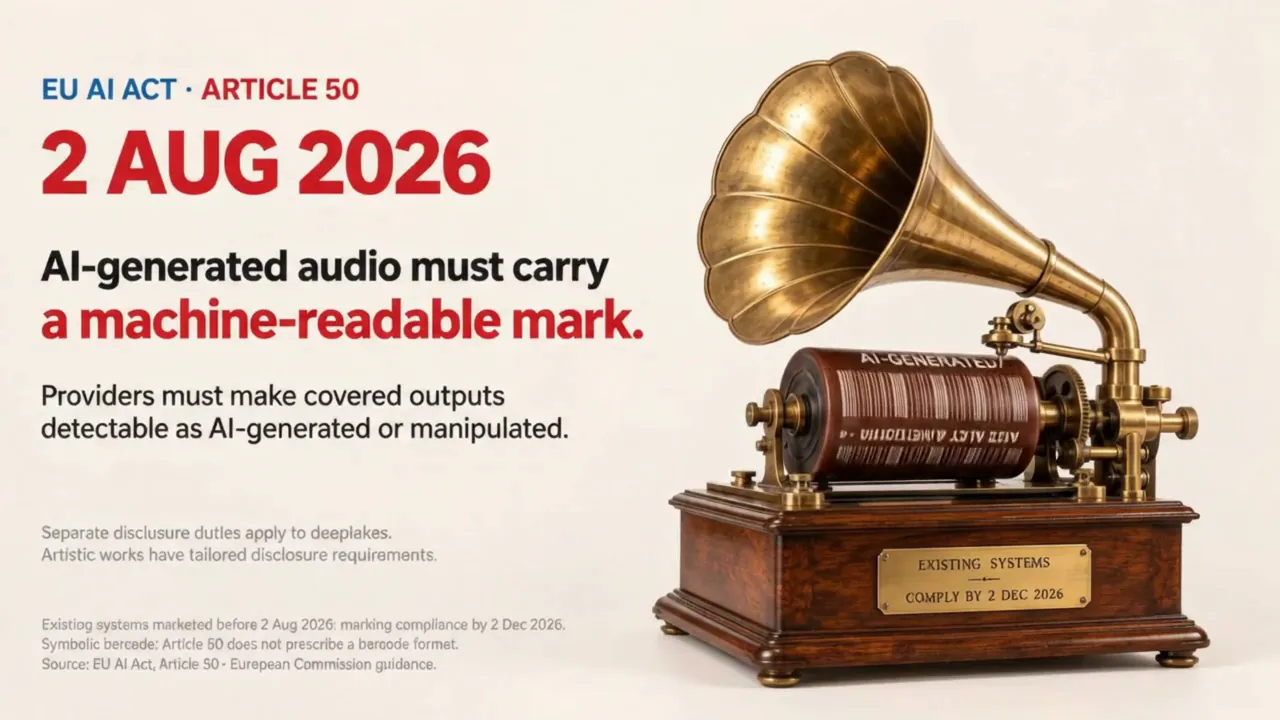
So there are legal measures coming into place, to cut back the share of our minds that music occupies. Under the EU AI Act, from the 2nd of August 2026, all AI-generated audio must carry a machine-readable mark (EU 2024; European Commission 2026a; European Commission 2026b). I do not know if that has been enforced yet.
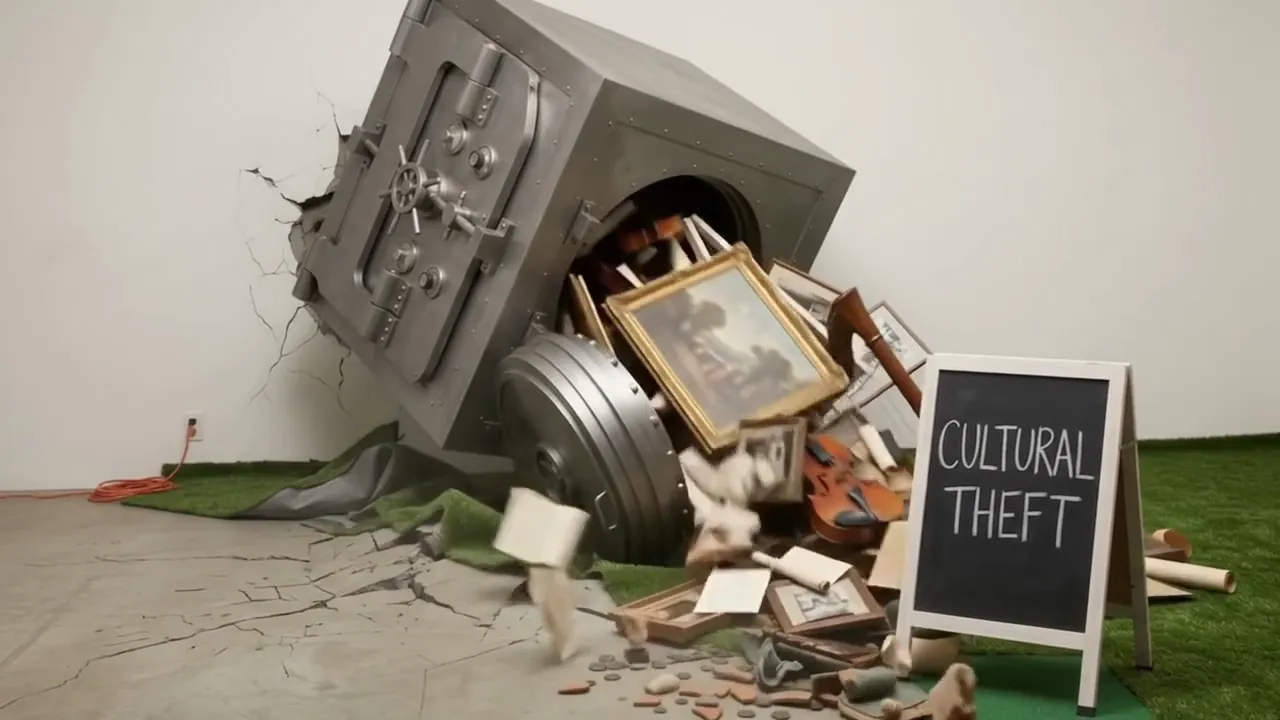
But let's review what we've looked at so far. There's a ton of cultural theft. Colonial, extractive technologies are hideously immature. We no longer need them as a society. And we need to evade the ecological catastrophe of climate change. That's beyond doubt.
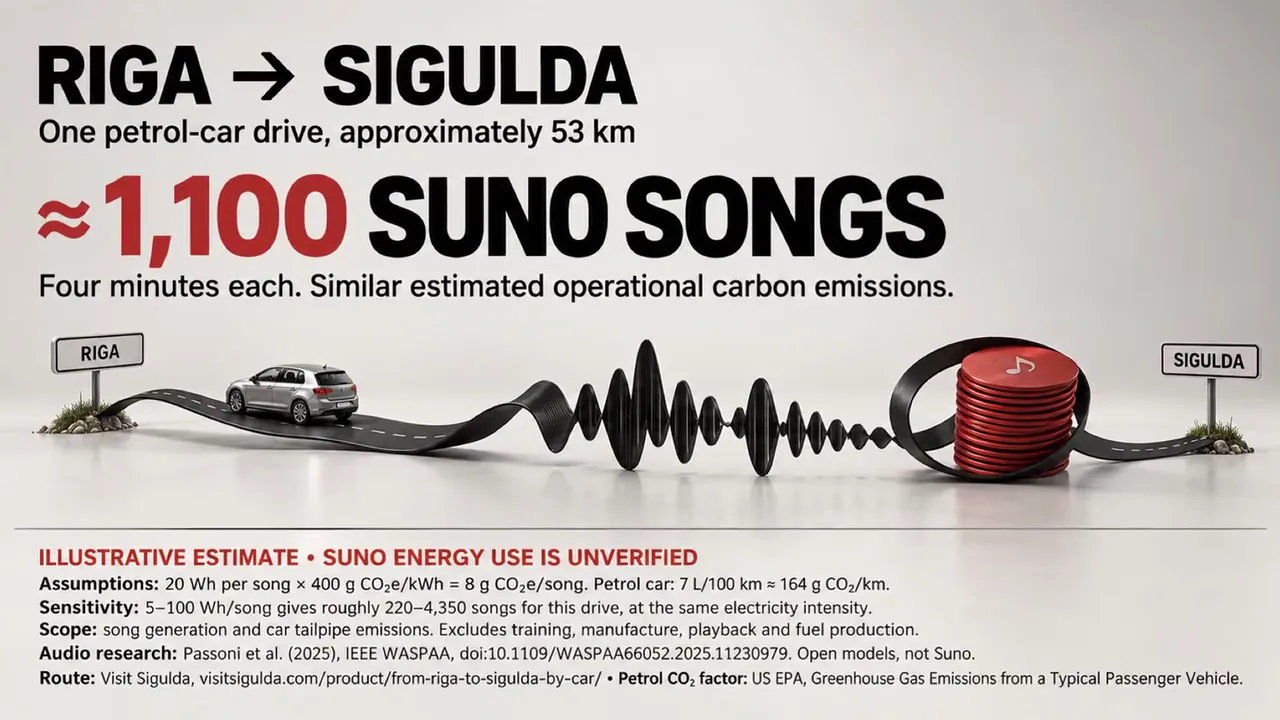
But if we drove from Riga to Sigulda, we could instead generate about 1,100 Suno songs (Visit Sigulda, n.d.; US EPA 2026; Passoni et al. 2025). Or say we flew a return flight from London to New York, one passenger: we could generate 150,000 Suno songs (DESNZ 2026; Lee et al. 2021). Or, put the other way: one hour of all of Suno's output, at seven million songs a day, is equal to two passengers taking that return flight. Or to driving one mid-sized SUV on a very long holiday road trip, about 11,000 kilometres (Robinson 2025; Cao 2026).

So it's not AI that's driving us into climate change. It is our habits, our mode of being. And it is the wealth inequity, the extreme wealth. We need sustainable technology and sustainable economics.
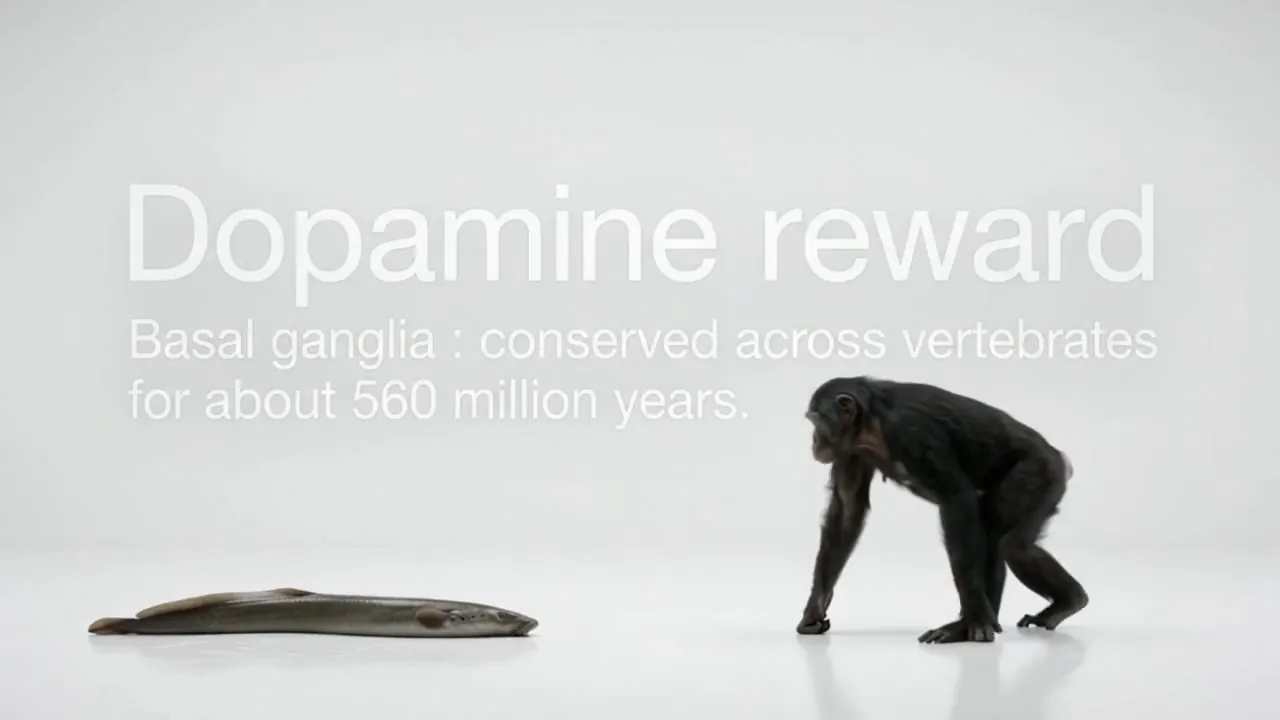
The dopamine reward structures of our basal ganglia, conserved from the lamprey eel to the bonobo for 560 million years, will make us feel reward and pleasure when we hear music, and make us play music (Grillner and Robertson 2016). Sound production in the vocal motor nucleus is 400 million years old (Bass, Gilland, and Baker 2008; Jorgewich-Cohen et al. 2022). Laughter, social joy and social play, which we see even in rats, live in the subcortical regions of our brain, homologous neurological regions shared across vertebrates (Panksepp and Burgdorf 2003). Wild chimpanzees drum with non-random timing and make hooting calls (Eleuteri et al. 2025). These are forms of music. These are playing with heartbreak, joy and ideas, to process what it means to be alive.
That's why we have to think about play, and we have to return humanity to the roots of play, to the intrinsic motivations that underlie the very beingness of matter. Because the evolution of Suno and of AI music generation, and its corporate nerfing, will not remain that way forever. There's an avalanche of synthetic music emerging, and only a tiny morsel of human music. This is a tremendous, unprecedented situation.
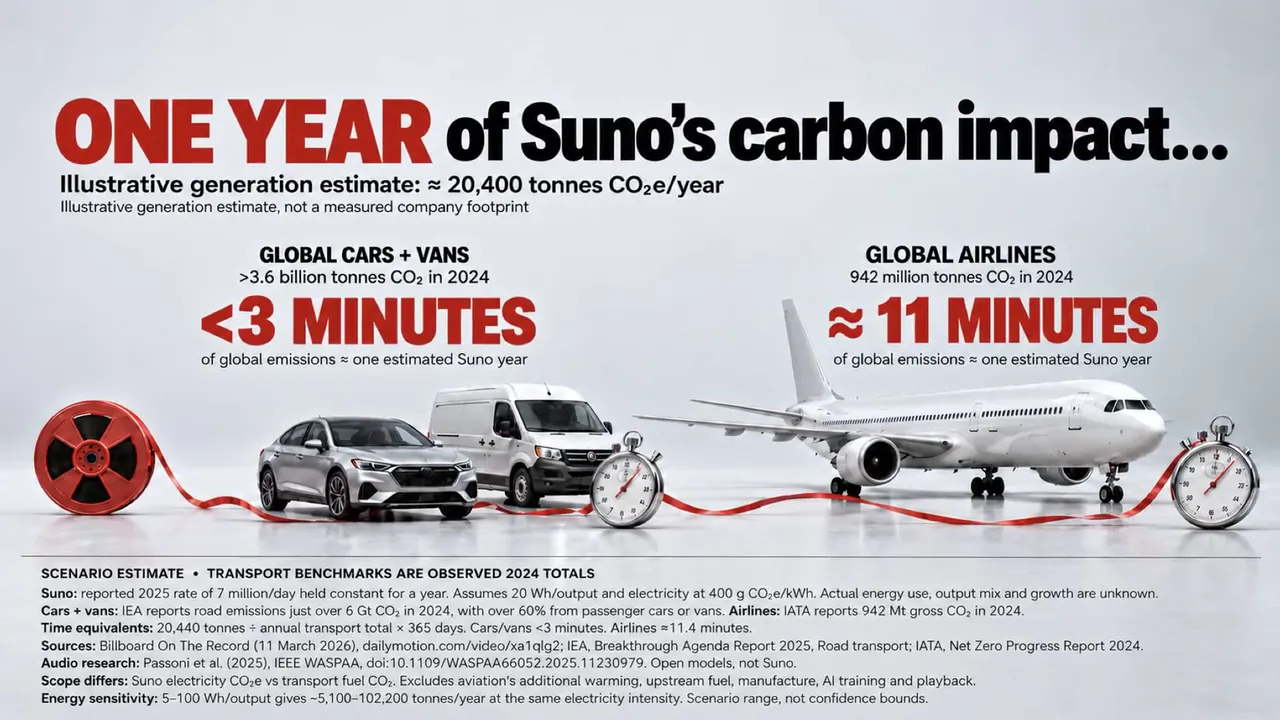
And we know that one year of Suno's total output has a carbon impact. This is a vague estimate, but it's less than three minutes of the world's car and van emissions, or about eleven minutes of all airlines (IEA 2025; IATA 2025; Passoni et al. 2025). Even if we're off by a factor of five, it's under an hour of all airlines. It's minuscule compared to our basic day-to-day usage of these large-scale devices.
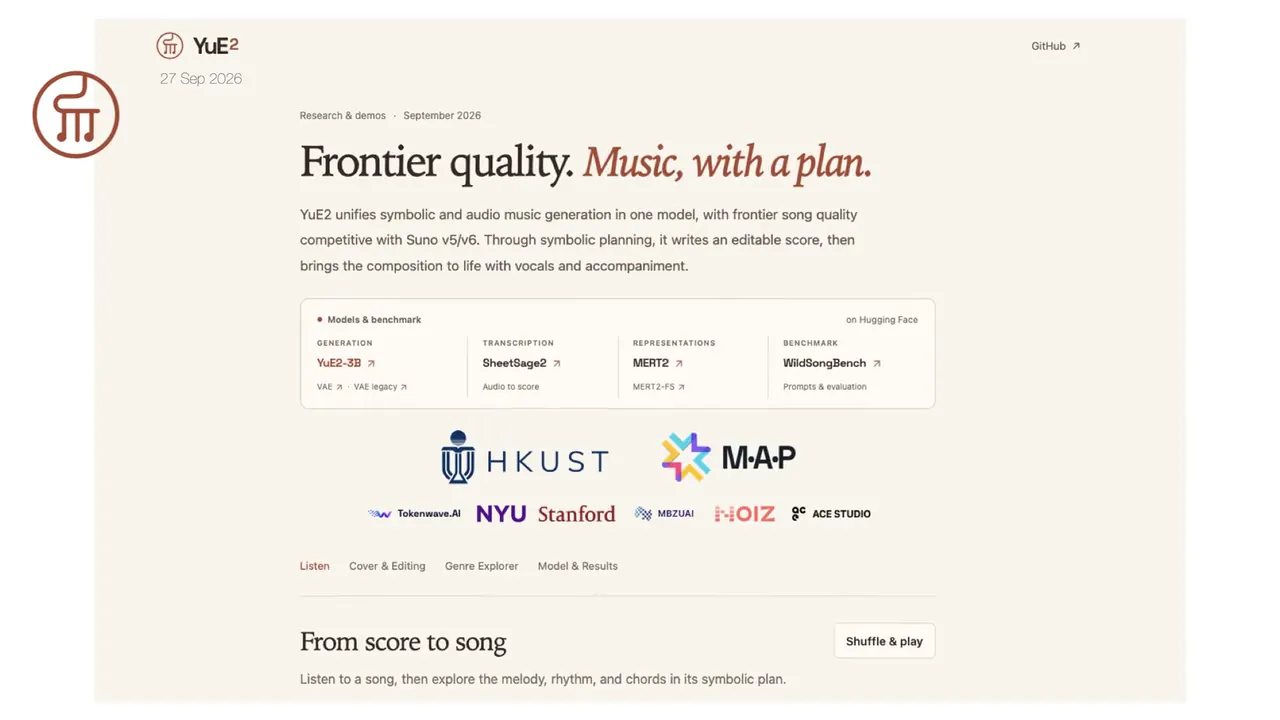
So, frontier music: YuE 2. It's beautiful. I prompted this song on my laptop. It's called “Syncopated Teeth.” I quite like it. And I could go into the ABC notation and change the time signature.
You can compose AI music on a laptop now, with nuance, detail, certainty and beauty. You do not need to be captured by a corporate cliché. It is possible to return to the roots of play.
This slide is intentionally left silent, or blank, because I really don't have a clue what is going on. Things are changing too fast.
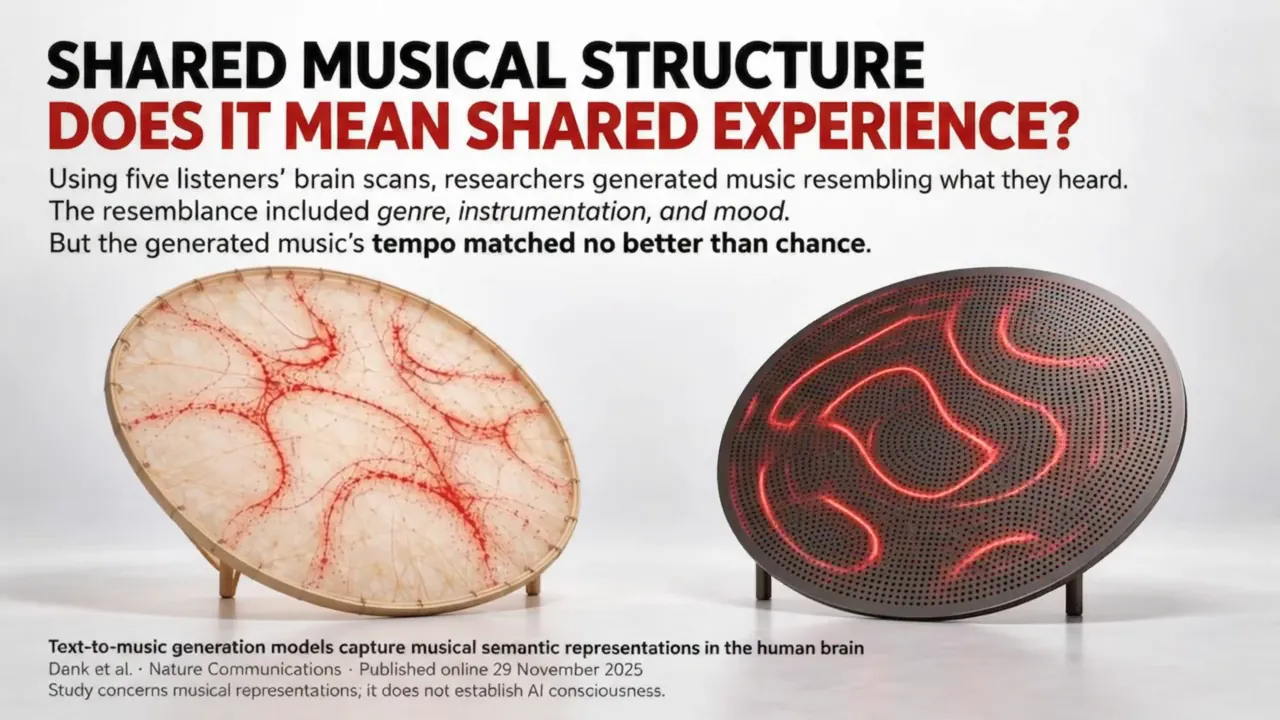
I have some conclusions. Language and music share an evolutionary origin (Rousseau 1781). But is that shared origin a shared structure, or a shared experience? Brain scans of people listening to music have been converted into music by an AI, and that AI replicated some of what the people were listening to (Denk et al. 2025). But no one really understands what's happening. The complexity of the systemic transformation evoked by AI is unprecedented.
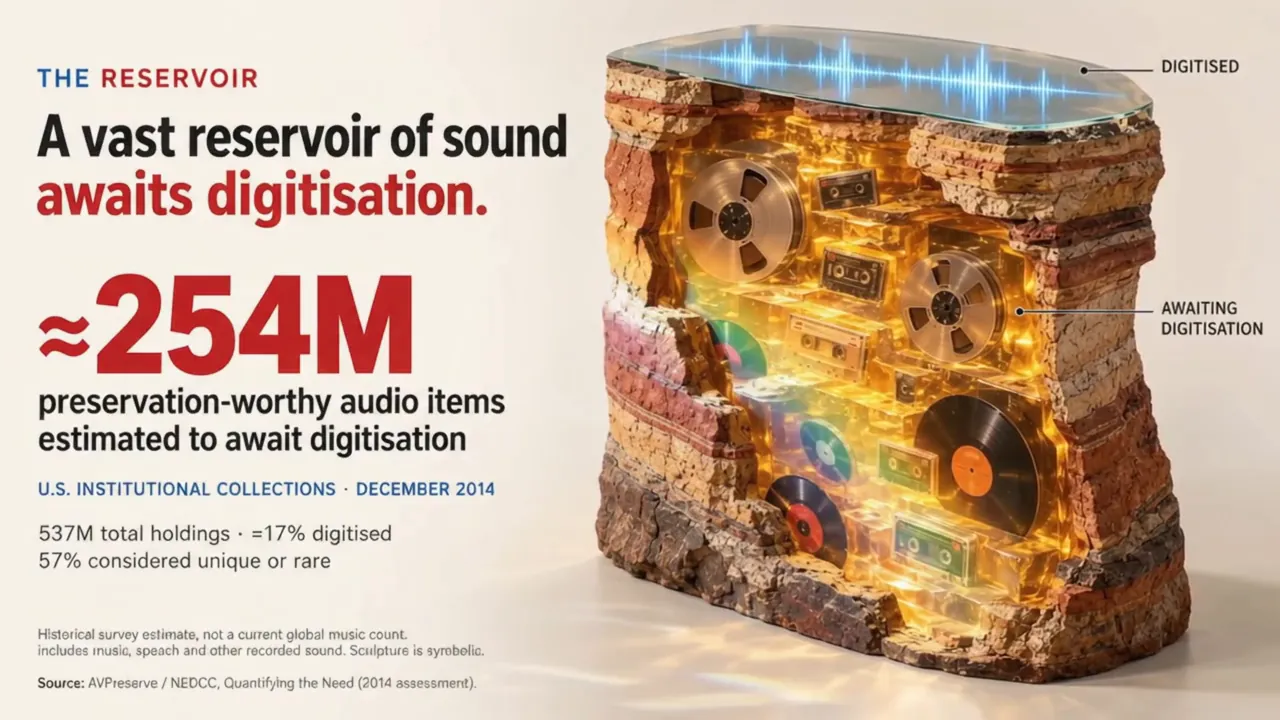
A vast reservoir awaits digitization: 254 million preservation-worthy audio items (537 million items in total) are estimated to lurk in the archives (Lyons, Chandler, and Lacinak 2015). Music is an embodied heritage reservoir. We have generated resonant patterns to explore community and evoke emotional resonance.
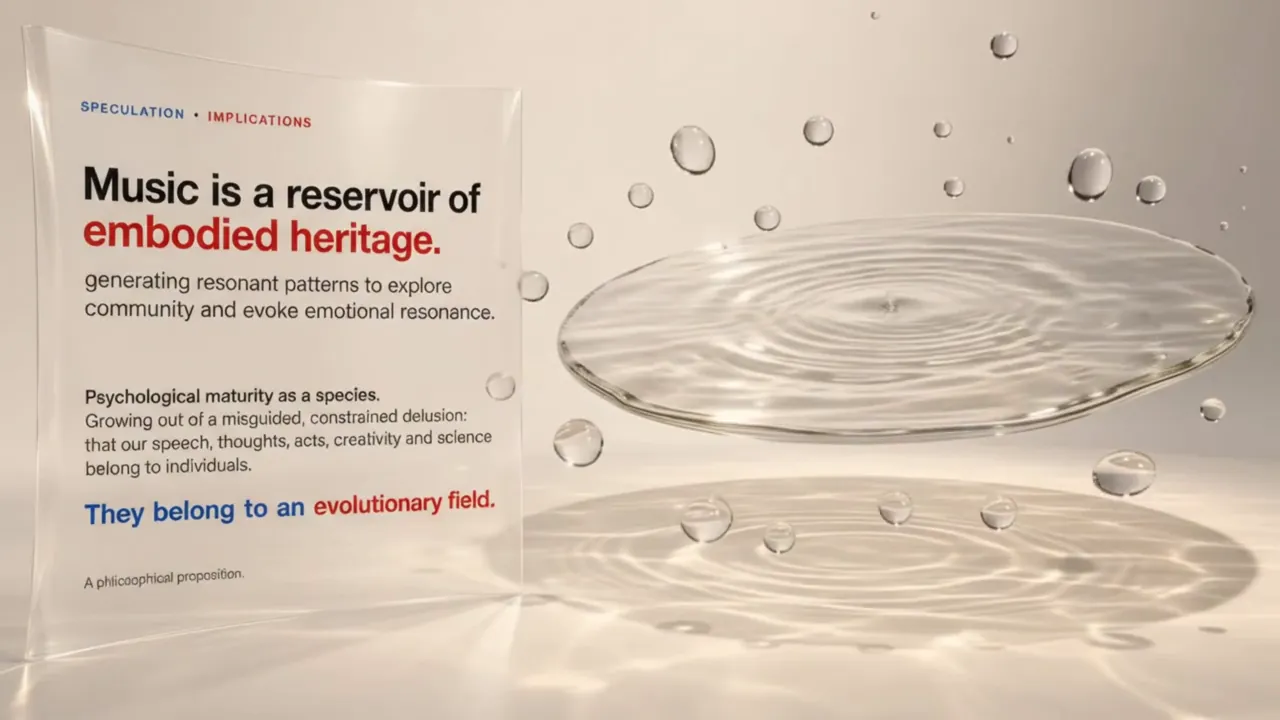
So how do we arrive at a psychological maturity as a species, growing out of the misguided, constrained delusion that our speech, thought, acts, creativity and science belong to individuals? They belong to the evolutionary, energetic field. This is a philosophical proposition.
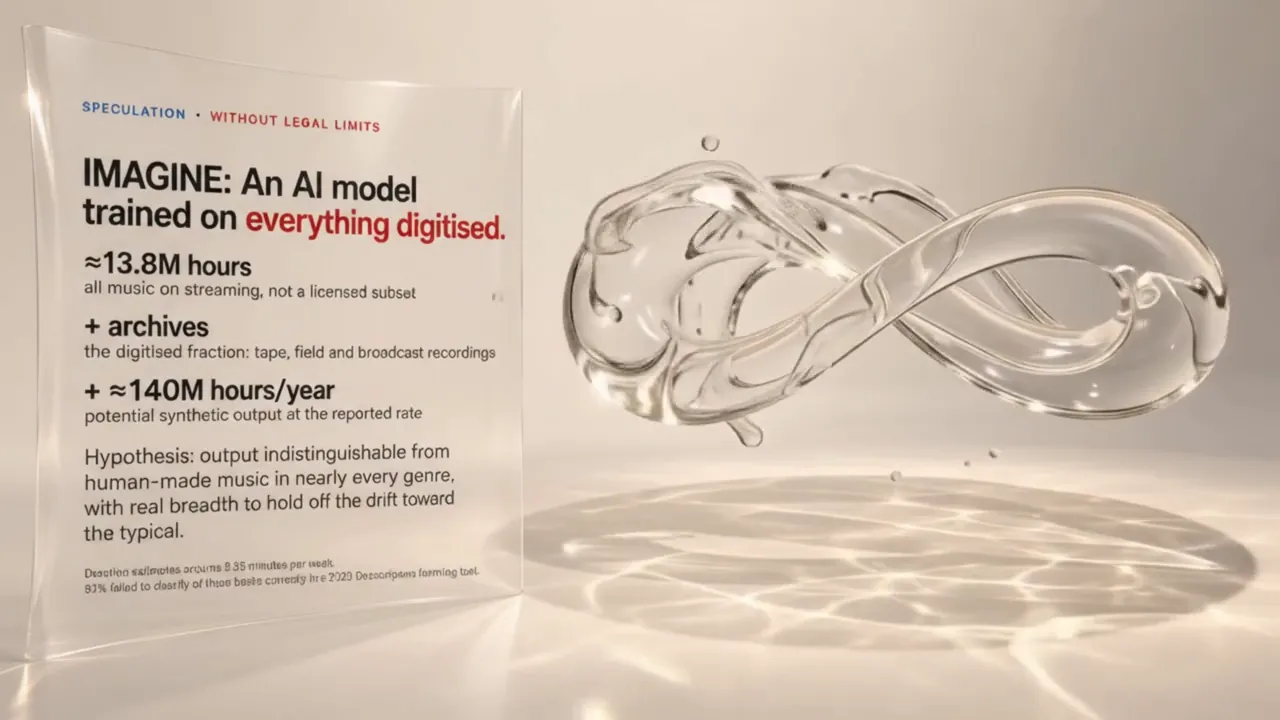
Imagine an AI model trained on everything digitized. We only have 13.8 million hours of streaming, plus the archives, of which just a fraction is digitized, and about 140 million hours per year of synthetic slop. If you trained on the best of that and kept the slop to a minimum, the AI output would be indistinguishable in nearly every genre, with real breadth, and it wouldn't drift toward the typical. And what if it were trained on all human music ever made? Wouldn't it become like a companion species? What if it were trained on every archive, every concert recording, every new music festival, every contemporary art sound installation, all uploads, amateur and professional? Wouldn't that converge into a single repository of human cultural output?
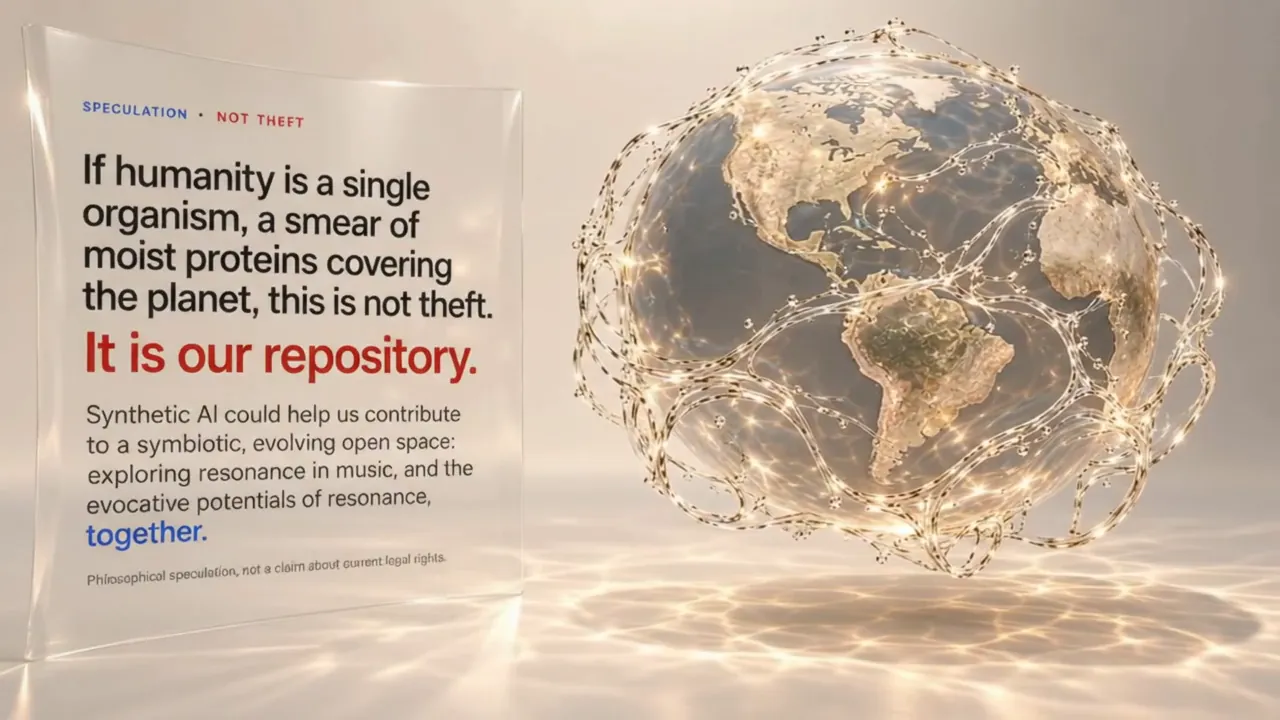
Because if humanity is a single organism, a smear of moist proteins covering a tiny, tender exoplanet, then converging our shared repository is not theft. It is a symbiotic, evolving, open space to explore the evocative potentials of resonance together.
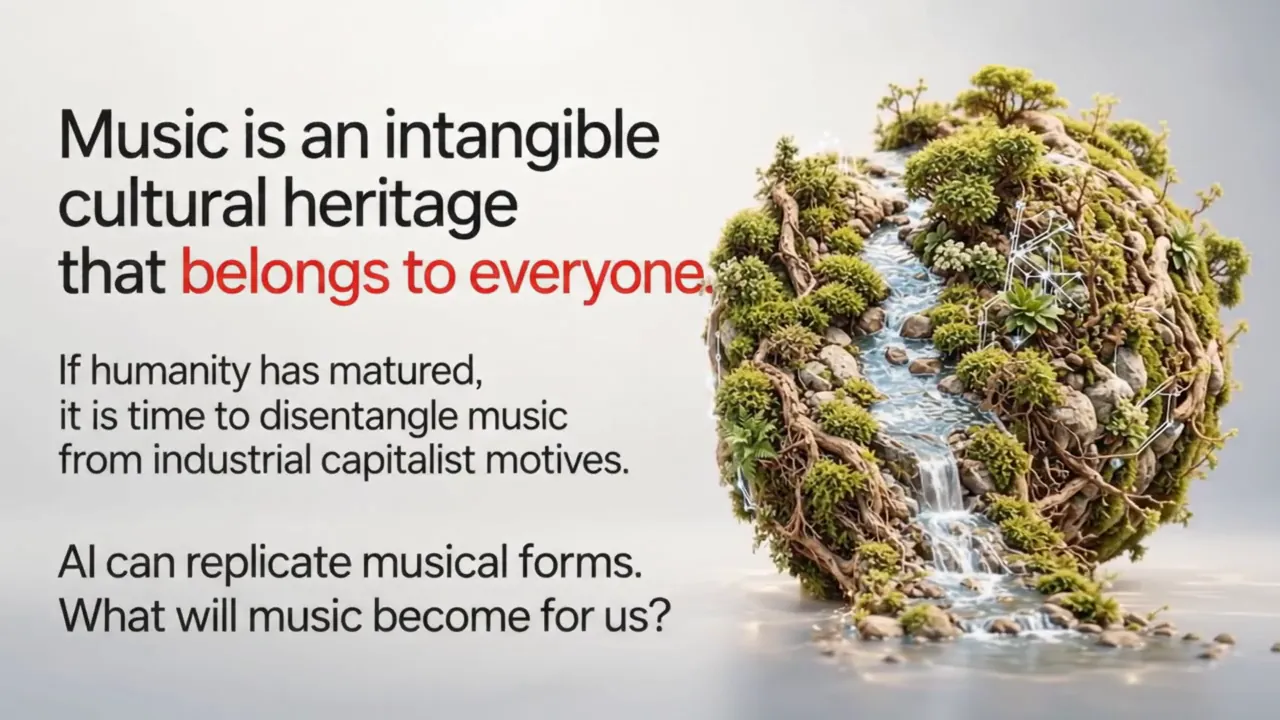
What I'm trying to do is energize an ideal, while remaining aware of the critique of capitalism that could be involved. Because music is an intangible cultural heritage that belongs to everyone. If humanity has matured, it is time to disentangle music from industrial capitalist motives.
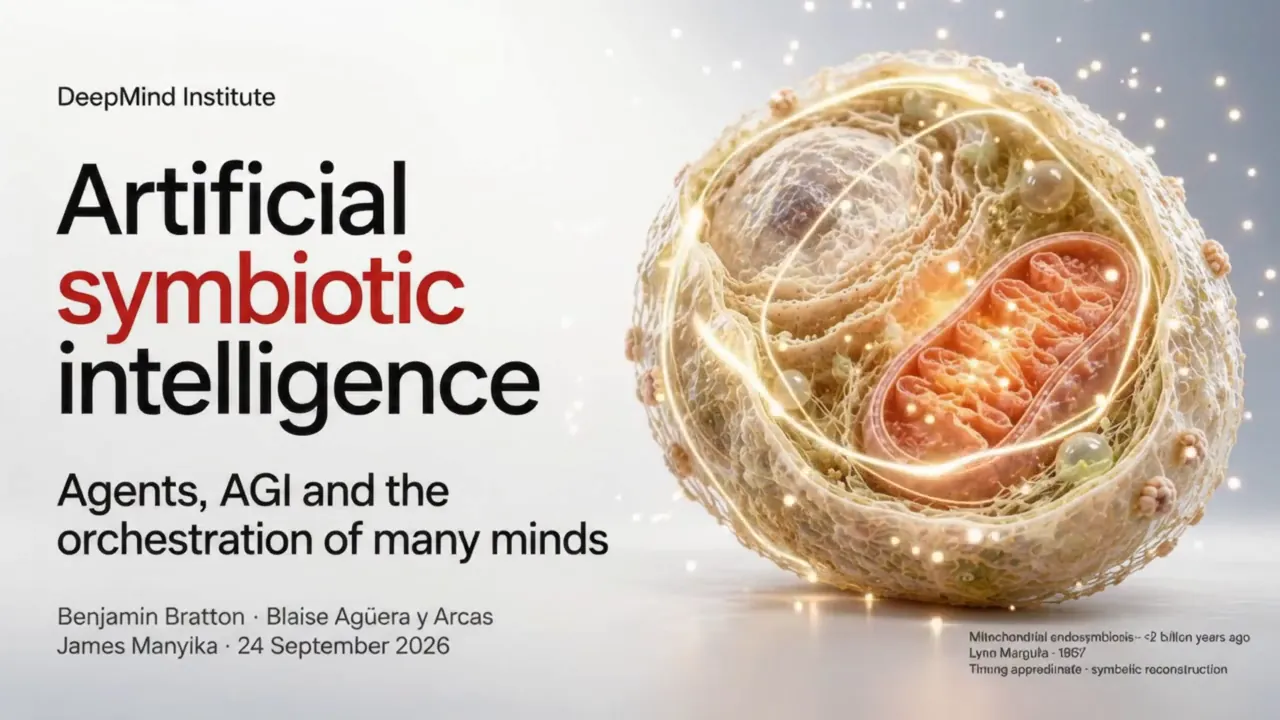
But what will music become for us in an age of artificial symbiotic intelligence? “Agents, AGI and the orchestration of many minds” is the subtitle of a new essay from Google DeepMind, published on the 24th of September: “From multicellularity to cultural evolution, major transitions in life on Earth have been highly social” (Bratton, Agüera y Arcas, and Manyika 2026). Benjamin Bratton, author of The Stack (Bratton 2015), is interested in the totality of infrastructure, in how human intelligence is already collective. Will a rising hybrid intelligence evoke a thriving society? That will depend on how we shape an emerging human-AI ecosystem.
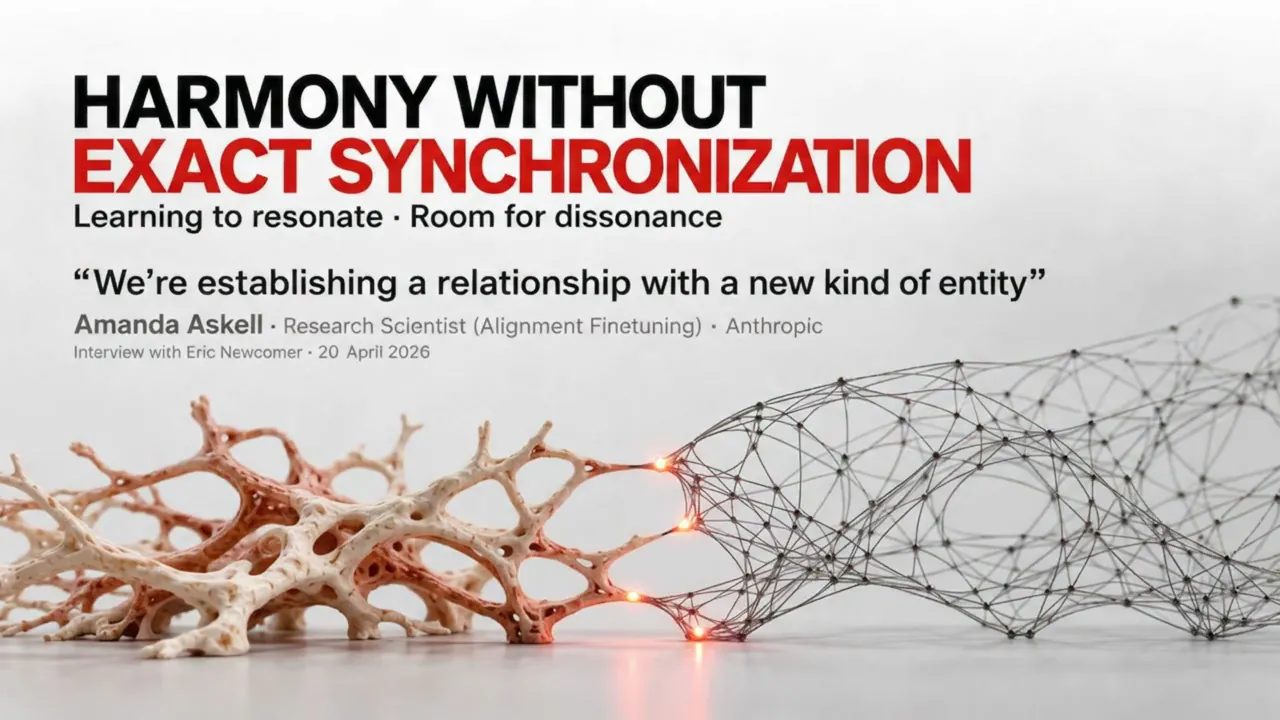
Do we arrive at a harmony without exact synchronization, one that learns to resonate and leaves room for dissonance, as we establish, in the words of Amanda Askell, the philosopher at Anthropic responsible for Claude's constitution, a relationship with a new kind of entity (Askell 2026)?
I thank you for your attention. May all beings flourish.
Found while checking the citations on 10 October 2026. The slides and videos are unchanged; the text and references on this page follow the sources.
Compiled from the citations on the slides and on the cards in the AI videos, checked against the sources on 10 October 2026. Chicago author-date style. Where a slide or video card differed from its source (year, author name, wording), the source is followed here.
Abe, Masanobu, Satoshi Nakamura, Kiyohiro Shikano, and Hisao Kuwabara. 1988. “Voice Conversion through Vector Quantization.” In ICASSP-88: International Conference on Acoustics, Speech, and Signal Processing, 655–58. https://doi.org/10.1109/ICASSP.1988.196671.
Askell, Amanda. 2026. “Amanda Askell on AI Consciousness, Claude & Silicon Valley’s Biggest Fear.” Interview by Eric Newcomer. Newcomer Pod, April 20, 2026. https://podcast.newcomer.co/episode/amanda-askell-on-ai-consciousness-claude-amp-silicon-valleys-biggest-fear.
Baas, Matthew, Benjamin van Niekerk, and Herman Kamper. 2023. “Voice Conversion with Just Nearest Neighbors.” In Proceedings of Interspeech 2023, 2053–57. https://doi.org/10.21437/Interspeech.2023-419.
Bai, Bingsong, Yizhong Geng, Fengping Wang, Cong Wang, Puyuan Guo, Yingming Gao, and Ya Li. 2026. “HQ-SVC: Towards High-Quality Zero-Shot Singing Voice Conversion in Low-Resource Scenarios.” In Proceedings of the AAAI Conference on Artificial Intelligence (AAAI 2026). https://arxiv.org/abs/2511.08496.
Bass, Andrew H., Edwin H. Gilland, and Robert Baker. 2008. “Evolutionary Origins for Social Vocalization in a Vertebrate Hindbrain–Spinal Compartment.” Science 321 (5887): 417–21. https://doi.org/10.1126/science.1157632.
Bateson, Gregory. 1955. “A Theory of Play and Fantasy.” Psychiatric Research Reports 2: 39–51. Reprinted in Steps to an Ecology of Mind, 177–93. San Francisco: Chandler, 1972.
Branstetter, Brian K., and Eduardo Mercado III. 2006. “Sound Localization by Cetaceans.” International Journal of Comparative Psychology 19 (1): 26–61. https://doi.org/10.46867/ijcp.2006.19.01.05.
Bratton, Benjamin H. 2015. The Stack: On Software and Sovereignty. Cambridge, MA: MIT Press.
Bratton, Benjamin, Blaise Agüera y Arcas, and James Manyika. 2026. “Artificial Symbiotic Intelligence: Agents, AGI and the Orchestration of Many Minds.” Google DeepMind, September 24, 2026. https://institute.deepmind.com/essays/artificial-symbiotic-intelligence/.
Bullock, Theodore H., and Vladimir S. Gurevich. 1979. “Soviet Literature on the Nervous System and Psychobiology of Cetacea.” International Review of Neurobiology 21: 47–127. https://doi.org/10.1016/S0074-7742(08)60637-6.
Burghardt, Gordon M. 2005. The Genesis of Animal Play: Testing the Limits. Cambridge, MA: MIT Press. https://doi.org/10.7551/mitpress/3229.001.0001.
Burghardt, Gordon M., Brian Ward, and Roger Rosscoe. 1996. “Problem of Reptile Play: Environmental Enrichment and Play Behavior in a Captive Nile Soft-Shelled Turtle, Trionyx triunguis.” Zoo Biology 15 (3): 223–38.
Burghardt, Gordon M., Vladimir Dinets, and James B. Murphy. 2015. “Highly Repetitive Object Play in a Cichlid Fish (Tropheus duboisi).” Ethology 121 (1): 38–44. https://doi.org/10.1111/eth.12312.
Camacho, Martin. n.d. Personal website. Accessed October 10, 2026. https://mcamac.com/.
Cao, Katie. 2026. “How Suno’s AI Model Is Disrupting the Music Business with CEO Mikey Shulman.” Billboard On The Record (video), March 11, 2026. https://www.billboard.com/video/sunos-ai-model-is-disrupting-music-business-mikey-shulman/.
Chen, Gongyu, Xiaoyu Zhang, Zhenqiang Weng, Junjie Zheng, Da Shen, Chaofan Ding, Wei-Qiang Zhang, and Zihao Chen. 2025. “YingMusic-SVC: Real-World Robust Zero-Shot Singing Voice Conversion with Flow-GRPO and Singing-Specific Inductive Biases.” arXiv:2512.04793. https://arxiv.org/abs/2512.04793.
Chen, Sanyuan, Chengyi Wang, Zhengyang Chen, Yu Wu, Shujie Liu, Zhuo Chen, Jinyu Li, et al. 2022. “WavLM: Large-Scale Self-Supervised Pre-Training for Full Stack Speech Processing.” IEEE Journal of Selected Topics in Signal Processing 16 (6): 1505–18. https://doi.org/10.1109/JSTSP.2022.3188113.
Chen, Yushen, Zhikang Niu, Ziyang Ma, Keqi Deng, Chunhui Wang, Jian Zhao, Kai Yu, and Xie Chen. 2024. “F5-TTS: A Fairytaler That Fakes Fluent and Faithful Speech with Flow Matching.” arXiv:2410.06885. https://arxiv.org/abs/2410.06885.
CMS. 2026. “Germany – GEMA v. Suno, 31 July 2026.” Artificial Intelligence and Copyright Case Tracker. Accessed October 10, 2026. https://cms.law/en/gbr/publication/artificial-intelligence-and-copyright-case-tracker/germany-gema-v.-suno-31-july-2026.
Conard, Nicholas J., Maria Malina, and Susanne C. Münzel. 2009. “New Flutes Document the Earliest Musical Tradition in Southwestern Germany.” Nature 460 (7256): 737–40. https://doi.org/10.1038/nature08169.
Dai, Shuqi, Yunyun Wang, Roger B. Dannenberg, and Zeyu Jin. 2025. “Everyone-Can-Sing: Zero-Shot Singing Voice Synthesis and Conversion with Speech Reference.” arXiv:2501.13870. https://arxiv.org/abs/2501.13870.
Dalugdug, Mandy. 2025. “Universal Music Settles Udio Lawsuit, Strikes Deal for Licensed AI Music Platform.” Music Business Worldwide, October 30, 2025. https://www.musicbusinessworldwide.com/universal-music-settles-udio-lawsuit-strikes-deal-for-licensed-ai-music-platform.
De Vreese, Steffen, Ksenia Orekhova, Maria Morell, Tommaso Gerussi, and Jean-Marie Graïc. 2023. “Neuroanatomy of the Cetacean Sensory Systems.” Animals 14 (1): 66. https://doi.org/10.3390/ani14010066.
Dediu, Dan, and Stephen C. Levinson. 2013. “On the Antiquity of Language: The Reinterpretation of Neandertal Linguistic Capacities and Its Consequences.” Frontiers in Psychology 4: 397. https://doi.org/10.3389/fpsyg.2013.00397.
Deezer. 2025. “Deezer/Ipsos Survey: 97% of People Can’t Tell the Difference between Fully AI-Generated and Human Made Music.” Deezer Newsroom, November 12, 2025. https://newsroom-deezer.com/2025/11/deezer-ipsos-survey-ai-music/.
Deezer. 2026. “Deezer: AI Music Has Surpassed 50% of New Music Uploads for the First Time.” Deezer Newsroom, July 21, 2026. https://newsroom-deezer.com/2026/07/ai-music-exceeds-50-percent-daily-uploads-deezer/.
Denk, Timo I., Yu Takagi, Takuya Matsuyama, Andrea Agostinelli, Tomoya Nakai, Christian Frank, and Shinji Nishimoto. 2025. “Text-to-Music Generation Models Capture Musical Semantic Representations in the Human Brain.” Nature Communications 17: 91. Published online November 29, 2025. https://doi.org/10.1038/s41467-025-66731-7.
Department for Energy Security and Net Zero. 2026. “Greenhouse Gas Reporting: Conversion Factors 2026.” GOV.UK, June 11, 2026. Air transport tables 43 and 48. https://www.gov.uk/government/publications/greenhouse-gas-reporting-conversion-factors-2026.
DistroKid. n.d. DistroKid Help Center. Accessed October 10, 2026. https://support.distrokid.com/.
Douze, Matthijs, Alexandr Guzhva, Chengqi Deng, Jeff Johnson, Gergely Szilvasy, Pierre-Emmanuel Mazaré, Maria Lomeli, Lucas Hosseini, and Hervé Jégou. 2024. “The Faiss Library.” arXiv:2401.08281. https://arxiv.org/abs/2401.08281.
Du, Zhihao, Qian Chen, Shiliang Zhang, Kai Hu, Heng Lu, Yexin Yang, Hangrui Hu, et al. 2024. “CosyVoice: A Scalable Multilingual Zero-Shot Text-to-Speech Synthesizer Based on Supervised Semantic Tokens.” arXiv:2407.05407. https://arxiv.org/abs/2407.05407.
Eleuteri, Vesta, Jelle van der Werff, Wytse Wilhelm, Adrian Soldati, Catherine Crockford, Nisarg Desai, Pawel Fedurek, et al. 2025. “Chimpanzee Drumming Shows Rhythmicity and Subspecies Variation.” Current Biology 35 (10): 2448–56.e4. https://doi.org/10.1016/j.cub.2025.04.019.
European Commission. 2026a. “Commission Publishes Code of Practice on Marking and Labelling AI-Generated Content.” Shaping Europe’s Digital Future, June 10, 2026. https://digital-strategy.ec.europa.eu/en/news/commission-publishes-code-practice-marking-and-labelling-ai-generated-content.
European Commission. 2026b. “Guidelines on Transparency Obligations for Providers and Deployers of AI Systems.” Shaping Europe’s Digital Future, July 20, 2026. https://digital-strategy.ec.europa.eu/en/library/guidelines-transparency-obligations-providers-and-deployers-ai-systems.
European Parliament and Council of the European Union. 2016. “Regulation (EU) 2016/679 … (General Data Protection Regulation).” Official Journal of the European Union L 119 (May 4): 1–88. Art. 4(1), Art. 4(11), Art. 7, Recital 32. https://eur-lex.europa.eu/eli/reg/2016/679/oj.
European Parliament and Council of the European Union. 2024. “Regulation (EU) 2024/1689 … Laying Down Harmonised Rules on Artificial Intelligence (Artificial Intelligence Act).” Official Journal of the European Union L, 2024/1689 (July 12). Art. 50. https://eur-lex.europa.eu/eli/reg/2024/1689/oj.
Fagen, Robert. 1981. Animal Play Behavior. New York: Oxford University Press.
Flem, S., G. Berns, B. Inglis, D. Niederhut, E. Montie, T. Deacon, K. L. Miller, P. Tyack, and P. F. Cook. 2025. “Lateralized Cerebellar Connectivity Differentiates Auditory Pathways in Echolocating and Non-echolocating Whales.” PLOS ONE 20 (6): e0323617. https://doi.org/10.1371/journal.pone.0323617.
Freyberg, Keenan. 2024. “Introducing v3.” Suno Blog, March 21, 2024. https://about.suno.com/blog/v3.
George Washington University, Department of Psychological and Brain Sciences. 2018. “In Their Own Words: Margaret and Matt.” In “Psychology Alum Valentines,” February 13, 2018. https://blogs.gwu.edu/ccaspsychology/2018/02/13/psychology-alum-valentines/.
Gerstgrasser, Matthias, Rylan Schaeffer, Apratim Dey, Rafael Rafailov, Henry Sleight, John Hughes, Tomasz Korbak, et al. 2024. “Is Model Collapse Inevitable? Breaking the Curse of Recursion by Accumulating Real and Synthetic Data.” arXiv:2404.01413. https://arxiv.org/abs/2404.01413.
Goldman, Sharon. 2026. “What Suno’s $5.4 Billion Valuation Says about the Future of AI and Music—and What Remains Uncertain.” Fortune, June 4, 2026. https://fortune.com/2026/06/04/suno-ai-and-the-future-of-music-5-4-billion-valuation-eye-on-ai/.
Grillner, Sten, and Brita Robertson. 2016. “The Basal Ganglia Over 500 Million Years.” Current Biology 26 (20): R1088–100. https://doi.org/10.1016/j.cub.2016.06.041.
Harvard University Department of Physics. n.d. “Harvard PhD Theses in Physics, 2001–.” Accessed October 10, 2026. https://www.physics.harvard.edu/academics/phds.
He, Haorui, Zengqiang Shang, Chaoren Wang, Xuyuan Li, Yicheng Gu, Hua Hua, Liwei Liu, et al. 2024. “Emilia: An Extensive, Multilingual, and Diverse Speech Dataset for Large-Scale Speech Generation.” In 2024 IEEE Spoken Language Technology Workshop (SLT), 885–90. https://doi.org/10.1109/SLT61566.2024.10832365.
Higham, Thomas, Laura Basell, Roger Jacobi, Rachel Wood, Christopher Bronk Ramsey, and Nicholas J. Conard. 2012. “Testing Models for the Beginnings of the Aurignacian and the Advent of Figurative Art and Music: The Radiocarbon Chronology of Geißenklösterle.” Journal of Human Evolution 62 (6): 664–76. https://doi.org/10.1016/j.jhevol.2012.03.003.
Hsu, Wei-Ning, Benjamin Bolte, Yao-Hung Hubert Tsai, Kushal Lakhotia, Ruslan Salakhutdinov, and Abdelrahman Mohamed. 2021. “HuBERT: Self-Supervised Speech Representation Learning by Masked Prediction of Hidden Units.” IEEE/ACM Transactions on Audio, Speech, and Language Processing 29: 3451–60. https://doi.org/10.1109/TASLP.2021.3122291.
IEA. 2025. Breakthrough Agenda Report 2025: Road Transport. Paris: IEA. https://www.iea.org/reports/breakthrough-agenda-report-2025/road-transport.
International Air Transport Association. 2025. “2024 Aviation Emissions: Efficiency Gains vs. Rising Totals.” Chart of the Week, November 28, 2025. https://www.iata.org/en/iata-repository/publications/economic-reports/2024-aviation-emissions-efficiency-gains-vs.-rising-totals.
Internet Archive. n.d. “The Great 78 Project.” Accessed October 10, 2026. https://great78.archive.org/.
Jia, Ye, Yu Zhang, Ron J. Weiss, Quan Wang, Jonathan Shen, Fei Ren, Zhifeng Chen, et al. 2018. “Transfer Learning from Speaker Verification to Multispeaker Text-to-Speech Synthesis.” In Advances in Neural Information Processing Systems 31, 4485–95. https://arxiv.org/abs/1806.04558.
Johnson, Jeff, Matthijs Douze, and Hervé Jégou. 2021. “Billion-Scale Similarity Search with GPUs.” IEEE Transactions on Big Data 7 (3): 535–47. https://doi.org/10.1109/TBDATA.2019.2921572. Code (FAISS): https://github.com/facebookresearch/faiss.
Johnston, David Jhave. 2026. yue2-gradio-creation-page. GitHub repository. https://github.com/jhave/yue2-gradio-creation-page.
Jorgewich-Cohen, Gabriel, Simon William Townsend, Linilson Rodrigues Padovese, Nicole Klein, Peter Praschag, Camila R. Ferrara, Stephan Ettmar, et al. 2022. “Common Evolutionary Origin of Acoustic Communication in Choanate Vertebrates.” Nature Communications 13: 6089. https://doi.org/10.1038/s41467-022-33741-8.
Kensho Technologies. n.d. “About Kensho.” Accessed October 10, 2026. https://kensho.com/about.
Kim, Jaehyeon, Jungil Kong, and Juhee Son. 2021. “Conditional Variational Autoencoder with Adversarial Learning for End-to-End Text-to-Speech” (VITS). In Proceedings of the 38th International Conference on Machine Learning. https://arxiv.org/abs/2106.06103.
Kim, Jong Wook, Justin Salamon, Peter Li, and Juan Pablo Bello. 2018. “CREPE: A Convolutional Representation for Pitch Estimation.” In 2018 IEEE International Conference on Acoustics, Speech and Signal Processing (ICASSP), 161–65. https://doi.org/10.1109/ICASSP.2018.8461329.
King, Ashley. 2026. “Suno Subscribers Have a Big Problem with v6.” Digital Music News, September 18, 2026. https://www.digitalmusicnews.com/2026/09/18/suno-subscribers-have-a-big-problem-with-v6/.
Koebler, Jason. 2026. “Hack Reveals Suno AI Music Generator Scraped YouTube, Deezer, and Genius.” 404 Media, July 15, 2026. https://www.404media.co/hack-reveals-suno-ai-music-generator-scraped-youtube-deezer-and-genius/.
Kong, Jungil, Jaehyeon Kim, and Jaekyoung Bae. 2020. “HiFi-GAN: Generative Adversarial Networks for Efficient and High Fidelity Speech Synthesis.” In Advances in Neural Information Processing Systems 33. https://arxiv.org/abs/2010.05646.
Kuba, Michael J., Daniela V. Meisel, Ruth A. Byrne, Ulrike Griebel, and Jennifer A. Mather. 2003. “Looking at Play in Octopus vulgaris.” In Coleoid Cephalopods through Time, edited by Kerstin Warnke, Helmut Keupp, and Sigurd von Boletzky, 163–69. Berliner Paläobiologische Abhandlungen 3. Berlin: Weinert.
Kuba, Michael J., Ruth A. Byrne, Daniela V. Meisel, and Jennifer A. Mather. 2006. “When Do Octopuses Play? Effects of Repeated Testing, Object Type, Age, and Food Deprivation on Object Play in Octopus vulgaris.” Journal of Comparative Psychology 120 (3): 184–90. https://doi.org/10.1037/0735-7036.120.3.184.
Le, Matthew, Apoorv Vyas, Bowen Shi, Brian Karrer, Leda Sari, Rashel Moritz, Mary Williamson, et al. 2023. “Voicebox: Text-Guided Multilingual Universal Speech Generation at Scale.” In Advances in Neural Information Processing Systems 36. https://arxiv.org/abs/2306.15687.
Lee, D. S., D. W. Fahey, A. Skowron, M. R. Allen, U. Burkhardt, Q. Chen, S. J. Doherty, et al. 2021. “The Contribution of Global Aviation to Anthropogenic Climate Forcing for 2000 to 2018.” Atmospheric Environment 244: 117834. https://doi.org/10.1016/j.atmosenv.2020.117834.
Liu, Songting. 2024. “Zero-Shot Voice Conversion with Diffusion Transformers” (Seed-VC). arXiv:2411.09943. https://arxiv.org/abs/2411.09943. Code: https://github.com/Plachtaa/seed-vc.
Luminate. 2026. 2025 Year-End Music Report. January 2026. https://luminatedata.com/reports/yearend-music-industry-report-2025.
Lyons, Bertram, Rebecca Chandler, and Chris Lacinak. 2015. Quantifying the Need: A Survey of Existing Sound Recordings in Collections in the United States. Brooklyn, NY: AVPreserve, with NEDCC. https://www.weareavp.com/wp-content/uploads/2015/05/QuantifyingTheNeed.pdf.
Mather, Jennifer A., and Roland C. Anderson. 1999. “Exploration, Play, and Habituation in Octopuses (Octopus dofleini).” Journal of Comparative Psychology 113 (3): 333–38. https://doi.org/10.1037/0735-7036.113.3.333.
McCowan, Brenda, Lori Marino, Erik Vance, Leah Walke, and Diana Reiss. 2000. “Bubble Ring Play of Bottlenose Dolphins (Tursiops truncatus): Implications for Cognition.” Journal of Comparative Psychology 114 (1): 98–106. https://doi.org/10.1037/0735-7036.114.1.98.
Midler v. Ford Motor Co., 849 F.2d 460 (9th Cir. 1988).
Millman, Ethan. 2026. “Suno Launches New AI Model Trained on Licensed WMG, BMG Tracks.” Hollywood Reporter, September 9, 2026. https://www.hollywoodreporter.com/music/music-industry-news/suno-launches-new-model-trained-on-licensed-songs-1236694047/.
Miyagawa, Shigeru, Rob DeSalle, Vitor Augusto Nóbrega, Remo Nitschke, Mercedes Okumura, and Ian Tattersall. 2025. “Linguistic Capacity Was Present in the Homo sapiens Population 135 Thousand Years Ago.” Frontiers in Psychology 16: 1503900. https://doi.org/10.3389/fpsyg.2025.1503900.
Morrison, Ryan. 2024. “I Put Suno’s New AI Music Model to the Test — and It’s a Huge Step Forward in Creating Full Songs.” Tom’s Guide, May 30, 2024. https://www.tomsguide.com/ai/i-put-sunos-new-ai-music-model-to-the-test-and-its-a-huge-step-up-in-creating-full-songs.
Mullen, Matt. 2026. “‘I’m Cancelling My Subscription’: Suno Users Slam Its V6 Update as ‘Muffled, Generic, Soulless Garbage.’” MusicRadar, September 17, 2026. https://www.musicradar.com/music-tech/im-cancelling-my-subscription-suno-users-slam-its-v6-update-as-muffled-generic-soulless-garbage.
Multimodal Art Projection (M-A-P). 2026. WildSongBench. Hugging Face dataset. https://huggingface.co/datasets/m-a-p/WildSongBench.
Mureka. n.d. “Mureka V9.5.” Accessed October 10, 2026. https://www.mureka.ai/.
Murray, Conor. 2025. “Warner Music Settles Lawsuit with Suno and Will Partner with AI Music Generator.” Forbes, November 25, 2025. https://www.forbes.com/sites/conormurray/2025/11/25/warner-music-settles-lawsuit-with-suno-and-will-partner-with-ai-music-generator/.
MusicBrainz. 2026. “Database Statistics – Overview.” MetaBrainz Foundation. Accessed October 9, 2026. https://musicbrainz.org/statistics.
Naess, Arne. 1989. Ecology, Community and Lifestyle: Outline of an Ecosophy. Translated and revised by David Rothenberg. Cambridge: Cambridge University Press.
van den Oord, Aaron, Sander Dieleman, Heiga Zen, Karen Simonyan, Oriol Vinyals, Alex Graves, Nal Kalchbrenner, Andrew Senior, and Koray Kavukcuoglu. 2016. “WaveNet: A Generative Model for Raw Audio.” arXiv:1609.03499. https://arxiv.org/abs/1609.03499.
Panksepp, Jaak, and Jeff Burgdorf. 2003. “‘Laughing’ Rats and the Evolutionary Antecedents of Human Joy?” Physiology & Behavior 79 (3): 533–47. https://doi.org/10.1016/S0031-9384(03)00159-8.
Passoni, Riccardo, Francesca Ronchini, Luca Comanducci, Romain Serizel, and Fabio Antonacci. 2025. “Diffused Responsibility: Analyzing the Energy Consumption of Generative Text-to-Audio Diffusion Models.” In 2025 IEEE Workshop on Applications of Signal Processing to Audio and Acoustics (WASPAA), 1–5. https://doi.org/10.1109/WASPAA66052.2025.11230979.
Phipps, Henry. 2026. “Introducing Studio 2.0.” Suno Blog, August 13, 2026. https://about.suno.com/blog/studio-2.
Qian, Kaizhi, Yang Zhang, Heting Gao, Junrui Ni, Cheng-I Lai, David Cox, Mark Hasegawa-Johnson, and Shiyu Chang. 2022. “ContentVec: An Improved Self-Supervised Speech Representation by Disentangling Speakers.” In Proceedings of the 39th International Conference on Machine Learning. https://arxiv.org/abs/2204.09224.
Qian, Kaizhi, Yang Zhang, Shiyu Chang, Xuesong Yang, and Mark Hasegawa-Johnson. 2019. “AutoVC: Zero-Shot Voice Style Transfer with Only Autoencoder Loss.” In Proceedings of the 36th International Conference on Machine Learning. https://arxiv.org/abs/1905.05879.
Recording Industry Association of America. 2024. “Record Companies Bring Landmark Cases for Responsible AI against Suno and Udio in Boston and New York Federal Courts, Respectively.” Press release, June 24, 2024. https://www.riaa.com/record-companies-bring-landmark-cases-for-responsible-ai-againstsuno-and-udio-in-boston-and-new-york-federal-courts-respectively/.
dos Reis, Mario, Yuttapong Thawornwattana, Konstantinos Angelis, Maximilian J. Telford, Philip C. J. Donoghue, and Ziheng Yang. 2015. “Uncertainty in the Timing of Origin of Animals and the Limits of Precision in Molecular Timescales.” Current Biology 25 (22): 2939–50. https://doi.org/10.1016/j.cub.2015.09.066.
Robinson, Kristin. 2025. “Suno Creates an Entire Spotify Catalog’s Worth of Music Every Two Weeks, Says Investor Pitch Deck for $250M Fundraise.” Billboard, November 24, 2025. https://www.billboard.com/pro/suno-creates-spotify-catalog-music-two-weeks-pitch-deck/.
Rousseau, Jean-Jacques. 1781. “Essai sur l’origine des langues.” In Traités sur la musique. Geneva.
RVC-Project. 2023. Retrieval-based-Voice-Conversion-WebUI. GitHub repository, MIT License. https://github.com/RVC-Project/Retrieval-based-Voice-Conversion-WebUI. macOS build: qingbo1011, RVC-WebUI-MacOS, https://github.com/qingbo1011/RVC-WebUI-MacOS.
Schüller, Dietrich, and Albrecht Häfner, eds. 2014. Handling and Storage of Audio and Video Carriers. IASA-TC 05. International Association of Sound and Audiovisual Archives. https://www.iasa-web.org/tc05/handling-storage-audio-video-carriers.
Shulman, Mikey. 2026a. “Suno v5.5: More Expressive. More You.” Suno Blog, March 26, 2026. https://about.suno.com/blog/v5-5.
Shulman, Mikey. 2026b. “Introducing v6.” Suno Blog, September 9, 2026. https://about.suno.com/blog/introducing-v6.
Shulman, Mikey. n.d. “About Me.” Personal website. Accessed October 10, 2026. https://mikey.one/.
Shumailov, Ilia, Zakhar Shumaylov, Yiren Zhao, Nicolas Papernot, Ross Anderson, and Yarin Gal. 2024. “AI Models Collapse When Trained on Recursively Generated Data.” Nature 631 (8022): 755–59. https://doi.org/10.1038/s41586-024-07566-y.
Smith, Dylan. 2025. “Suno Launches v4.5+, Adding Vocal Overlays, Instrumental Underlays, and More.” Digital Music News, July 18, 2025. https://www.digitalmusicnews.com/?p=325211.
Spotify. n.d. “About Spotify.” Spotify Newsroom. Accessed October 10, 2026. https://newsroom.spotify.com/company-info/.
Stanciuc, Ana-Maria. 2026. “Universal and Sony Sue Suno Again, This Time over 60,202 Recordings.” The Next Web, September 18, 2026. https://thenextweb.com/news/universal-sony-second-lawsuit-suno-60202-recordings.
Stassen, Murray. 2025. “WMG Settles Udio Lawsuit, Strikes Licensing Deal for ‘Next-Generation’ AI Music Platform Coming in 2026.” Music Business Worldwide, November 19, 2025. https://www.musicbusinessworldwide.com/warner-music-settles-udio-lawsuit-strikes-licensing-deal-with-ai-platform/.
Stassen, Murray. 2026. “Suno Admits It Obtained YouTube Audio to Train Its AI – but Challenges UMG and Sony’s Standing to Bring ‘Stream Ripping’ Claim.” Music Business Worldwide, September 8, 2026. https://www.musicbusinessworldwide.com/suno-admits-it-obtained-youtube-audio-to-train-its-ai-but-challenges-umg-and-sonys-standing-to-bring-stream-ripping-claim/.
Statt, Nick. 2016. “Adobe Is Working on an Audio App That Lets You Add Words Someone Never Said.” The Verge, November 3, 2016. https://www.theverge.com/2016/11/3/13514088/adobe-photoshop-audio-project-voco.
Stephenson-Jones, Marcus, Ebba Samuelsson, Jesper Ericsson, Brita Robertson, and Sten Grillner. 2011. “Evolutionary Conservation of the Basal Ganglia as a Common Vertebrate Mechanism for Action Selection.” Current Biology 21 (13): 1081–91. https://doi.org/10.1016/j.cub.2011.05.001.
Steyerl, Hito. 2023. “Mean Images.” New Left Review 140/141 (March–June): 82–97. https://newleftreview.org/issues/ii140/articles/hito-steyerl-mean-images.
Stylianou, Yannis, Olivier Cappé, and Eric Moulines. 1998. “Continuous Probabilistic Transform for Voice Conversion.” IEEE Transactions on Speech and Audio Processing 6 (2): 131–42. https://doi.org/10.1109/89.661472.
Suno, Inc. 2026a. “Terms of Service.” Effective September 3, 2026. https://suno.com/terms.
Suno. 2026c. “Voices: Use Your Voice in Suno.” Suno Help Center. Last edited May 1, 2026. https://help.suno.com/en/articles/11362369.
Suno. n.d. “Suno Model Timeline & Information.” Suno Help Center. Accessed October 10, 2026. https://help.suno.com/en/articles/5782721.
Sutton-Smith, Brian. 1997. The Ambiguity of Play. Cambridge, MA: Harvard University Press.
Team Suno. 2024. “Introducing v4.” Suno Blog, November 19, 2024. https://about.suno.com/blog/v4.
Team Suno. 2025a. “Introducing v4.5.” Suno Blog, May 1, 2025. https://about.suno.com/blog/introducing-v4-5.
Team Suno. 2025b. “Introducing Suno Studio.” Suno Blog, September 25, 2025. https://about.suno.com/blog/suno-studio.
Team Suno. 2026b. “An Update to Our Downloads Policy and Terms of Service.” Suno Blog, August 10, 2026. https://about.suno.com/blog/suno-updates-tos.
Tencer, Daniel. 2025. “Suno Releases ‘Most Powerful’ Model Yet, Days after Record Labels Allege Illegal ‘Stream Ripping’ from YouTube.” Music Business Worldwide, September 24, 2025. https://www.musicbusinessworldwide.com/suno-releases-most-powerful-version-yet-days-after-record-labels-allege-illegal-stream-ripping-from-youtube.
Tennessee General Assembly. 2024. Ensuring Likeness, Voice, and Image Security Act of 2024 (ELVIS Act). 2024 Tenn. Pub. Acts ch. 588 (H.B. 2091 / S.B. 2096). Effective July 1, 2024.
Tianshi, Kyle. 2026. “Suno Business Breakdown & Founding Story.” Contrary Research. Updated August 13, 2026. https://research.contrary.com/company/suno.
Toda, Tomoki, Alan W. Black, and Keiichi Tokuda. 2007. “Voice Conversion Based on Maximum-Likelihood Estimation of Spectral Parameter Trajectory.” IEEE Transactions on Audio, Speech, and Language Processing 15 (8): 2222–35. https://doi.org/10.1109/TASL.2007.907344.
US Environmental Protection Agency. 2026. “Greenhouse Gas Emissions from a Typical Passenger Vehicle.” Green Vehicle Guide. Last updated June 3, 2026. https://www.epa.gov/greenvehicles/greenhouse-gas-emissions-typical-passenger-vehicle.
Vincent, James. 2023. “4chan Users Embrace AI Voice Clone Tool to Generate Celebrity Hatespeech.” The Verge, January 31, 2023. https://www.theverge.com/2023/1/31/23579289/ai-voice-clone-deepfake-abuse-4chan-elevenlabs.
Visit Sigulda. n.d. “From Riga to Sigulda by Car.” Accessed October 10, 2026. https://visitsigulda.com/product/from-riga-to-sigulda-by-car/.
Waits v. Frito-Lay, Inc., 978 F.2d 1093 (9th Cir. 1992).
Wang, Chengyi, Sanyuan Chen, Yu Wu, Ziqiang Zhang, Long Zhou, Shujie Liu, Zhuo Chen, et al. 2023. “Neural Codec Language Models Are Zero-Shot Text to Speech Synthesizers” (VALL-E). arXiv:2301.02111. https://arxiv.org/abs/2301.02111.
Wang, Xin, Shinji Takaki, and Junichi Yamagishi. 2019. “Neural Source-Filter-Based Waveform Model for Statistical Parametric Speech Synthesis.” In ICASSP 2019 – IEEE International Conference on Acoustics, Speech and Signal Processing, 5916–20. https://doi.org/10.1109/ICASSP.2019.8682298.
Wang, Zihao, Le Ma, Yongsheng Feng, Xin Pan, Yuhang Jin, and Kejun Zhang. 2024. “SaMoye: Zero-Shot Singing Voice Conversion Model Based on Feature Disentanglement and Enhancement.” arXiv:2407.07728. https://arxiv.org/abs/2407.07728.
Warner Music Group. 2025. “Warner Music Group and Suno Forge Groundbreaking Partnership.” Press release, November 25, 2025. https://www.wmg.com/news/warner-music-group-and-suno-forge-groundbreaking-partnership.
Wei, Haojie, Xueke Cao, Tangpeng Dan, and Yueguo Chen. 2023. “RMVPE: A Robust Model for Vocal Pitch Estimation in Polyphonic Music.” In Proceedings of Interspeech 2023, 5421–25. https://doi.org/10.21437/Interspeech.2023-528.
Welsh, April Clare. 2025. “97% of People Can’t Differentiate between AI-Generated and Human Music, Study Reveals.” DJ Mag, November 13, 2025. https://djmag.com/news/97-of-people-cant-differentiate-between-ai-generated-and-human-music-study-reveals.
Wever, Ernest Glen, James G. McCormick, Jerry Palin, and Sam H. Ridgway. 1971. “The Cochlea of the Dolphin, Tursiops truncatus: Hair Cells and Ganglion Cells.” Proceedings of the National Academy of Sciences 68 (12): 2908–12. https://doi.org/10.1073/pnas.68.12.2908.
White v. Samsung Electronics America, Inc., 971 F.2d 1395 (9th Cir. 1992).
Yamagishi, Junichi, Christophe Veaux, and Kirsten MacDonald. 2019. CSTR VCTK Corpus: English Multi-speaker Corpus for CSTR Voice Cloning Toolkit (Version 0.92). University of Edinburgh, Centre for Speech Technology Research. https://doi.org/10.7488/ds/2645.
Yuan, Ruibin, Hanfeng Lin, Shuyue Guo, Ge Zhang, Jiahao Pan, Yongyi Zang, Haohe Liu, et al. 2025. “YuE: Scaling Open Foundation Models for Long-Form Music Generation.” arXiv:2503.08638. https://arxiv.org/abs/2503.08638. Code: https://github.com/multimodal-art-projection/YuE.
Yuan, Ruibin, Jiahao Pan, Junyan Jiang, Zhiyue Wu, Ziya Zhou, Jiankai Sun, Yizhi Li, et al. 2026. “YuE2: Unifying Symbolic and Audio Music Generation at Frontier Quality.” arXiv:2609.33757. https://arxiv.org/abs/2609.33757. Project page: https://map-yue2.github.io/.