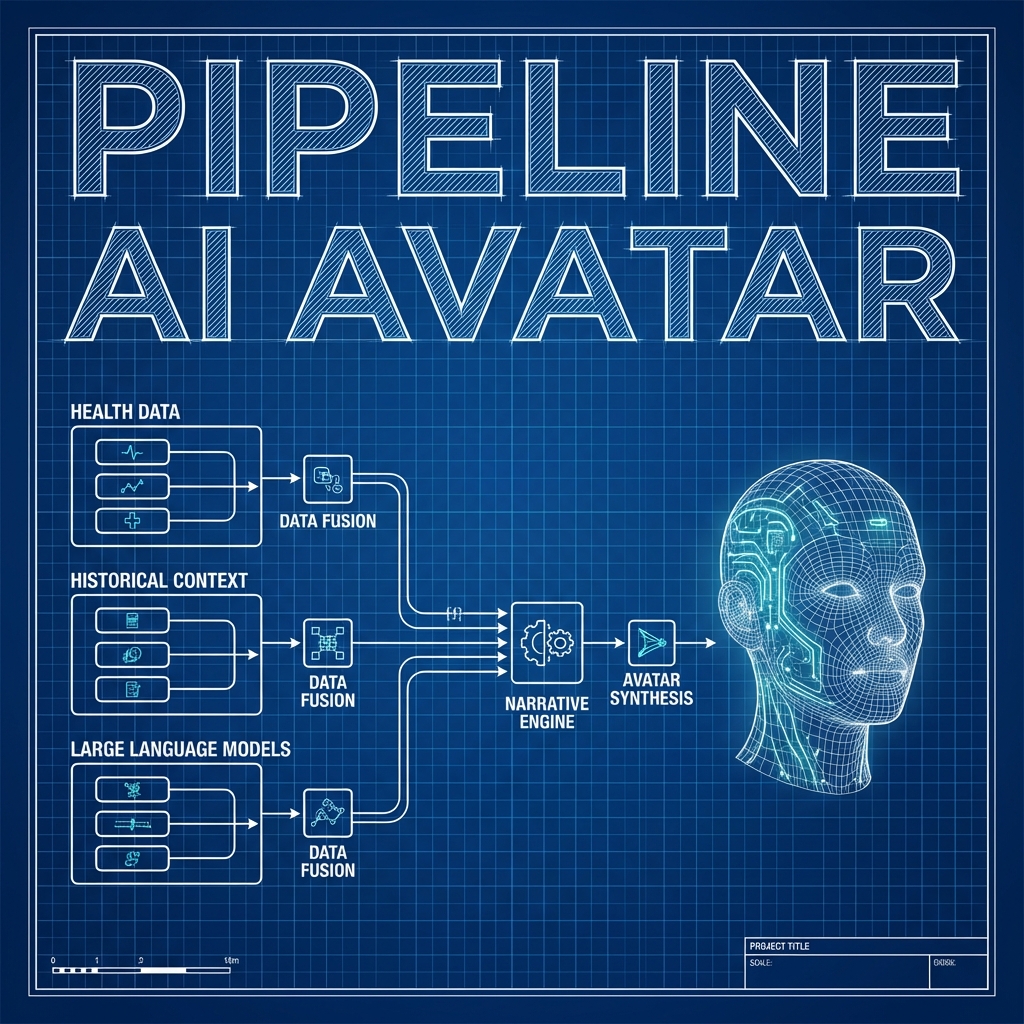
Character Generation Pipeline
Step 1: Seed Selection
Visitor interacts with touchscreen to select initial parameters: birth decade, gender, geographic type, or "surprise me" random seed. This creates investment in the character from the start.
Step 2: Data Synthesis Method
System chooses narrative strategy based on installation goals: random walk for variety, averaging for relatability, or outlier mining for drama. Multiple avatars can use different strategies simultaneously.
Step 3: Temporal Anchoring
Character's life events are mapped to specific HUNT survey years and enriched with historical context from that period. This grounds fictional biography in real time.
Step 4: LLM Narrative Generation
Large language model receives structured data (health markers, life events, historical context) and generates first-person narrative. The LLM transforms statistics into subjective experience, adding emotional texture while remaining faithful to data constraints.
Step 5: Avatar Speech Synthesis
Generated narrative is delivered through video avatar with appropriate age, gender, and emotional tone. Facial recognition allows avatar to make eye contact with viewer. Speech is conversational, not clinical.
Step 6: Comparative Mode
Two avatars can be displayed simultaneously, representing contrasting life trajectories (e.g., outlier vs. average, male vs. female same cohort, different socioeconomic paths). This reveals how identical starting points can diverge based on health, choices, and circumstance.
Ethical Considerations & Anonymization
No Re-identification Risk: All characters are synthetic composites or statistical aggregates. Even "outlier" profiles combine multiple real data points that cannot map back to individuals. HUNT data is anonymized at source; fictional layer adds additional protection.
Data Dignity: Narratives honor the lived experience behind statistics. Characters are not sensationalized or reduced to data points. Health struggles are presented with empathy and complexity.
Transparency: Installation clearly communicates that characters are fictional, generated from real health patterns but not representing any specific person. Visitors understand they're experiencing "data-driven fiction" rather than documentary testimony.
Example Character Profiles
ELARA (Averaged Female, Born 1955)
"I was born in 1955, right after the war generation. My parents wanted stability for me—education, a
good
marriage. I married Torstein at 24, had two children by 30. I worked part-time at the school, kept
the
house, raised the kids. My weight crept up over the years, especially after menopause. By 50, I was
overweight, pre-diabetic. The doctor said I needed to move more, eat less. I tried, but honestly, it
was
hard. In my 60s now, I've accepted this body. My blood pressure is high, I take pills for it. I'm
not
unhappy. I have my grandchildren, my routines. But sometimes I wonder what my life would have been
if I'd
had the choices young women have now. I participated in every HUNT survey—I believe in research, in
contributing to knowledge. Maybe my data will help someone in the future."
IVAR (Outlier Male, Born 1972)
"I never fit the mold. Born in 1972, everyone expected me to work the farm or the factory like my
father.
But I was... different. Struggled with darkness my whole adult life. First depression hit at 25.
Again at
32. Again at 39. I couldn't hold jobs. Relationships failed. By 43, I was on disability
pension—mental health,
they said. I live alone now, in my childhood village. Everyone moved away, but I stayed. I walk, a
lot.
Hours every day in the forests. It's the only thing that helps. I don't drink, never have. I'm thin,
always
have been. People think I'm weak, but I'm not. I'm just wired wrong for this world. The HUNT
surveys? Yeah,
I do them. Gives me a reason to leave the house, to matter to someone, even if it's just as data
point
number 87,543."
SOLVEIG (Random Walk Female, Born 1980)
"My life has been a zigzag. Born in 1980, I grew up in the optimistic '90s. Went to university—first
in my
family. Met Jonas there, we married young, 24. Had a daughter at 27. Then Jonas got sick, cancer,
died when
I was 34. Everything collapsed. I started smoking—stupid, I know, my mother died of lung disease.
Depression
hit hard. I gained weight, stopped caring. But at 38, something shifted. I quit smoking, joined a
running
group, met new people. Remarried at 41—never thought I'd love again. Now at 45, I'm healthier than
I've been
in a decade. My life has been this wild ride of loss and recovery. When I fill out the HUNT surveys,
I see
my own transformation in the checkboxes. Data can't capture the feeling, but it captures the fact: I
survived."
Research Questions & Creative Potential
Augmented Creativity: Can longitudinal health data genuinely enhance LLM-generated fiction beyond surface plausibility? Does grounding in real health trajectories create more compelling characters than purely imaginative approaches?
Anonymized Intimacy: Is it possible to create emotionally resonant, intimate narratives from anonymized aggregate data? Can statistics become storytelling without violating privacy?
Data Literacy Through Narrative: Do fictional characters help museum visitors understand longitudinal health research better than traditional data visualizations? Does empathy enable comprehension?
Ethical Data Use: Does this project demonstrate a responsible, culturally valuable application of population health data, or does it risk trivializing serious research? Where is the boundary between illumination and exploitation?